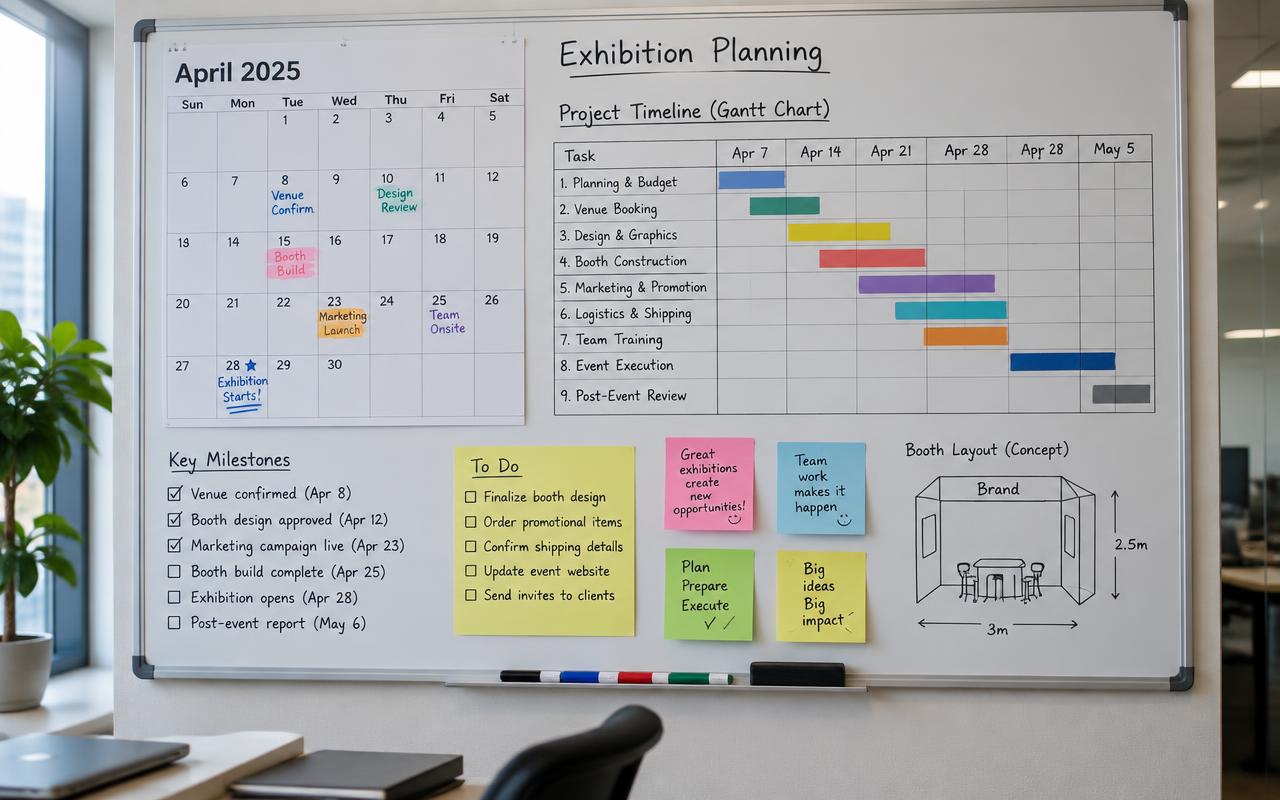
By the Exhibition Stall Design editorial team · Updated 1 October 2026 · 13 min read
Short answer
To plan an exhibition in India: decide the outcome before the show, pick the show by buyer fit rather than headline footfall, book space as early as the organiser opens sales and pay attention to open sides, set one primary goal with a number attached, allocate the budget across space, stand, AV, graphics, travel, collateral and follow-up, brief a stall partner against the planner's lead times — 3 weeks under 24 sq.m, 4 from 24 sq.m, 5 from 54 sq.m — prepare and rehearse your staff, capture every lead digitally, and follow up inside 48 hours while you are still remembered.
Key takeaways
- Decide the outcome first. The show, the stall size and the design are all consequences of it, not inputs to it.
- Choose the show by who attends, not by how many. A smaller show full of your buyers beats a large one full of someone else's.
- Open sides matter as much as area. An island stall and an inline stall of the same size are different jobs at different prices.
- One primary goal, with a number in it. Three goals of equal weight means a layout that compromises all three.
- Budget the whole participation, not the stand. In the worked allocation on this page the stand is 38% of a ₹10,00,000 show budget and space rent is 30%.
- Brief the stall partner against the real lead time: 3 weeks base, +1 from 24 sq.m, +2 from 54 sq.m, +2 for a premium finish, +2 for a double-decker.
- Check the arithmetic of the space before you design it. Display area ÷ 2.5 is how many visitors fit at once; area ÷ 9 is how many staff you need.
- Budget the follow-up before the show. An un-followed lead is indistinguishable from a lead you never captured.
Start from the outcome, not the show
Most exhibition planning starts in the wrong place — with a show someone has already decided to attend, a stall size already booked, and a budget already approved. Everything after that is decoration. The planning question that actually determines whether a participation works is asked earlier and sounds almost too simple: what has to be true after this show that is not true now?
Answer it concretely. Forty distributor meetings in three days is an outcome. Two hundred qualified contacts in a specific industry segment is an outcome. A product seen and photographed by the trade press is an outcome. "Brand visibility" is not, because nothing downstream can be designed against it and nothing afterwards can be measured against it either.
Once the outcome is written down, the rest of the plan stops being a series of opinions. Which show to attend is decided by where those buyers are. How much space to take is decided by how many conversations have to happen simultaneously. What the stall must contain is decided by what each conversation needs — a demonstration, a seat, a sample, a quiet corner for a contract. Budget follows from all three. The whole process collapses from a dozen judgement calls to one.
Choosing the right show
The temptation is to choose by size, because footfall is the number organisers lead with and the easiest thing to compare. It is close to useless on its own. A hall with a large general audience and a hundred visitors who buy what you sell is worse value than a focused show with four hundred of them, and it is more expensive, because space in the large show costs more and you need more staff to work it.
Ask for the visitor profile of previous editions rather than the attendance figure — the breakdown by industry, by job function and by region. Ask which halls your category sits in, because a show is really several shows under one roof and the aisle you are in matters more than the show you are at. Ask who else exhibits in that hall: your competitors being present is usually a signal that the buyers are, not a reason to avoid it.
Then test it cheaply. Walk the show as a visitor one edition before you exhibit at it. A day on the floor tells you which aisles have traffic, where it dies, how big a stand needs to be to register, what the lighting in the hall is like, and whether the people you want to meet are actually there. It is the highest-return day in the whole planning process and almost nobody spends it.
- Visitor profile from previous editions, broken down by industry, job function and region — not the headline attendance
- Which hall your category sits in, and what the neighbouring categories are
- Who exhibits in that hall, and whether your buyers would have a reason to walk it
- Whether the show is primarily trade or part-public, which changes staffing and lead quality entirely
- The floor plan: where the entrances, food courts, seminar halls and toilets are, because traffic follows them
- Space rates by position, and what a corner or island actually costs over an inline position
- The exhibitor manual, read before booking — height limits, build-up hours and rules decide what is possible
- Whether you can walk the show as a visitor before committing to exhibit at it
Booking space: position, open sides and layout
Two things are being bought when you book space, and exhibitors usually think about only one. The first is area. The second is the number of open sides, which changes the stall's behaviour and its price more than almost any design decision. Each open side is another finished face, another lighting run, another way for a visitor to walk in and another position your team has to cover.
Corner and island positions sell first for exactly this reason, so the practical advice about booking early is not about discounts — it is about choice. The cheapest area in a good position outperforms expensive area in a bad one, and you cannot design your way out of being in a dead aisle.
The layout column below is the planner's own classification, and it is worth matching to your outcome before you commit. If your goal needs long conversations, an island stall with four approach routes and no back wall is harder to work than a corner with a defensible closed side. If your goal is reach, the island wins.
| Open sides | Layout | What it is good for | Cost and staffing implication |
|---|---|---|---|
| 1 | Inline stall | Focused messaging, one clear entry, a defensible back wall for graphics and storage | Lowest cost per sq.m; easiest to staff; least visibility from the aisle |
| 2 | Corner stall | Best general-purpose choice — two approach routes with two closed sides for storage and a meeting corner | Moderate; good visibility for a small premium on space |
| 3 | Three-side open stall | High footfall and visibility, strong for demonstrations and sampling | Three finished faces and three lighting runs; more staff to cover |
| 4 | Island stall | Maximum reach and presence, works for large product displays and launches | Highest cost per sq.m, no back wall for storage, most staff needed |
Confirm which sides are open before the design starts. A design drawn for a corner cannot simply be dropped into an inline position — the storage and the graphics both live on the sides that are no longer there.
Setting one goal with a number in it
A stall can be optimised for reach, for depth of conversation, for demonstration throughput or for closing — and those four optimise differently. Reach wants open sightlines and a short, large message. Depth wants seating, acoustic separation and a reason to stay. Demonstration wants a counter at working height, power, and room for a small audience to form without blocking the aisle. Closing wants a closed room and a table.
This is why one primary goal matters. Three goals of equal weight produce a layout that does all three adequately and none of them well, in a space that was already too small — because every stall is too small. Rank them: one primary, one secondary, and an explicit decision that the third is not being designed for.
Attach a number, and attach it to something you can count on the day. Meetings booked, demonstrations run, samples placed, contacts captured and qualified. Not impressions, not footfall past the stand, not anything you would have to infer. The number's job is to make the post-show conversation about arithmetic instead of opinion — and to let you cut the right thing when the budget comes back ten percent over.
The budget: where the money actually goes
The most common budgeting error is to budget the stand and treat everything else as incidental. The stand is usually the second-largest line, not the largest, and several of the small lines are the ones that decide whether the participation returns anything — lead capture and follow-up in particular.
The allocation below is a complete participation budget, not a fabrication quote. Space rent goes to the organiser. The stand line is the fabricator's itemised scope, which for a stall of this value sits comfortably inside the published ₹9,000–₹18,000 per sq.m band for the structure, with graphics, lighting, flooring, furniture, freight and crew on their own lines underneath it. The rest is yours to spend.
Treat the proportions as the planning tool rather than the absolute figures. Space rent is 30% here and the stand 38%, which together is about 68% — so a rule of thumb that the other two-thirds of the budget is "the stand" will under-fund everything else by a wide margin. And note the last line: if follow-up is not budgeted, it does not happen, and an un-followed lead is indistinguishable from a lead never captured.
| Space rent paid to the organiser | ₹3,00,000 |
|---|---|
| Stall design, fabrication, freight, installation and dismantle | ₹3,80,000 |
| AV, screens and lighting beyond the stand's own fixtures | ₹90,000 |
| Graphics, print and signage artwork | ₹45,000 |
| Furniture and fittings on rental | ₹35,000 |
| Travel, accommodation and per diems for the team | ₹75,000 |
| Collateral, samples and giveaways | ₹40,000 |
| Lead capture, pre-show outreach and post-show follow-up | ₹35,000 |
| Total participation budget, before GST | ₹10,00,000 |
Illustrative allocation only, to show proportions rather than prices. Space rent depends entirely on the show and position; the stand line depends on area and finish; GST is extra. If you capture 200 qualified leads against this budget, the cost per lead is ₹5,000 — which is the number worth comparing against your other channels.
Exhibiting soon? Let's build your stall.
Check the arithmetic of the space before you design it
Before a designer touches it, check that the stall can physically do what the plan requires. Storage takes 10% of the area up to 18 sq.m and 15% above it. A meeting corner takes 5% by default, or 20% when meetings are a stated goal. Display gets the remainder.
From there, two numbers. Display area ÷ 2.5 is roughly how many visitors can be inside the stand at once; total area ÷ 9 is how many staff you need on duty, with two as the floor. At 9 sq.m that is 7.6 sq.m of display, about 3 visitors and 2 staff. At 36 sq.m it is 28.8 sq.m, about 11 visitors and 4 staff.
Now compare the visitors column against the outcome you wrote down. If you need forty meetings across three show days, you need roughly fourteen a day, which is one every half hour across a seven-hour day — and that requires a seat, a staff member free to sit in it, and a stall where a seated conversation is possible while other visitors are being received. That is a space-planning requirement, not a sales one, and it is the kind of thing that is free to fix at this stage and impossible to fix later.
| Stall size | Display area | Storage | Staff on duty | Visitors at once | Lead time |
|---|---|---|---|---|---|
| 9 sq.m | 7.6 sq.m | 0.9 sq.m | 2 | 3 | 3 weeks |
| 12 sq.m | 10.2 sq.m | 1.2 sq.m | 2 | 4 | 3 weeks |
| 18 sq.m | 15.3 sq.m | 1.8 sq.m | 2 | 6 | 3 weeks |
| 24 sq.m | 19.2 sq.m | 3.6 sq.m | 3 | 7 | 4 weeks |
| 36 sq.m | 28.8 sq.m | 5.4 sq.m | 4 | 11 | 4 weeks |
| 54 sq.m | 43.2 sq.m | 8.1 sq.m | 6 | 17 | 5 weeks |
Same arithmetic as our stall planner. Staff = area ÷ 9, minimum 2. Visitors = display ÷ 2.5, minimum 3. Lead time is 3 weeks base, +1 from 24 sq.m and +2 from 54 sq.m, before the premium and double-decker additions.
The countdown to doors open
Work backwards from the first hour of build-up, never forwards from today. The sequence below assumes a stall in the 24–53 sq.m range at standard finish, which the planner puts at 4 weeks of lead time. Add 2 weeks for a premium finish, 2 for a double-decker, 1 more week from 54 sq.m, and transit time if the venue is in another city.
The stages that look soft at the front are the only soft stages there are. Production, organiser approval and build-up hours cannot be compressed, so every day lost before design freeze is paid for later at a worse exchange rate.
01
Before anything: write the outcome and pick the show
One sentence with a number in it. Then choose the show against the visitor profile of previous editions, walk it as a visitor if the calendar allows, and read the exhibitor manual before you commit to a position — height limits, build-up hours and rigging rules decide what you can build.
02
As soon as space sales open: book position, not just area
Corner and island positions go first, so booking early buys choice rather than discount. Confirm your area, your number of open sides and your stall number in writing, and get the exhibitor manual and any organiser portal login at the same time. Both will be needed by whoever builds the stand.
03
6 weeks out: set the budget and gather the brief
Allocate across space, stand, AV, graphics, furniture, travel, collateral and follow-up. Then gather the brief in one sitting: the allotment letter, area and open sides, height limit, dates, your goal with its number, products with weights and power needs, brand files, three annotated references and a budget range. Those items usually live with four different people, and collecting them one email at a time is where the first lost week comes from.
04
4 weeks out: brief the stall partner
Send the identical brief to every supplier you are approaching. A complete brief returns a concept and an itemised quote in about 48 hours; an incomplete one returns questions. Ask for itemisation — structure, graphics, lighting, flooring, furniture, freight, installation, dismantle and GST on separate lines — and confirm whether dismantle and clearance are inside the figure.
05
3 weeks out: freeze the design and raise the order
Approve the dimensioned drawing set and the materials schedule, not just the render. Consolidate every stakeholder's comments into one reply per revision round — serial feedback is the single most common cause of a compressed build. The purchase order releases production and books the crew.
06
2 weeks out: approvals, artwork and pre-show outreach
Your partner files the organiser submissions: drawings, dimensions, structural and electrical loads, fire-retardancy certificates. You supply print-ready artwork at final size, because printing runs last in production and graphics are the most visible element on the stand. This is also when pre-show outreach earns its budget — invite the buyers you already know, with a specific time rather than an open invitation.
07
The week before build-up: brief and rehearse the team
Decide who is on the stand in which shift, what the opening question is, how a visitor gets qualified in thirty seconds, who takes a technical question and who takes a commercial one. Rehearse it. Also decide now how a lead gets captured and scored, because a process invented on day one produces a spreadsheet nobody can use on day four.
08
Build-up week: be reachable, and attend the handover
Have a decision-maker on the phone through build-up hours. Attend the handover in person if you can — ten minutes on the stand is worth an hour of calls, and it is the moment to move a counter while a crew is still in the hall. Get products, samples and literature on site before doors, not on the morning.
09
Show days: work the plan, record everything
Staff to the shift plan, keep the demonstration running on a schedule people can be told about, and capture every lead digitally with a qualification score and one line of context. Debrief for ten minutes at the end of each day: what worked, which question visitors kept asking, what to change tomorrow.
10
Within 48 hours: follow up
Score and sort leads the same day they are captured, and send the first follow-up within 48 hours while you are still the stall they remember. Then close the loop on the number you wrote at the start: meetings booked against meetings targeted, cost per lead, and what you would change. Write it down — it is the brief for next year, and it is the only part of the process that compounds.
Staffing: the part the stand cannot do for you
A stall creates opportunities. It cannot have the conversation, and the most common reason a well-built participation under-delivers is that nobody decided in advance what the people on it were going to say.
Start with the arithmetic: area ÷ 9, minimum two, is the number on duty — not the number travelling. Shifts need cover for breaks, and a show day is longer and much more tiring than an office day. Then decide composition rather than headcount: who answers a technical question, who can talk commercials, who is there to capture and qualify, and who is senior enough to say yes to something.
Finally, rehearse the first thirty seconds. Every visitor interaction is decided in them, and "can I help you" invites "no". A single qualifying question that is about the visitor's problem, not your product, is worth more than any amount of product training — and it has to be agreed and practised, because on day one it will be improvised otherwise.
- Staff on duty = stall area ÷ 9, minimum 2 — plus cover for breaks and shift changes
- One agreed opening question, rehearsed, that is about the visitor rather than the product
- A thirty-second qualification: who they are, what they need, when they need it, whether they decide
- A clear handover rule for technical and commercial questions, so nobody freezes
- One person senior enough to make a commitment on the stand
- A shift plan with named cover for lunch, the quiet hour and the last hour
- A written daily debrief, ten minutes, and one change made for the next day
- A rule about not standing in a line across the front of the stall, which reads as a barrier
- Phones away in the aisle-facing zone; it is the single most visible signal of an unworked stand
Lead capture and follow-up: where participations are won or lost
The stand is the cost and the leads are the product, yet lead handling is routinely the least planned part of an exhibition. A stack of business cards with no context is not a lead list — three weeks later nobody can remember which card wanted a quotation and which was a student.
Capture digitally, with structure: contact, company, what they actually asked for, a qualification score, and one line of context in whoever's words. Decide the fields and the scoring before the show. The marginal cost of doing this properly is almost nothing and it is the difference between a list and an asset.
Then follow up inside 48 hours. Not because of any rule, but because a visitor who walked a hall for a day met dozens of suppliers and your advantage decays with every one of them who emails first. The follow-up should reference what was actually discussed — which is only possible if somebody wrote it down on the stand.
| What to measure | How to compute it | What to do with it |
|---|---|---|
| Leads captured | Count of complete records, not cards collected | The denominator for everything else; an incomplete record is not a lead |
| Qualified leads | Leads meeting your pre-agreed score threshold | Compare against the number in your goal; this is the participation's real output |
| Cost per lead | Total participation budget ÷ qualified leads | Compare against your other channels, not against last year's show alone |
| Meetings held | Count against the number you targeted | Tells you whether the layout supported the goal or fought it |
| Demonstrations run | Count per day, and the drop-off by hour | Decides demo scheduling and staffing for the next edition |
| Follow-up latency | Hours from capture to first contact | Under 48 is the target; above a week, capture quality stops mattering |
| Conversion over time | Qualified leads that progress, tracked for two quarters | The only honest measure of whether the show is worth repeating |
Agree these fields before the show and nominate one owner for the list. A measurement framework invented afterwards measures whatever happens to have been recorded.
The stand is the cost; the leads are the product. An un-followed lead is indistinguishable from a lead you never captured.
Mistakes that cost exhibitors the most
Almost every failure in this list is a planning failure that was free to avoid at the time and expensive to fix later. They repeat across industries, show sizes and budgets with remarkable consistency.
The most expensive single one is choosing the show by footfall rather than by visitor profile, because nothing downstream can recover from being in front of the wrong audience. The second is three competing messages on one brand wall: a visitor walking an aisle reads one thing, from a distance, in about three seconds, and a stall that says three things says nothing.
The third is spending the entire budget before the show and nothing after it. The leads arrive at the end, which is exactly when the budget, the energy and the attention have all run out.
- Choosing the show by headline footfall instead of visitor profile
- Booking area without checking how many sides are open
- Three messages of equal weight on the brand wall, so the aisle reads none of them
- Briefing late, then paying for the compressed schedule in night shifts and rush charges
- Approving the render and never reading the drawing set or the materials schedule
- Serial stakeholder feedback, which multiplies revision rounds and squeezes production
- Under-lighting the stand, because hall lighting is designed for circulation, not for your product
- No storage, so bags, cartons and coats end up on the display floor by mid-morning
- Staff standing in a line across the front of the stall, which reads as a barrier
- No agreed opening question, so the first thirty seconds are improvised every time
- Collecting cards instead of structured, scored lead records
- No follow-up budget, no owner for the list, and no contact until the week after
- Nothing designed for reuse, so next year's participation costs what this one did
Frequently asked questions
How far in advance should I plan an exhibition?+
Start the outcome and show selection as early as you can, and book space as soon as the organiser opens sales — corner and island positions sell first, so early booking buys choice rather than a discount. For the stand itself, work backwards from build-up using the planner's figures: 3 weeks under 24 sq.m, 4 from 24 sq.m, 5 from 54 sq.m, plus 2 weeks for a premium finish and 2 more for a double-decker.
How do I choose which show to exhibit at?+
By who attends, not how many. Ask for the visitor profile of previous editions broken down by industry, job function and region; find out which hall your category sits in and who else exhibits there; read the exhibitor manual before booking. If the calendar allows, walk the show as a visitor one edition before you exhibit at it — it is the highest-return day in the whole process.
How much space do I need?+
Work it out from the plan rather than the budget. Display area ÷ 2.5 is how many visitors fit at once and total area ÷ 9 is the staff you need on duty. Then check that against your goal: forty meetings across three days is roughly fourteen a day, which needs a seat, a free staff member and a layout where a seated conversation is possible while others are being received.
Why do open sides matter so much?+
Each open side is another finished face, another lighting run, another entry to plan and another position to staff. An island stall and an inline stall of the same area are different jobs at different prices. Confirm which sides are open before design starts — a layout drawn for a corner cannot be dropped into an inline position, because the storage and graphics lived on the sides that are gone.
How should I split the budget?+
Budget the participation, not the stand. In the worked allocation on this page, space rent is 30% and the stand 38% of a ₹10,00,000 total, with AV, graphics, furniture, travel, collateral and follow-up making up the rest. Treat the proportions as the planning tool; the absolute figures depend on your show and position.
What is the single most important thing to get right?+
One primary goal with a number attached. Reach, depth of conversation, demonstration throughput and closing all optimise differently, and a stall designed for three of them does none of them well. Rank them, attach a countable number to the first, and put that sentence at the top of every brief.
What should I not cut when the budget is tight?+
Lighting, and follow-up. Hall lighting is designed for circulation rather than for your product, so an unlit stand reads as under-funded whatever the structure cost. And an un-followed lead is indistinguishable from a lead never captured, so a participation with no follow-up budget has bought the cost and not the product.
How many staff do I need on the stand?+
Area ÷ 9, minimum two, on duty at any time — plus cover for breaks and shift changes, so the travelling party is larger than the duty count. Decide composition as well as headcount: who handles technical questions, who handles commercials, who captures and qualifies, and who is senior enough to commit to something.
How quickly should I follow up on leads?+
Within 48 hours, and sort and score them the same day they are captured. A visitor who walked the hall met dozens of suppliers, and your advantage decays with each one who emails first. Reference what was actually discussed — which is only possible if somebody wrote a line of context on the stand.
How do I know whether the show was worth it?+
Decide the measures before you go: qualified leads against the number in your goal, cost per lead against your other channels, meetings held against meetings targeted, demonstrations run, follow-up latency, and conversion tracked for two quarters afterwards. A framework invented after the show only measures whatever happened to get recorded.
Can I reuse the stall at the next show?+
Yes, if it is designed for it: a modular frame, standard panel sizes that reconfigure across stall areas, track lighting, flat-packing counters and graphics on tensioned fabric so only changed panels need reprinting. Ask for a written post-show inventory of what went back to storage — without it, reusable assets become untraceable within two shows.