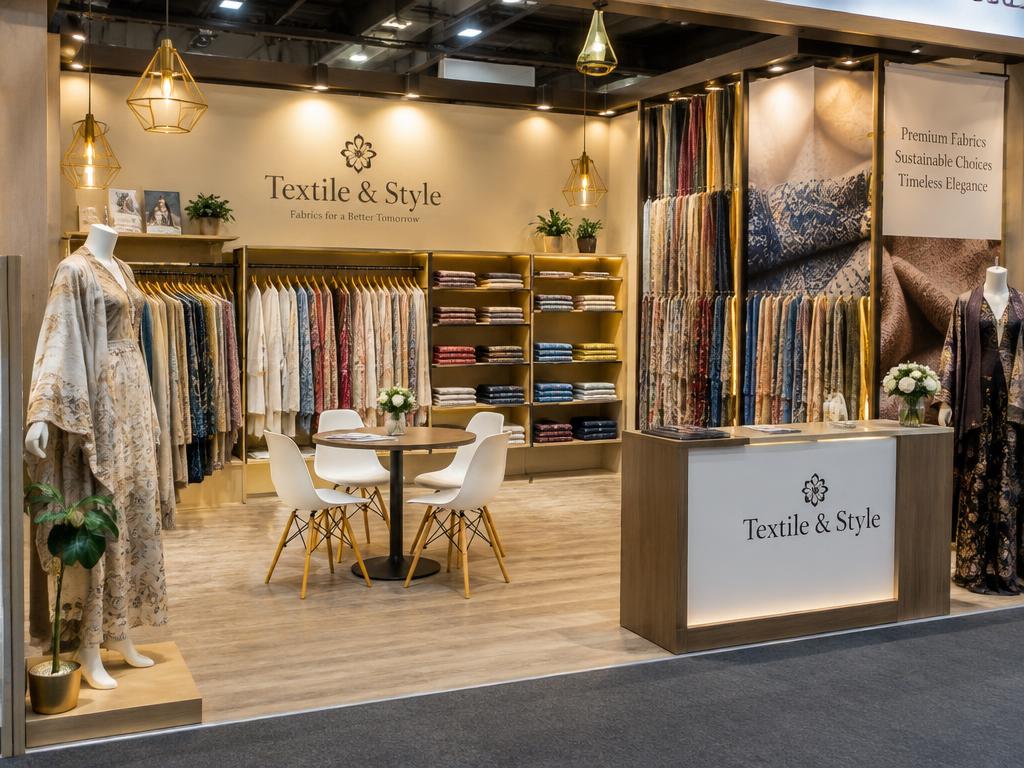
Industry
Textiles & Apparel exhibition stalls
Fabric walls, display racks and fashion-forward booth design.
What a textiles & apparel stand has to do
Textile buyers work by hand and by eye. They need to touch the fabric, see it under light that does not distort the colour, and compare several qualities side by side — which makes lighting specification unusually important on a textile stand.
Volume is the other issue. A sourcing stand may carry hundreds of samples, and the design has to present them as an organised, browsable system rather than a wall of hanging cloth.
Why textiles & apparel stands are harder than they look
Every sector has a handful of constraints that decide the design before anyone discusses how it should look. For textiles & apparel exhibitors these are the ones that matter, and they are worth settling in the brief rather than in the workshop.
- Colour-accurate lighting so fabric reads true
- Presenting large sample volumes without visual chaos
- Buyers needing surface space to lay out and compare
- Hanging weight of heavy fabric rolls and sample books
- Private space for price negotiation
What we build into a textiles & apparel stand
These are the features textiles & apparel buyers expect to find, drawn from what the sector's shows actually demand rather than from a generic stand specification.
- High-CRI lighting throughout, so colour does not shift on stand
- Sample display organised by quality, weight or collection
- A large table surface for laying out and comparing fabric
- Load-rated hanging rails and sample-book shelving
- A semi-private corner for commercial negotiation
- Fabric-led wall treatment that demonstrates the product itself
How we divide the floor for textiles & apparel
Floor area is the scarcest thing on any stand, and the split between display, demonstration, meeting and storage is a sector decision long before it is an aesthetic one. For textiles & apparel the usual division looks like this.
Textiles & Apparel stand zones
| Zone | What it is for |
|---|---|
| Sample display | Organised, browsable system — rails, shelves and swatch walls |
| Comparison table | Generous flat surface where buyers lay fabric side by side |
| Negotiation corner | Semi-private, seated, for pricing conversations |
| Collection wall | Hero fabrics presented as the brand statement |
Space, staffing and lead time by stall size
| Stall size | Footprint | Likely layout | Display | Staff | Build weeks |
|---|---|---|---|---|---|
| 18 sq.m | 3 × 6 m | Inline or corner | 15.3 sq.m | 2 | 3 |
| 36 sq.m | 6 × 6 m | Corner or three-side open | 28.8 sq.m | 4 | 4 |
| 54 sq.m | 6 × 9 m | Corner or three-side open | 43.2 sq.m | 6 | 5 |
| 72 sq.m | 6 × 12 m | Three-side open or island | 57.6 sq.m | 8 | 5 |
Same formula as our stall planner: storage 10% of area up to 18 sq.m and 15% above, meeting space 5% unless you are hosting meetings, display takes the remainder, staff = area ÷ 9.
Materials and finishes we specify
Material choice on a textiles & apparel stand is driven by what the stand has to survive and what the product has to look like next to it.
- Tensioned fabric walls that demonstrate the product in the structure
- High-CRI track and spot lighting for accurate colour
- Load-rated steel rails and timber shelving for sample weight
- Light-toned laminate surfaces that do not cast colour onto cloth
- Carpet or timber flooring to signal quality underfoot
Shows
Textiles & Apparel shows we build for
We build for Bharat Tex, Texprocil shows and Garment fairs among others. Editions, dates and halls change year to year, so confirm the current details with the organiser before planning around them.
01
Brief
Share stall size, expo and goals. We call within 2 hours.
02
3D Design
Photoreal concepts in 48 hours, revised until perfect.
03
Fabrication
Built and pre-assembled in our own workshops.
04
Install & Show
On-site crew builds, hands over and dismantles.


FAQ
Textiles & Apparel stalls: FAQ
What makes a good textiles & apparel exhibition stall?+
High-CRI lighting throughout, so colour does not shift on stand, Sample display organised by quality, weight or collection, A large table surface for laying out and comparing fabric — in that order of priority. Textiles & Apparel stands are judged on sourcing enquiries and sample requests, so the stand succeeds when a buyer sits down with fabric in their hands.
How much does a textiles & apparel stall cost?+
Custom stalls typically run ₹9,000–₹18,000 per sq.m for the build, depending on finishes, lighting and AV. Sector-specific requirements — load-rated platforms, closed meeting rooms, refrigeration, secure showcases — are quoted on their own lines.
How early should we brief for a textiles & apparel show?+
Four to six weeks for a standard custom stand, and eight weeks or more where the stand needs structural engineering, closed meeting rooms, services such as water and drainage, or organiser approvals beyond the usual set.
Do you understand our sector's compliance requirements?+
We build to the specification your regulatory, security or technical team approves, and we raise the organiser and venue requirements that affect the layout early. We do not advise on the content of regulated claims.
Can you deliver textiles & apparel stalls across several cities?+
Yes. We cover 119 cities with the same workshops and project managers, and a modular build can travel between shows so the cost per edition falls after the first build.
Is 3D design included?+
Yes, free with every confirmed fabrication order and revised until you approve it.
Services for this industry
Textiles & Apparel stalls in key cities
Popular builds for textiles & apparel
Other industries
Exhibiting soon? Let's build your stall.