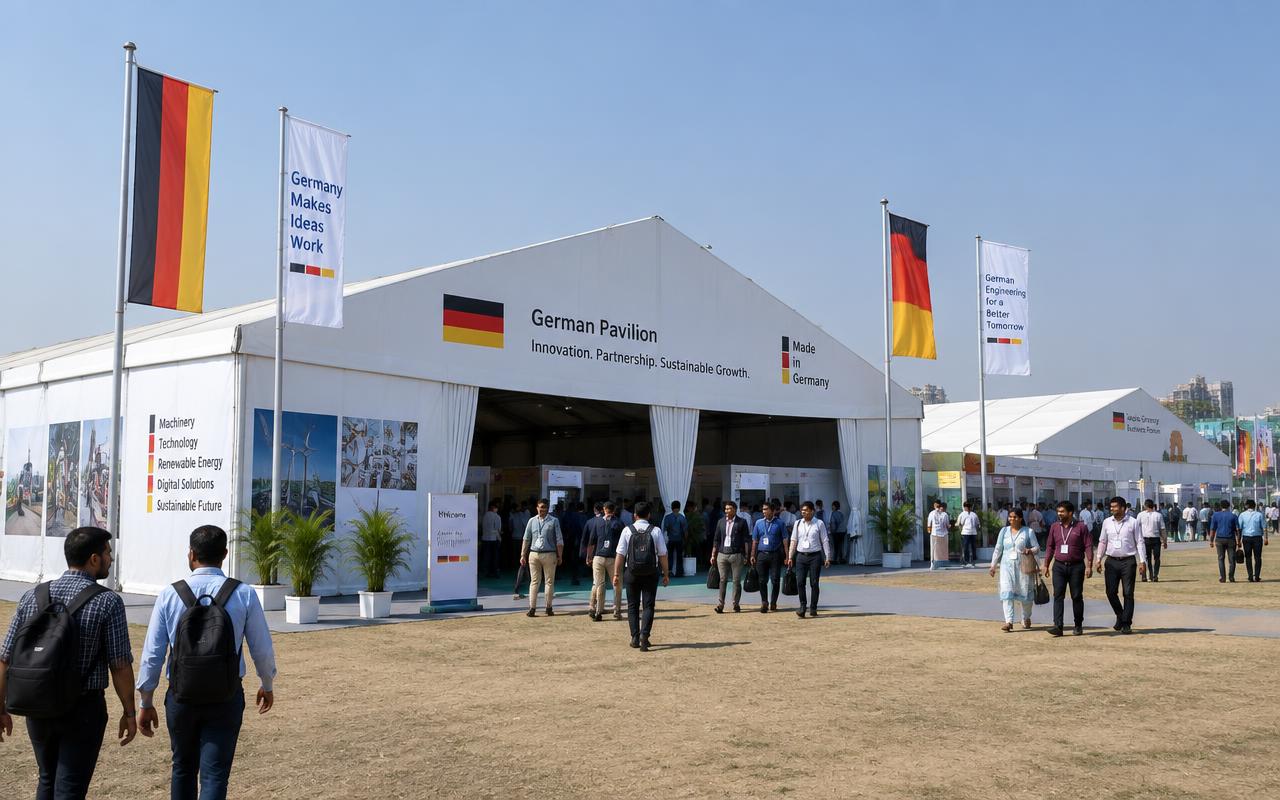
Jamnagar venue
Stall fabrication at Open Exhibition Grounds, Jamnagar
Open grounds where hangar-style German-tent exhibitions and trade fairs are set up.
11
Jamnagar venues covered
0
Named exhibition venues
11
Venue categories
Tier 2
Gujarat market
Exhibiting at Open Exhibition Grounds, Jamnagar
Open grounds where hangar-style German-tent exhibitions and trade fairs are set up. Everything from the first 3D concept to clearing the stand after dismantle is handled by one team and one project manager.
Two stands of identical size can need completely different engineering depending on the room they go into. Height limits, rigging availability, fixing restrictions, power allocation and build hours all change with the venue, and all of them are settled in writing before fabrication starts.
Open Exhibition Grounds, Jamnagar sits in Jamnagar's venue mix at the most open end of it — no walls, no ceiling, no fixed limits, and no shelter either. That position, more than the stall size, is what decides how the stand is engineered: the 11 venues we cover in the city span purpose-built halls, borrowed interiors and open ground, and those are three different trades rather than three versions of one.
Jamnagar is a growing exhibition market rather than a mature one, and the venues reflect that: 11 venue categories and no single purpose-built exhibition centre on our list. Rooms are shared with other kinds of event, so the paperwork and the hours come from whoever owns the room rather than from an exhibition operator.
Building on an open exhibition ground
An open ground is the most flexible and the most exposed option in any city. There is no door to limit panel size and usually no ceiling to limit height, because vehicles can reach the stand itself — but weather, dust, ground level and generator power all have to be designed in rather than assumed, and a hangar or German tent normally sits over the top of the whole thing.
Open exhibition grounds vary from one address to the next even inside Jamnagar, so the figures below are the pattern rather than the contract. The organiser's pack for your show is what we actually design to.
What changes at open exhibition grounds
| Build input | At open exhibition grounds |
|---|---|
| Access route & panel sizes | Vehicles usually reach the stand itself, so panel size is limited by the truck and the crew rather than by a door. That is the one real structural advantage an open ground gives a builder. |
| Fixing method | Pegs, ballast and ground anchors, plus fixings into the hangar or tent frame where the organiser permits them. Tall elements are triangulated because there is nothing solid to lean against. |
| Power source | Generator supply with its own distribution and a backup path. Cable runs are long, so voltage drop, protected routing and crossing points across walkways are designed rather than discovered. |
| Floor protection | Raised platform flooring to level uneven ground, keep dust down and give cables a route. Underneath the platform, drainage matters as much as levelling does. |
| Build & strike hours | A longer build-up window than an indoor hall, because tenting, flooring and power all precede the stand. Daylight working is the norm and dust is continuous. |
| Weather & environment | The governing constraint. Rain, wind, heat and dust are all designed for — sealed edges, covered junctions, wind loading on anything tall, and no graphic that cannot take a shower. |
These six are the ones that change the stand rather than the drawing. Confirm them for your edition with the organiser and we will design to the answers; where an answer is unavailable we design to the conservative assumption and revise once it arrives.
How we build for this kind of venue
- Generator power with its own distribution and a backup path
- A longer build-up window because tenting, flooring and power precede the stand
- Raised platform flooring to level the ground, seal out dust and carry cable runs
- Weather protection and water ingress planned for, not improvised on the day
- Drainage considered under the platform as carefully as the levels above it
- Panels sized by the truck and the crew rather than by a door
What to ask the organiser about open exhibition grounds
A quote for open exhibition grounds is an estimate until these answers exist, and a price afterwards. Ask the organiser for them in writing — not because anyone is being difficult, but because the same venue issues different rules for different shows.
Get these in writing before you brief anyone
- Who is responsible for drainage and for standing water during the show
- The ground surface — levelled earth, hardstanding or turf — and whether pegging is permitted
- Wind-loading limits on tall or hanging elements, and whether any are barred outright
- The build-up sequence, since flooring and tenting have to be finished before stands begin
- Vehicle access to the stand itself, and for how long a vehicle may remain
- Whether power is generator or mains, the allocation per stand, and the distance to the connection point
Who exhibits at Jamnagar venues, and what that changes
Exhibitors at Jamnagar venues come mainly from chemicals, textiles, diamonds & jewellery, ceramics and engineering — the sectors that fill Gujarat's show floors. Those audiences do not want the same stand, and at open exhibition grounds the difference shows up in the build rather than in the brief: who needs a closed room, who needs a load-rated floor, who needs water and drainage, who needs nothing but a screen and two chairs.
Where a Jamnagar show draws from several of those sectors at once, the stand has to serve two briefs in one footprint. Zoning does it — chemicals on the open frontage where it needs to be seen, textiles in the pocket behind where it needs to be discussed — and the space plan below is where that gets decided.
Jamnagar's sector mix and what each needs from a stand
| Sector | What the stand has to do |
|---|---|
| Chemicals | Chemical exhibitors sell specification rather than appearance. Plan a technical literature wall, a closed meeting space for formulation talk, and a safe display method for anything in a container. |
| Textiles | Textile buyers handle everything. Rail and drape capacity, a fold-and-compare table, true-colour lighting, and a lockable store for the sample ranges that leave the stand each day. |
| Diamonds & jewellery | Jewellery needs locked and individually lit cases, a seated viewing position with true-colour light, and staff positions that keep every case in view from one spot. |
| Ceramics | Ceramics and tiles are heavy and reflective. Load-rated display frames, a layout that shows tile at floor angle as well as on the wall, and lighting that does not glare off glaze. |
| Engineering | An engineering audience reads drawings and specifications, so the stand needs a technical wall, a sample or cutaway to handle, and a table with chairs where a quote can actually be discussed. |
The sectors listed are the ones that drive exhibiting activity across Gujarat. Where your show draws from more than one of them, the space plan below is where the compromise gets resolved.
Services
What we build at Open Exhibition Grounds, Jamnagar
Exhibition Stall Design
Concept-to-3D stall design that stops visitors in the aisle.
Stall Fabrication
In-house carpentry, metal and print for flawless builds.
Custom Exhibition Booths
One-of-a-kind booths built around your brand.
Modular Exhibition Stalls
Reusable, quick-install stalls for frequent exhibitors.
Octanorm & System Stalls
Clean aluminium shell-scheme and system booths.
Double-Decker Stalls
Two-storey stands that double your space.
Pavilion Design
State, industry and association pavilions.
Country Pavilions
National pavilions at Indian and global expos.
Trade Show Booths
High-impact booths for B2B trade shows.
Exhibition Stand Builders
End-to-end stand building with on-site crews.
Event Stage Fabrication
Stages, backdrops and sets for events.
AV & LED Wall Support
LED walls, sound, screens and AV crews.
Stall sizes and lead times for Open Exhibition Grounds, Jamnagar
Most stands at a venue like this fall between 9 and 72 sq.m. The table below uses the same formula as our stall planner — storage at 10% of area up to 18 sq.m and 15% above, a meeting corner at 5% unless you are hosting meetings, display taking the remainder — so you can sanity-check a quote against the space you have actually booked.
Lead time is the column exhibitors underestimate. Three weeks is the base for a custom build, four from 24 sq.m and five from 54 sq.m, and those are fabrication weeks after design sign-off rather than from the day you first call. At open exhibition grounds the build-up window itself is rarely the problem; the approval and fabrication time ahead of it usually is.
Space, staffing and lead time by stall size
| Stall size | Footprint | Likely layout | Display | Staff | Visitors at once | Build weeks |
|---|---|---|---|---|---|---|
| 9 sq.m | 3 × 3 m | Inline or corner | 7.6 sq.m | 2 | 3 | 3 |
| 18 sq.m | 3 × 6 m | Inline or corner | 15.3 sq.m | 2 | 6 | 3 |
| 36 sq.m | 6 × 6 m | Corner or three-side open | 28.8 sq.m | 4 | 11 | 4 |
| 54 sq.m | 6 × 9 m | Corner or three-side open | 43.2 sq.m | 6 | 17 | 5 |
| 72 sq.m | 6 × 12 m | Three-side open or island | 57.6 sq.m | 8 | 23 | 5 |
Custom stalls typically run ₹9,000–₹18,000 per sq.m for the build; modular and octanorm construction costs less, and an upgraded shell scheme less again. AV, furniture, flooring, transport and taxes are quoted on separate lines.
Designing a stand that works at Open Exhibition Grounds, Jamnagar
Open-ground visitors arrive hot, dusty and already tired of walking. A shaded standing area with somewhere to put a bag converts better than another graphic wall, and it costs less.
Height and light are what buy visibility in a shared hall. Where the venue allows it, go up — a tall brand element or a hanging banner is read from across the floor in a way that floor-level graphics never are.
Exhibitors here come largely from chemicals, textiles and diamonds & jewellery, and a chemicals audience has specific expectations: product visible, specification available, and somewhere to talk without shouting. We design for that rather than applying a generic layout.
How a build at open exhibition grounds runs
01
Read the venue pack
The job starts with paperwork rather than with a concept. We want the stand plan, the access route, the power allocation and the permitted working hours in writing, and at open exhibition grounds we pay particular attention to whether tenting and flooring are provided by the organiser, and when they will be finished.
02
Design to the limits
Design happens against the constraints rather than around them, so platform flooring, sealed edges, wind loading on tall elements and generator distribution is a starting condition here rather than a late revision. What you approve in 3D is therefore something that can actually be built in this room.
03
Build and test in the workshop
The stall is fabricated and then stood up in our own workshop: panels numbered, graphics trial-fitted, circuits tested and lamps aimed. Problems get found where there is time to fix them rather than at open exhibition grounds at midnight.
04
Install, hand over, strike
On site the work is assembly rather than fabrication, which is the whole point of the previous stage. At open exhibition grounds the install also covers levelling, dust sealing at the platform edges and covered electrical junctions, and the same crew comes back to strike the stand and clear the space.
What else is in Jamnagar
There is no dedicated expo hall on the Jamnagar list, so every show in the city borrows a room built for something else. That is the single most useful thing to know before designing a stand here: whatever the venue is, it was not designed for exhibitions, and the rules will reflect that.
Underneath the named venues sit the 11 venue categories we cover in every city, Jamnagar included: industry association halls, stadium & sports complexes, corporate campus event spaces, industrial estate expo grounds, government exhibition grounds, resort & lawn venues, 5-star hotel ballrooms, convention & banquet halls, open exhibition grounds, mall atriums and university & college campuses. A large share of exhibiting activity in India happens in those rooms rather than in exhibition halls, which is why they get their own pages rather than a footnote.
Every Jamnagar venue we cover
Build-up
Build-up, access and approvals in Jamnagar
Logistics in Jamnagar come down to three things: how the panels reach the hall, how much power the stand is allocated, and when the organiser lets you work. All three are settled in writing before we cut material.
Everything the stand needs — structure, print, lighting, flooring, furniture, AV and the crew to install and strike it — can be bundled into a single itemised quote with one project manager behind it.
What we handle for you
- Organiser drawings, electrical load details and approvals in the format Jamnagar organisers ask for
- Design checked against height, rigging, fixing and fire rules before sign-off
- Pre-assembly and electrical testing in the workshop before dispatch
- Transport, installation and an on-site crew inside the build-up window
- Dismantle and clearing the stand inside the dismantle period
Exhibiting elsewhere in Gujarat
Jamnagar is one of 10 Gujarat cities on our list, alongside Ahmedabad, Surat, Vadodara, Rajkot and Gandhinagar, plus 4 more. For an exhibitor doing a state circuit that matters practically: the structure travels, the graphics are reprinted, and nobody has to re-engineer a stand for each stop.
Because we cover open exhibition grounds in all 10 Gujarat cities on our list, a stand designed for this venue type is designed for the state. The structure, the fixing method and the power assumptions carry over; only the footprint and the graphics change.
If this venue is one stop on a programme, say so at design stage. A stand drawn to be reused is drawn differently — demountable joints, numbered panels, graphics on replaceable skins and a storage footprint that fits a standard crate — and retrofitting that later costs more than building it in.
01
Brief
Share stall size, expo and goals. We call within 2 hours.
02
3D Design
Photoreal concepts in 48 hours, revised until perfect.
03
Fabrication
Built and pre-assembled in our own workshops.
04
Install & Show
On-site crew builds, hands over and dismantles.




FAQ
Venue FAQ
Can you build at Open Exhibition Grounds, Jamnagar?+
Yes. We build at open exhibition grounds throughout Jamnagar, covering design, fabrication, installation and dismantle inside the organiser's window.
What does a stall at Open Exhibition Grounds, Jamnagar cost?+
Custom stalls typically range from ₹9,000 to ₹18,000 per sq.m depending on size, finishes and AV; modular and octanorm builds cost less. Share your stand size and show dates for an itemised quote.
Can you work to a shell scheme at Open Exhibition Grounds, Jamnagar?+
Yes. Where the organiser supplies shell scheme panels we upgrade them with printed fabric or vinyl, raised flooring, spotlights and a branded counter, which lifts the stand a long way at modest cost.
Do you handle approvals for Open Exhibition Grounds, Jamnagar?+
Yes. We prepare dimensioned drawings, electrical load details and structural documents to the organiser's format, and check the design against the venue's height, rigging and fire rules before fabrication.
How early should I book for a show at Open Exhibition Grounds, Jamnagar?+
Four to six weeks ahead for a custom stall and eight or more for a double-decker or pavilion. Urgent builds in seven to ten days are possible with a simplified design.
What are the build-up timings at Open Exhibition Grounds, Jamnagar?+
Build-up windows are set by the organiser for each show rather than by the venue alone, so we confirm them in writing for your edition and plan the build — including night shifts if needed — around them.
Is build-up longer on an open ground?+
Yes. Tenting, flooring and power distribution all have to be finished before stand building starts, so the organiser's build-up period is longer than an indoor hall's and the sequence is published. We plan our arrival against that sequence rather than against the first available day.
What happens to an open-ground stand if it rains?+
A stand designed for the site takes it. Platform flooring lifts the build clear of standing water, edges are sealed, electrical junctions are covered, and graphics are specified in materials that tolerate a wetting rather than paper-faced boards that do not.
Do you design differently for chemicals exhibitors here?+
Yes. Jamnagar's show calendar is driven by chemicals, textiles, diamonds & jewellery, ceramics and engineering, and the sector decides the fundamentals — how much product has to be on open display, how private the meeting space needs to be, whether the floor has to carry load and whether water, drainage or three-phase power are required. We brief against the sector before the identity.
Can the same stand be used at another Gujarat venue?+
Usually, if it is built for it. We cover 10 Gujarat cities including Jamnagar, Ahmedabad, Surat and Vadodara, and a frame-and-skin stand can be stored, re-skinned with new graphics and rebuilt at the equivalent venue elsewhere in the state. Say so at design stage, because a reusable stand is detailed differently.
What is the biggest risk at open exhibition grounds?+
Discovering a constraint after fabrication. Flooring, tenting and generator power all precede your stand on an open ground, so a crew planned in for the first available day arrives before the site is ready for them. That is why we ask for the access route, the fixing rules, the power allocation and the build-up window in writing before anything is cut, rather than treating any of them as a site problem.
More in Jamnagar
Other Gujarat cities we cover
Exhibiting soon? Let's build your stall.