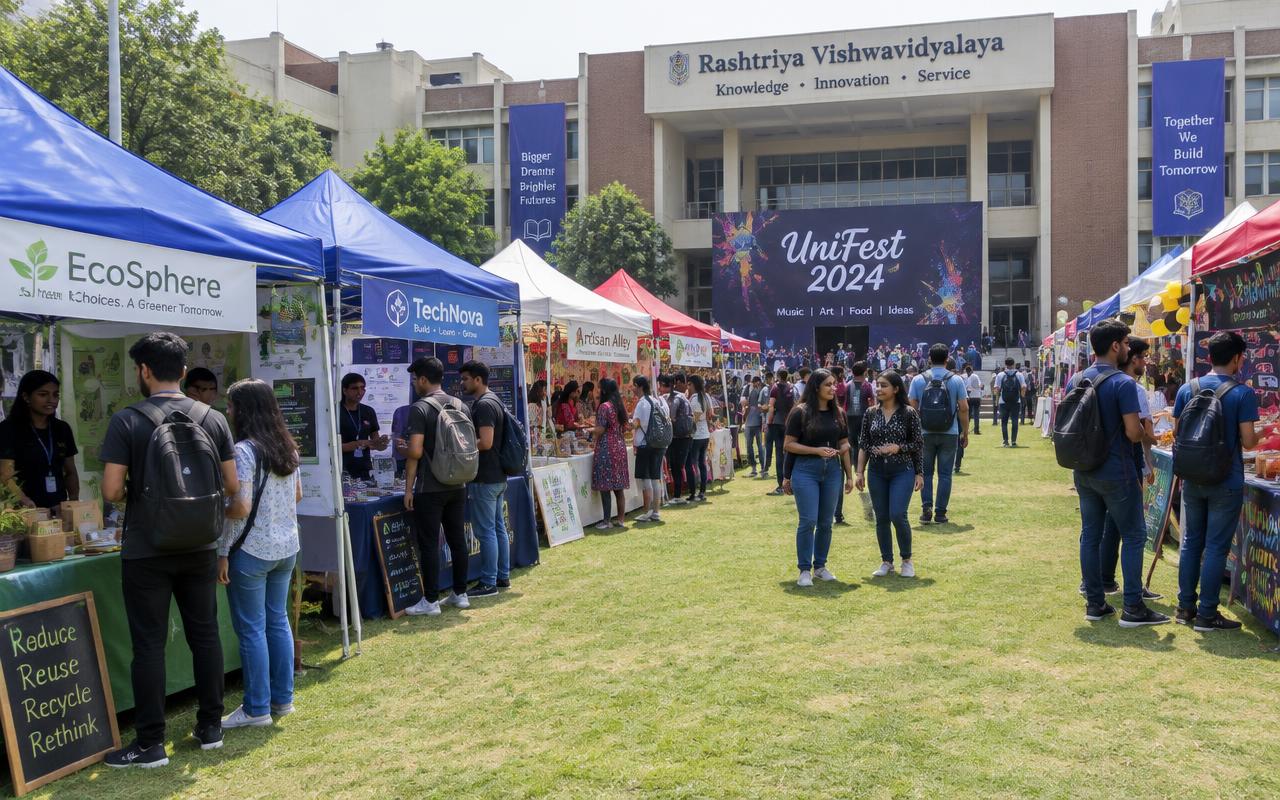
Goa venue
Stall fabrication at University & College Campuses, Goa
Auditoriums and grounds used for education fairs, tech fests and placement expos.
15
Goa venues covered
4
Named exhibition venues
11
Venue categories
Tier 2
Goa market
Exhibiting at University & College Campuses, Goa
Auditoriums and grounds used for education fairs, tech fests and placement expos. Everything from the first 3D concept to clearing the stand after dismantle is handled by one team and one project manager.
A venue imposes a rulebook, and the stall has to be built to it: how high you can go, whether you can hang anything, what you may fix into the floor, how much power you get and which hours you can work. We read that rulebook at design stage, not at build-up.
Placed against the rest of the Goa list, University & College Campuses, Goa is the institutional end of it — many small stands, a modest budget and a timetable that belongs to the campus. Knowing that before you design is what stops a stand being drawn for a hall and then built in a ballroom, which is the most expensive revision in this business.
As a Tier 2 market in Goa, Goa runs a thinner and more seasonal show calendar across 11 venue categories and 4 named venues. That usually means a shorter build window, a venue in use the day before, and a strike timed against the next booking rather than the next show.
Building on a university or college campus
What governs a campus build is the institution's own timetable. Trucks come through a named gate in a named hour, the hall is free between sessions rather than for a day, estate staff rather than an organiser control the power, and the whole thing has to be struck before teaching resumes. Modular construction and reusable graphics are what make that economic for an annual fair.
Within Goa the specific room still matters: two university & college campuses in the same city can differ on clear height, access and power. We confirm those in writing for your edition rather than carrying an assumption from the last build.
What changes at university & college campuses
| Build input | At university & college campuses |
|---|---|
| Access route & panel sizes | Specific gates in specific hours, then a carry to the auditorium or the ground. Modular sections two people can lift beat panels that need four, because the last fifty metres are usually by hand. |
| Fixing method | Freestanding on finished floors indoors; pegged or ballasted on grounds. Auditorium seating, stages and fittings are left untouched, which means working around them rather than through them. |
| Power source | Limited campus distribution shared with the building's normal use. Lighting loads are kept modest and anything heavy is confirmed with the estate office rather than assumed. |
| Floor protection | Protection over auditorium, corridor and foyer floors, and platform flooring on quadrangles and grounds. Grass and paving are reinstated after strike as part of the job. |
| Build & strike hours | Worked around classes, examinations and campus security timings, which in practice means early mornings, evenings or a weekend rather than a continuous window. |
| Weather & environment | Depends on the space, and many campus fairs run indoors and outdoors at once — which makes them two specifications under one brief. |
Every row here is a design input rather than a detail. Two stands of identical area in Goa can need completely different engineering because these six answers differ, which is why we settle them before anything is cut.
How we build for this kind of venue
- Protection over auditorium, corridor and foyer floors
- Platform flooring on quadrangles and grounds, with turf reinstated after strike
- Built and struck around class, examination and security timings
- Reusable graphics and frames for a fair that repeats every year
- Modular systems for fast, repeatable builds across many small stands
- Power drawn from limited campus distribution shared with normal use
What to ask the organiser about university & college campuses
A quote for university & college campuses is an estimate until these answers exist, and a price afterwards. Ask the organiser for them in writing — not because anyone is being difficult, but because the same venue issues different rules for different shows.
Get these in writing before you brief anyone
- Floor-protection expectations for indoor spaces and reinstatement for grounds
- Lift availability and the stair route where there is no lift
- Whether seating, stages and fittings in an auditorium may be moved at all
- Which gate vehicles may use, in which hours, and who issues the passes
- Who on the estate or faculty side signs off the build, and when
- The power available per stand and which department controls the supply
Who exhibits at Goa venues, and what that changes
The sector mix in Goa is tourism, pharma, mining, seafood and hospitality, and each of those brings its own non-negotiables onto a stand. The table below is what we design against at university & college campuses before a single visual is drawn, because most of these requirements are structural or electrical rather than decorative.
Most Goa exhibitors are selling to more than one of those audiences, which is an argument for a layout rather than a style. Give the tourism audience the frontage and the pharma audience the back corner, and the stand stops trying to be two things in the same square metre.
Goa's sector mix and what each needs from a stand
| Sector | What the stand has to do |
|---|---|
| Tourism | Tourism stands sell a place. Large imagery high up, a literature counter, seating for an itinerary conversation, and screen content that reads from the aisle without sound. |
| Pharma | A pharma audience talks in private. A closed meeting corner, lockable sample storage, a wipe-clean dispensing counter and literature capacity matter more than open display area. |
| Mining | Mining audiences want equipment, wear parts and tonnage evidence. Load-rated plinths, a safe barrier line, heavy-duty flooring and a technical wall for specifications. |
| Seafood | Seafood exhibitors often need chilled display, which means a drained wet area, a dedicated power point for refrigeration, ventilation and a wipe-clean counter. |
| Hospitality | Hospitality buyers are judging finish, so the stand itself is the sample. Real materials, resolved detailing, a seated meeting area and lighting that flatters are the brief. |
The sectors listed are the ones that drive exhibiting activity across Goa. Where your show draws from more than one of them, the space plan below is where the compromise gets resolved.
Services
What we build at University & College Campuses, Goa
Exhibition Stall Design
Concept-to-3D stall design that stops visitors in the aisle.
Stall Fabrication
In-house carpentry, metal and print for flawless builds.
Custom Exhibition Booths
One-of-a-kind booths built around your brand.
Modular Exhibition Stalls
Reusable, quick-install stalls for frequent exhibitors.
Octanorm & System Stalls
Clean aluminium shell-scheme and system booths.
Double-Decker Stalls
Two-storey stands that double your space.
Pavilion Design
State, industry and association pavilions.
Country Pavilions
National pavilions at Indian and global expos.
Trade Show Booths
High-impact booths for B2B trade shows.
Exhibition Stand Builders
End-to-end stand building with on-site crews.
Event Stage Fabrication
Stages, backdrops and sets for events.
AV & LED Wall Support
LED walls, sound, screens and AV crews.
Stall sizes and lead times for University & College Campuses, Goa
Most stands at a venue like this fall between 9 and 72 sq.m. The table below uses the same formula as our stall planner — storage at 10% of area up to 18 sq.m and 15% above, a meeting corner at 5% unless you are hosting meetings, display taking the remainder — so you can sanity-check a quote against the space you have actually booked.
Lead time is the column exhibitors underestimate. Three weeks is the base for a custom build, four from 24 sq.m and five from 54 sq.m, and those are fabrication weeks after design sign-off rather than from the day you first call. At university & college campuses the build-up window itself is rarely the problem; the approval and fabrication time ahead of it usually is.
Space, staffing and lead time by stall size
| Stall size | Footprint | Likely layout | Display | Staff | Visitors at once | Build weeks |
|---|---|---|---|---|---|---|
| 9 sq.m | 3 × 3 m | Inline or corner | 7.6 sq.m | 2 | 3 | 3 |
| 18 sq.m | 3 × 6 m | Inline or corner | 15.3 sq.m | 2 | 6 | 3 |
| 36 sq.m | 6 × 6 m | Corner or three-side open | 28.8 sq.m | 4 | 11 | 4 |
| 54 sq.m | 6 × 9 m | Corner or three-side open | 43.2 sq.m | 6 | 17 | 5 |
| 72 sq.m | 6 × 12 m | Three-side open or island | 57.6 sq.m | 8 | 23 | 5 |
Custom stalls typically run ₹9,000–₹18,000 per sq.m for the build; modular and octanorm construction costs less, and an upgraded shell scheme less again. AV, furniture, flooring, transport and taxes are quoted on separate lines.
Designing a stand that works at University & College Campuses, Goa
At an education or placement fair the visitor is comparing a row of near-identical stands, so the one legible differentiator — a number, a name, a single clear offer at head height — does more than any amount of finish.
Visitors decide whether to enter from several metres away, so the stand has to answer "what do you do?" before it answers anything else. One legible line at eye height does more than a wall of product shots.
Exhibitors here come largely from tourism, pharma and mining, and a tourism audience has specific expectations: product visible, specification available, and somewhere to talk without shouting. We design for that rather than applying a generic layout.
How a build at university & college campuses runs
01
Read the venue pack
The job starts with paperwork rather than with a concept. We want the stand plan, the access route, the power allocation and the permitted working hours in writing, and at university & college campuses we pay particular attention to the gate, the hour and the academic timetable the build has to fit between.
02
Design to the limits
The concept is then developed inside those limits rather than adjusted to them afterwards. At university & college campuses that means designing for modular sections two people can carry and a lighting load a campus board will actually take from the first sketch instead of retrofitting it to a finished drawing.
03
Build and test in the workshop
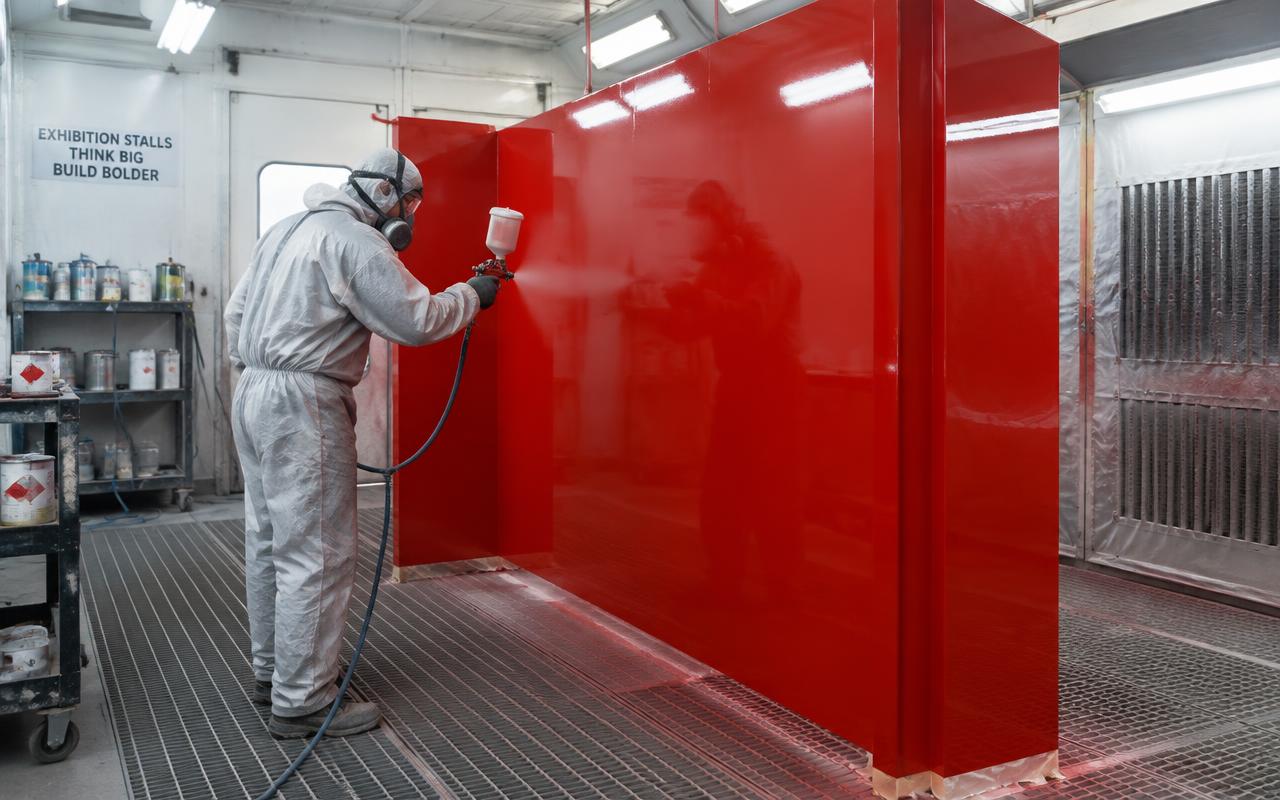
Carpentry, metalwork, spray finishing, large-format print and electrical assembly all happen in-house, and the whole stall is assembled once before it ships. That is what turns a short on-site window into enough time.
04
Install, hand over, strike
On site the work is assembly rather than fabrication, which is the whole point of the previous stage. At university & college campuses the install also covers floor protection indoors and reinstatement of grass and paving outside, and the same crew comes back to strike the stand and clear the space.
What else is in Goa
The named venue list for Goa runs to 4 buildings on top of this one: Dr Shyama Prasad Mukherjee Stadium, Kala Academy, Goa International Centre and Taj & Grand Hyatt Ballrooms. Taking each name at its word, they divide into 1 indoor stadium or arena, 1 auditorium, hall or cultural centre, 1 purpose-built exhibition or trade centre and 1 hotel ballroom or hotel convention hall — which is why a stand that worked at one Goa venue is not automatically a stand that works at the next.
We also cover 11 venue categories in Goa — convention & banquet halls, open exhibition grounds, mall atriums, university & college campuses, industry association halls, stadium & sports complexes, corporate campus event spaces, industrial estate expo grounds, government exhibition grounds, resort & lawn venues and 5-star hotel ballrooms — because most Indian shows outside the top handful of cities happen in a room that was built for something else. Each of those categories has its own access, fixing and power pattern, and each gets its own page.
Named Goa venues, read by what each one calls itself
| Venue | Type read from the name | What that implies for a stand |
|---|---|---|
| Dr Shyama Prasad Mukherjee Stadium | Indoor stadium or arena | In a volume this large a stand reads as small unless it builds upward or lights upward. |
| Kala Academy | Auditorium, hall or cultural centre | Most of the real traffic at an auditorium venue is in the foyer and during the breaks, so put the stand where people queue and plan for everything to happen in twenty-minute bursts.. |
| Goa International Centre | Purpose-built exhibition or trade centre | In a purpose-built hall you are one of many stands with identical freedoms, so differentiation comes from the things the hall allows and most exhibitors never use: height, light and a clear reason to step in off the aisle.. |
| Taj & Grand Hyatt Ballrooms | Hotel ballroom or hotel convention hall | Ballroom audiences are corporate and arrive in groups, so seated conversation space earns its square metres here in a way it would not at a consumer show. |
A venue's name is a strong hint and not a specification. We confirm height, rigging, fixing, power and hours from the organiser's pack for your edition before design sign-off.
Every Goa venue we cover
Build-up
Build-up, access and approvals in Goa
The two things that cost exhibitors time in Goa are materials arriving loose and electricals being tested for the first time on site. We ship pre-assembled, pre-wired and pre-fitted, which is why a tight build-up window is normally enough.
Design, fabrication, graphics, lighting, flooring, furniture, installation and dismantle can all sit on one quote, which is usually cheaper than sourcing them separately once you account for three margins and the coordination time.
What we handle for you
- Organiser drawings, electrical load details and approvals in the format Goa organisers ask for
- Design checked against height, rigging, fixing and fire rules before sign-off
- Pre-assembly and electrical testing in the workshop before dispatch
- Transport, installation and an on-site crew inside the build-up window
- Dismantle and clearing the stand inside the dismantle period
Taking the same stand to another city
Goa is a single-city market on our list, so a programme here usually pairs Goa with the nearest major exhibition cities — Delhi, Mumbai, Bengaluru and Chennai among them. The structure travels and the graphics are reprinted per city, which is cheaper than commissioning a second stand.
A stand engineered for this venue is rarely a one-show asset. Frame-and-skin construction lets the structure be stored and re-skinned for the next city, which is why the second show in a programme costs materially less than the first.
A multi-city programme is mostly a logistics question rather than a design one. One approved drawing set, one set of reusable panels, graphics printed per city and a crew that travels with the stand — that is the whole model, and it is what keeps the per-city cost falling as the programme goes on.
01
Brief
Share stall size, expo and goals. We call within 2 hours.
02
3D Design
Photoreal concepts in 48 hours, revised until perfect.
03
Fabrication
Built and pre-assembled in our own workshops.
04
Install & Show
On-site crew builds, hands over and dismantles.

FAQ
Venue FAQ
Can you build at University & College Campuses, Goa?+
Yes. We build at university & college campuses throughout Goa, covering design, fabrication, installation and dismantle inside the organiser's window.
What does a stall at University & College Campuses, Goa cost?+
Custom stalls typically range from ₹9,000 to ₹18,000 per sq.m depending on size, finishes and AV; modular and octanorm builds cost less. Share your stand size and show dates for an itemised quote.
How early should I book for a show at University & College Campuses, Goa?+
Four to six weeks ahead for a custom stall and eight or more for a double-decker or pavilion. Urgent builds in seven to ten days are possible with a simplified design.
Who is on site during build-up at University & College Campuses, Goa?+
A named project manager and the crew that pre-assembled the stall. They install to the drawing, hand over a working stand and return to dismantle and clear it within the organiser's window.
Can you work to a shell scheme at University & College Campuses, Goa?+
Yes. Where the organiser supplies shell scheme panels we upgrade them with printed fabric or vinyl, raised flooring, spotlights and a branded counter, which lifts the stand a long way at modest cost.
Do you handle approvals for University & College Campuses, Goa?+
Yes. We prepare dimensioned drawings, electrical load details and structural documents to the organiser's format, and check the design against the venue's height, rigging and fire rules before fabrication.
Can you build a campus fair stand around class timings?+
Yes, and it is usually the only way. Campus builds happen early morning, in the evening or over a weekend, around classes, examinations and security timings. Modular construction and workshop pre-assembly are what let a stand go up in a short window.
Can graphics be reused for next year's campus fair?+
Yes, if the stand is built for it. Frame-and-skin construction lets the structure be stored and re-skinned with new graphics, which is the main reason annual fairs end up cheaper in the second year than the first.
Do you design differently for tourism exhibitors here?+
Yes. Goa's show calendar is driven by tourism, pharma, mining, seafood and hospitality, and the sector decides the fundamentals — how much product has to be on open display, how private the meeting space needs to be, whether the floor has to carry load and whether water, drainage or three-phase power are required. We brief against the sector before the identity.
Can the same stand be used at a show in another city?+
Usually, if it is built for it. A frame-and-skin stand can be stored between shows, re-skinned with new graphics and rebuilt in another city, with print as the only significant per-city cost. It needs to be designed that way from the start rather than adapted later.
What is the biggest risk at university & college campuses?+
Discovering a constraint after fabrication. Campus power is modest and shared with the building's normal use, so a lighting load designed for an exhibition hall will not run here. That is why we ask for the access route, the fixing rules, the power allocation and the build-up window in writing before anything is cut, rather than treating any of them as a site problem.
More in Goa
Exhibiting soon? Let's build your stall.