By the Exhibition Stall Design editorial team · Updated 1 October 2026 · 9 min read
Short answer
Nine mistakes account for most of the money lost on country pavilions: a design begun before the stand plan arrives, a render approved without a specification, storage omitted, staff positioned as a barrier on the open edge, a stand that is under-lit, a wall carrying five messages, artwork that misses its date, a dismantle nobody planned, and leads nobody follows up. All nine are cheap to prevent at briefing stage and expensive to correct afterwards.
Key takeaways
- Itemised quotes are not a formality. A lump sum is not a cheaper stand, it is an unspecified one, and the gap shows up on site.
- A lead that is not contacted within 48 hours is indistinguishable from a lead you never captured. That is where the show budget is usually lost.
- Almost every expensive mistake is a decision taken late, not a decision taken wrongly. Timing is the main cost driver you control.
- Read the exhibitor manual before briefing a designer. Height, rigging, setback and dismantle rules all change what can be drawn.
- The dismantle window is enforced and the labour to meet it is the dearest you will buy. Contract the strike with the build, not after it.
- One message on the wall, decided early, prevents the most common visible failure: a stand that is busy and says nothing.
The nine failures, summarised before the detail
These are ordinary mistakes, which is exactly why they are expensive. Every one of them is a reasonable decision in isolation — a late brief follows a late booking, display area outranks storage, lighting looks like a finishing touch — and experienced exhibitors make them as readily as first-timers.
What they share is that the bill arrives later than the decision and in a different column: a late brief shows up as a rush charge, a missing specification as a stand that does not look like the render, a missing dismantle plan as a penalty. Read the table, then read the section on whichever row you recognise.
| Mistake | What it actually costs | The fix |
|---|---|---|
| Carrying five messages instead of one | A stand that is busy without being informative | One line of five words or fewer above head height; detail at counter level |
| Late artwork, and the reprint nobody budgeted for | A second payment for a surface you had already paid for | One deadline, one named owner, print-ready assets at briefing, a signed proof |
| No dismantle plan, and no inventory to reuse | A clearance charge, and assets you end up buying twice | Write the organiser's dismantle window into the schedule and label what comes back |
| Capturing names for three days and then returning to the day job | The entire cost of the show, written off | Score leads the same day and make first contact within 48 hours |
| Starting the concept on the booking plan instead of the real one | A redesign, then the rush charges that follow it | Confirm dimensions, open sides and permitted height in writing before the first concept |
| Signing off a 3D view with no materials list behind it | A built stand that does not match what was signed off | Ask for the schedule that sits behind the picture, and approve both together |
| No storage, so the cartons go on show | Cartons, bags and coats on display all show | Plan storage first and hide it behind the brand wall, where it costs no frontage |
| Standing the team along the open edge | Visitors who intended to step in walk past instead | Keep the open edge genuinely open and brief the team to let visitors come in first |
| Relying on the hall lighting | An expensive stand that photographs and reads as an inexpensive one | Budget lighting as its own line and aim every fixture at the workshop dry build |
Eight of the nine cost nothing to prevent. The ninth — lighting — costs a budget line, and it is still the cheapest visible improvement available.
A stand rarely fails at the venue. It fails at the brief, four weeks earlier.
1. Carrying five messages instead of one
The habit: accommodate everybody. Each product line, each certification and each division has a legitimate claim on the brand wall, and no individual request is unreasonable, so the wall ends up carrying all of them at the same size.
The bill: comprehension, and therefore footfall. A visitor walking an aisle gives a stand a glance, not a reading. Five messages of equal weight resolve into none, and the stand becomes visually busy without becoming informative — which is the specific failure that makes an expensive stand feel cluttered.
The fix: choose. One line of five words or fewer, above head height, high contrast, stating what you make and who it is for — and a logo on its own does not qualify. The rest of the story belongs at counter level or on a looping screen, for visitors who have already decided to stop.
2. Late artwork, and the reprint nobody budgeted for
The habit: treat the artwork deadline as softer than the build deadline, because artwork feels like a file rather than a thing. The logo pack, the product shots and the final copy arrive in pieces, days after they were due, and often after print has been released.
The bill: rework at full price. Large-format print is not a reprintable page — a back-wall graphic is a single run, and changing it after production means printing it twice, shipping it urgently and fitting it with a crew that is now on overtime. None of that was in the quote, and all of it is billable.
The fix: one date, one owner, print-ready assets gathered at briefing instead of chased at production, and a signed proof before release. Where the copy genuinely is not settled, say so early and have the layout isolate it on a smaller panel, so the inevitable change costs a small reprint rather than a large one.
| Back wall — tensioned fabric graphic, printed a second time | ₹34,000 |
|---|---|
| Two side panels, reprinted | ₹18,000 |
| Rush freight to the venue city | ₹7,500 |
| Night-shift crew to refit before doors open | ₹22,000 |
| Extra workshop handling and a day of floor space | ₹9,500 |
| Indicative cost of the rework, before GST | ₹91,000 |
Illustrative only, and entirely avoidable. The original graphics had already been paid for, so every line here is a second payment for the same surface. On a stand of this size that is roughly the cost of the whole lighting and flooring scope.
3. No dismantle plan, and no inventory to reuse
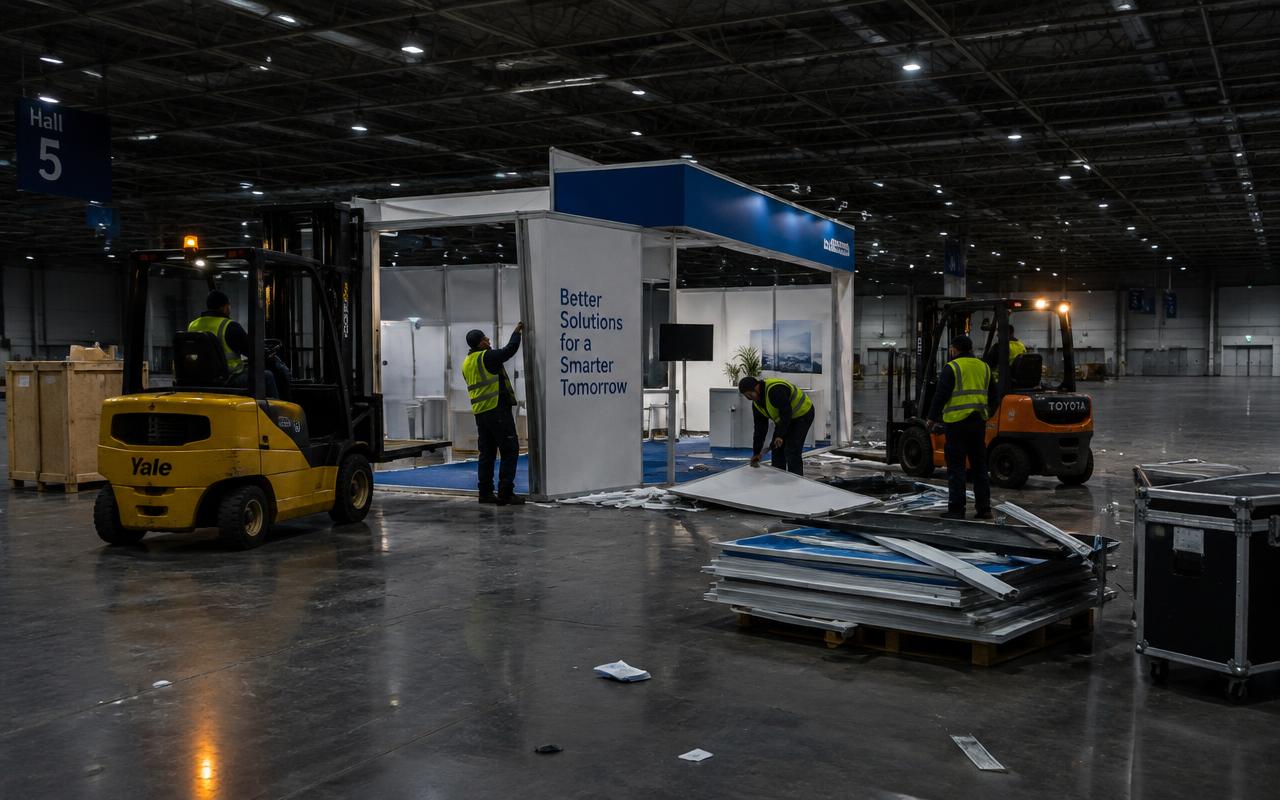
The habit: give the build four weeks of attention and the dismantle none. By the time it matters the show is finished, the team has travelled home, and the task falls to whoever is still reachable on the last night.
The bill: a clearance charge and an inventory. The organiser's window is enforced, and labour hired at short notice on the busiest night in the hall is the dearest you will buy. The quieter loss is the reusable part of the stand — frames, screens, furniture, graphics meant for the next three shows — abandoned or damaged, and therefore bought twice.
The fix: buy dismantle, clearance, return freight and storage as part of the build, not as an afterthought, and put the manual's window into the project schedule. Decide before the show what is coming back, label it on site, and hand the inventory to whoever briefs the next participation.
4. Capturing names for three days and then returning to the day job
The habit: capture names energetically for three days, bring back a stack of cards or a spreadsheet, and return to the day job. Follow-up starts the week after, in order, from whoever has time.
The bill: the whole participation. Space, design, build, travel, staff time and freight are sunk by the time the hall closes, and the only line with upside left is the follow-up, which decays fast. A visitor who had a good conversation on Tuesday cannot place which of forty stands it was by the following Monday, so a late first contact performs like a cold call on a list you paid a great deal to assemble.
The fix: decide the two questions that separate a buyer from a browser before doors open, review and score the day's leads each evening while the conversations are still fresh, and have the person who actually met them make contact inside 48 hours.
5. Starting the concept on the booking plan instead of the real one
The habit: start the design as soon as the space is booked, working from the brochure plan. That document gives an area and nothing else — not the final position, not which sides end up open, not the column standing in one corner, not what the neighbour intends to build.
The bill: the whole concept, twice. A design assumes a back wall, an entry point and a number of finished faces; change which sides are open and none of those assumptions survive. You then pay for the second design under a shorter deadline, which is where rush charges enter the project.
The fix: ask the organiser for the confirmed stand plan and the current exhibitor manual before the first concept, and confirm three things in writing — exact dimensions, which sides are open, and the permitted build height. A single email, sent early, removes the most expensive mistake on this list.
6. Signing off a 3D view with no materials list behind it
The habit: sign off a beautiful 3D view and treat that as the agreement. It is the natural thing to approve, because it is the only document in the pack that a non-technical stakeholder can read.
The bill: a stand that is recognisably the render and materially not it. Renders do not state whether a panel is laminate or spray-finished, whether a graphic is tensioned fabric or vinyl on board, how many lamps are on the wall or whether the plinth is lit. Those are the differences between finishes, and they are also the differences between quotes, which is why two vendors can bid the same picture at very different prices.
The fix: insist on the schedule behind the image and approve the two as one document — materials, finishes, substrates, lamp count and type, flooring build-up, furniture. At ₹9,000–₹18,000 per sq.m for a custom build, the schedule is the thing you are paying for; the render only illustrates it.
Exhibiting soon? Let's build your stall.
7. No storage, so the cartons go on show
The habit: treat storage as the lowest-value use of paid floor and leave it off the plan. On site it reappears anyway, as a gap behind a panel, the space under a counter, or a corner with a cloth thrown over it.
The bill: the appearance of the stand, continuously, for as long as the show runs. Packaging, courier bags, laptop cases, bottles, coats and surplus brochures do not disappear because they were left off the drawing — they simply end up where visitors can see them. The hidden cost is time, with staff hunting for samples instead of talking.
The fix: put storage on the drawing before anything else, at 10% of the area up to 18 sq.m and 15% beyond it, which is 5.4 sq.m on a 36 sq.m stand. Behind the brand wall it costs you no visible frontage; add a lock, a shelf and somewhere to hang coats and the floor stays clean all week.
8. Standing the team along the open edge
The habit: line the staff up at the front of the stand to greet people. It feels welcoming and proactive, and it is what an untrained team does by instinct when the aisle gets busy.
The bill: precisely the footfall the stand was built to attract. A line of people at the threshold signals that entry means being approached, and most visitors avoid that by continuing down the aisle. Senior buyers avoid it most reliably, which inverts the whole purpose of the exercise.
The fix: position the team inside the stand, at the counter, the demo point and the meeting corner, with the open edge genuinely open. Brief them to let a visitor get two steps in before speaking, and to stand at an angle to the aisle rather than facing it down. The arithmetic helps: a 36 sq.m stand needs about 4 people on it, and more than that is a crowd of your own making.
9. Relying on the hall lighting
The habit: cut the lighting line to protect the structure or the graphics. It is the easiest item to trim because nothing visibly disappears from the drawing when it goes, and the hall is already lit.
The bill: the appearance of the entire investment. Hall lighting is flat, high and designed for circulation, so an unlit stand sits in the same grey wash as the aisle and reads as under-funded no matter what the carpentry cost. Contrast is what the eye registers as quality, and contrast is only available from your own fixtures.
The fix: treat lighting as three layers — ambient to lift the stand above the hall, accent to pick out the brand wall and hero product, and task light at counters and meeting tables. Aim and lock every fixture during the workshop dry build, because there is never time to do it at the venue, and walk the stand at show light levels before doors open to see what is actually dark.
What else goes wrong on country pavilions
This scope adds a few failures of its own, and they are the ones a generic checklist will not flag. They matter more than they look, because this work is normally bought by large exhibitors, government bodies, export councils and multinationals who want a single accountable partner for the whole participation, and a quote comparison on price alone hides exactly these differences.
Start with this one: too many vendors with no single point of accountability. It is answered in procurement rather than in design — ask who does the work with their own hands, in whose workshop, with which crew, and ask it before you line two prices up. Put the remaining risks on the table at quoting stage, while they are still cheap to discuss.
- Budget overruns from scope that was never itemised — ask which part of this is done in-house and which is sub-contracted.
- Delayed approvals that compress build-up time — ask what happened the last time it went wrong, and what changed afterwards.
- Too many vendors with no single point of accountability — ask which part of this is done in-house and which is sub-contracted.
- Inconsistent branding across co-exhibitor booths — ask which part of this is done in-house and which is sub-contracted.
Six ordinary things, done in the right order
There is no clever process here. The nine mistakes are prevented by doing six ordinary things in the right order, early enough that each one still has options. The reason they are not done is almost always that the schedule started too late, which is why lead time is the first thing to fix: 3 weeks for a small stand, 4 from 24 sq.m and 5 from 54 sq.m, with more for a double-decker or a pavilion that needs structural sign-off and organiser approval.
01
Write the goal as a number
Qualified enquiries, meetings booked, samples dispatched — one primary goal with a figure attached. The layout follows from it, and so does the argument about what to cut.
02
Itemise the quote line by line
Structure, graphics, lighting, flooring, furniture, transport both ways, crew, dismantle, clearance and taxes as separate lines, with exclusions named in writing.
03
Approve a specification, not a picture
Materials, finishes, graphic substrates, lamp count and type, flooring and furniture, alongside the render and an eye-level view from the aisle.
04
Get the paperwork before the design
Confirmed stand plan, exhibitor manual, build height, rigging rules, open sides, build-up and dismantle windows. Ten minutes of reading, and it removes two of the nine outright.
05
Agree the strike and the follow-up in advance
Dismantle window, what comes back, who stores it, who contacts every lead and by when. Both belong in the plan written before the show, not in the week after it.
06
Lock the artwork date
One deadline, one named owner, print-ready assets collected at briefing, a signed printer's proof before release. This is the cheapest line of insurance on the project.
Before you sign anything
If you already have a design or a quote in hand, the fastest check is to read it against this page. Does it name materials and finishes? Does it count lamps? Does it allocate storage? Does it include transport, installation, dismantle, clearance and taxes as separate lines, or is it a single figure? A lump sum is not a cheaper stand; it is an unspecified one.
Give us the show, city, dates, area and open sides — and the quote you already have, if there is one — and we will itemise the comparison and draw a concept. 3D design comes free with a confirmed fabrication order, fabrication is in-house, organiser drawings and approvals are handled, and dismantle and clearance sit in the same scope as the build.
Frequently asked questions
Two quotes differ a lot for the same brief. Which is wrong?+
Usually neither — they are quoting different stands. Put both against the same written specification covering materials, finishes, lamp count, flooring and what is excluded, and the gap normally explains itself.
How much storage does a stand need?+
Plan 10% of the area up to 18 sq.m and 15% above it — about 5.4 sq.m on a 36 sq.m stand. Make it lockable and put it behind the brand wall so it costs no frontage.
Why does staff position matter so much?+
Because a line of people along the open edge reads as a barrier. The team trying hardest to greet people is often the reason people walk past. Standing at the counter and the demo point inside the stand fixes it at no cost, and about 4 people is the right number on a 36 sq.m stand.
How early should the brief go out?+
Allow 3 weeks for a small stand, 4 from 24 sq.m and 5 from 54 sq.m, and more where structural sign-off or organiser approval is involved. Earlier than that buys options; later than that buys rush charges.
Is a render enough to approve a stand?+
No. Approve the render together with a written materials, finish and lighting schedule. Without it, two vendors are quoting different stands from the same picture and neither can be held to the look you signed off.
When does follow-up need to happen?+
Score leads the same day and make first contact within 48 hours, from the person the visitor met. After about a week a good conversation has faded into a list of stands.
What should I do if artwork will be late?+
Tell the fabricator immediately and design around it by isolating the uncertain content onto a smaller, separately printed panel. A planned small reprint costs a fraction of an unplanned large one.
Country Pavilions near you
Our crews deliver country pavilions in every major Indian city.