By the Exhibition Stall Design editorial team · Updated 1 October 2026 · 9 min read
Short answer
On exhibition stand builders projects the expensive failures are consistent: designing before the confirmed stand plan exists, signing off a render with no materials schedule behind it, no storage on the drawing, the team lined along the open edge, too little light, too many messages, artwork delivered late, no plan for the strike, and leads that are captured and never contacted. None of them is a skill problem. Each is a decision taken late or left unowned, and the bill arrives as rework rather than in the quote you compared.
Key takeaways
- Plan storage before anything else goes on the drawing — 10% of the area up to 18 sq.m and 15% above it, which is 5.4 sq.m on a 36 sq.m stand.
- Read the exhibitor manual before briefing a designer. Height, rigging, setback and dismantle rules all change what can be drawn.
- Approve a specification, not a picture. A render with no materials, finish and lighting schedule is not something a workshop can be held to.
- Itemised quotes are not a formality. A lump sum is not a cheaper stand, it is an unspecified one, and the gap shows up on site.
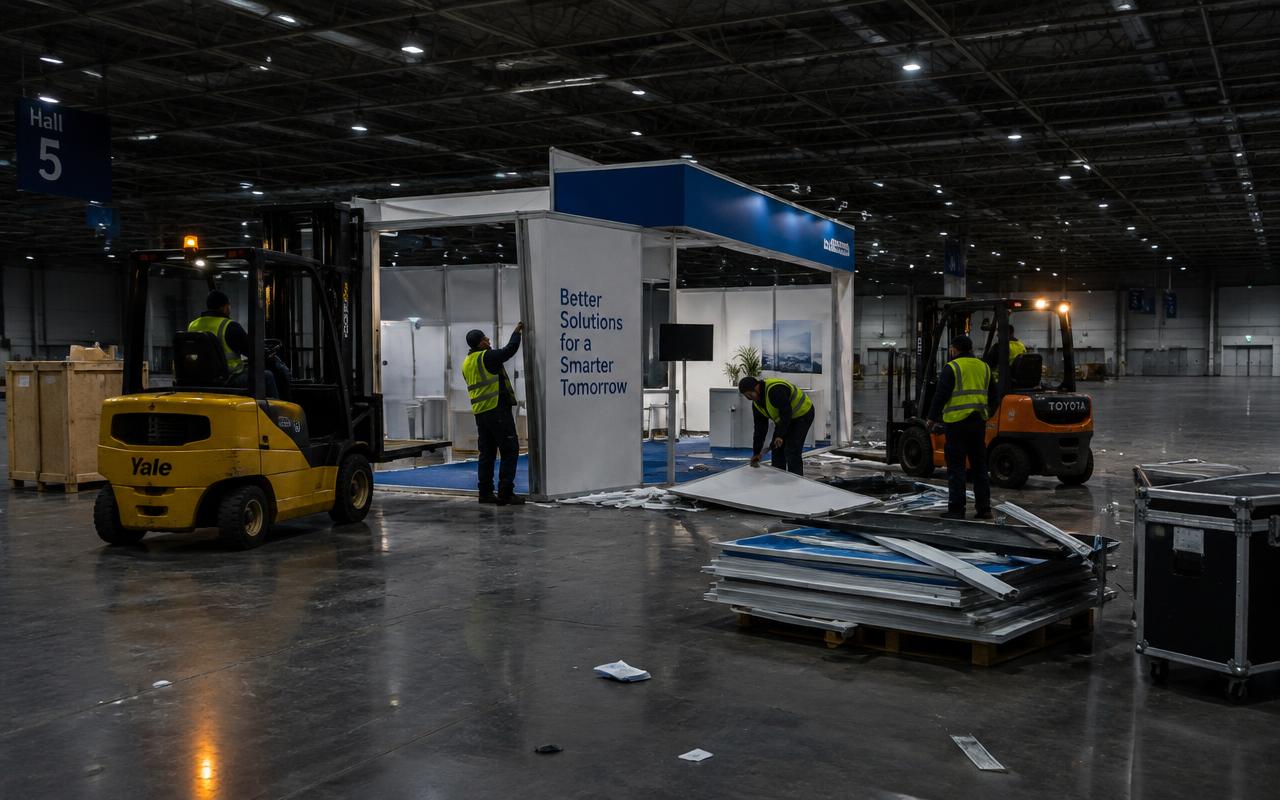
- The dismantle window is enforced and the labour to meet it is the dearest you will buy. Contract the strike with the build, not after it.
- Staff position is free to fix and changes footfall more than most design decisions. Nobody walks into a stand through a line of people.
The nine mistakes at a glance
None of these mistakes is exotic. They recur on every show floor, across every budget band, and experienced teams make them as often as first-time exhibitors — because each one is individually reasonable at the moment it is made. The brief is late because the space booking was late. Storage is dropped because display area felt more important. Lighting is trimmed because it is the easiest line to trim.
What they share is that the bill arrives later than the decision and in a different column: a late brief shows up as a rush charge, a missing specification as a stand that does not look like the render, a missing dismantle plan as a penalty. Read the table, then read the section on whichever row you recognise.
| Mistake | What it actually costs | The fix |
|---|---|---|
| Starting the concept on the booking plan instead of the real one | A second design, drawn under time pressure | Confirm dimensions, open sides and permitted height in writing before the first concept |
| Approving a render instead of a specification | Finishes you never chose, and two quotes you cannot compare | Approve a materials, finish and lighting schedule alongside the 3D view |
| No storage, so the cartons go on show | Cartons, bags and coats on display all show | Plan storage first and hide it behind the brand wall, where it costs no frontage |
| Lining the staff up at the front of the stand | The footfall you paid for, turned away at the threshold | Keep the open edge genuinely open and brief the team to let visitors come in first |
| Trimming the lighting line because it looked like a finishing touch | An expensive stand that photographs and reads as an inexpensive one | Budget lighting as its own line and aim every fixture at the workshop dry build |
| Giving every division a place on the wall | A stand that is busy without being informative | Pick the single message, and move everything else to counter level or a screen |
| Late artwork, and the reprint nobody budgeted for | A second payment for a surface you had already paid for | Fix an artwork deadline in the schedule and treat it as immovable |
| Having no plan for dismantle | A clearance charge, and assets you end up buying twice | Write the organiser's dismantle window into the schedule and label what comes back |
| Leads collected, follow-up unowned | The entire cost of the show, written off | Score leads the same day and make first contact within 48 hours |
Eight of the nine cost nothing to prevent. The ninth — lighting — costs a budget line, and it is still the cheapest visible improvement available.
A stand rarely fails at the venue. It fails at the brief, four weeks earlier.
1. Starting the concept on the booking plan instead of the real one
What people do: start the design as soon as the space is booked, working from the brochure plan. That document gives an area and nothing else — not the final position, not which sides end up open, not the column standing in one corner, not what the neighbour intends to build.
What it costs: a redesign. Open sides decide where the brand wall can go, where the entry is and how many finished faces you are paying for, so a concept drawn for an inline stand is not adaptable to a corner — it is replaceable. The second design is also the rushed one, which is where the real money goes.
The fix: one email, before anybody opens a sketchbook. Get the confirmed stand plan and this edition's exhibitor manual, and have the organiser state the exact dimensions, the open sides and the permitted height. Everything downstream is cheap to change once those three are fixed.
2. Approving a render instead of a specification
What people do: sign off a beautiful 3D view and treat that as the agreement. It is the natural thing to approve, because it is the only document in the pack that a non-technical stakeholder can read.
What it costs: the difference between the picture and the build, which is entirely in the detail a render does not carry. Laminate or spray finish, tensioned fabric or vinyl on board, eight lamps or three, a lit plinth or an unlit one — none of that is visible in a 3D view, and all of it is what separates one quote from another for the same image.
The fix: approve the render and a written schedule together — materials, finishes, graphic substrates, lamp count and type, flooring build-up and furniture list. For a custom build at ₹9,000–₹18,000 per sq.m, that schedule is what you are actually buying.
3. No storage, so the cartons go on show
What people do: treat storage as the lowest-value use of paid floor and leave it off the plan. On site it reappears anyway, as a gap behind a panel, the space under a counter, or a corner with a cloth thrown over it.
What it costs: visible clutter for the entire show, on the one asset you paid specifically to look good. Cartons, courier bags, laptop cases, water bottles, staff coats and leftover brochures all have to exist somewhere, and when there is no room for them they live in the sightline. It also costs time, because a team that cannot find the samples spends the show looking for them.
The fix: allocate storage first, at 10% of the stall area up to 18 sq.m and 15% above it — 5.4 sq.m on a 36 sq.m stand. Make it lockable, give it a shelf and a hanging rail, and put it behind the brand wall where it costs you no frontage at all.
4. Lining the staff up at the front of the stand
What people do: line the staff up at the front of the stand to greet people. It feels welcoming and proactive, and it is what an untrained team does by instinct when the aisle gets busy.
What it costs: precisely the footfall the stand was built to attract. A line of people at the threshold signals that entry means being approached, and most visitors avoid that by continuing down the aisle. Senior buyers avoid it most reliably, which inverts the whole purpose of the exercise.
The fix: move everyone inside — counter, demo point, meeting corner — and leave the edge clear. Brief the team to let a visitor take two steps in before speaking and to stand at an angle rather than facing the aisle down. Staffing numbers matter too: about 4 people suit a 36 sq.m stand, and anything more becomes a crowd you created yourself.
5. Trimming the lighting line because it looked like a finishing touch
What people do: rely on the hall lighting and whatever fixtures the organiser supplies, then spend the saving on more joinery or a bigger graphic. On paper it is the sensible trade: structure is permanent, lighting feels like a finishing touch.
What it costs: everything else you spent. Venue lighting is uniform, high and cold, so an unlit stand blends into the aisle and looks cheap irrespective of what the joinery cost. The eye reads quality as contrast, and contrast cannot come from a ceiling shared with the whole hall.
The fix: specify three layers rather than a lamp count — ambient to separate the stand from the aisle, accent several times brighter on the one or two things you want looked at, task light where people read. Aim the rig at the workshop dry build, not on site, and inspect it at show light levels before doors open.
6. Giving every division a place on the wall
What people do: accommodate everybody. Each product line, each certification and each division has a legitimate claim on the brand wall, and no individual request is unreasonable, so the wall ends up carrying all of them at the same size.
What it costs: comprehension, and therefore footfall. A visitor walking an aisle gives a stand a glance, not a reading. Five messages of equal weight resolve into none, and the stand becomes visually busy without becoming informative — which is the specific failure that makes an expensive stand feel cluttered.
The fix: choose. One line of five words or fewer, above head height, high contrast, stating what you make and who it is for — and a logo on its own does not qualify. The rest of the story belongs at counter level or on a looping screen, for visitors who have already decided to stop.
Exhibiting soon? Let's build your stall.
7. Late artwork, and the reprint nobody budgeted for
What people do: treat the artwork deadline as softer than the build deadline, because artwork feels like a file rather than a thing. The logo pack, the product shots and the final copy arrive in pieces, days after they were due, and often after print has been released.
What it costs: the same graphic, bought twice. Wide-format print is a single run, not a page you reprint for a few rupees, so a late change means a second print, urgent freight to reach the venue and a crew refitting it outside normal hours. None of those three lines existed in the quote you approved.
The fix: put one artwork deadline in the schedule with a named owner, collect brand assets in print-ready form at briefing rather than at production, and require a signed printer's proof. If copy is genuinely unsettled, design the layout so the uncertain element sits on a separate, smaller panel that can be reprinted alone.
| Reprint of the back-wall tensioned fabric graphic | ₹34,000 |
|---|---|
| Reprint of two side panels | ₹18,000 |
| Rush freight to the venue city | ₹7,500 |
| Night-shift crew to refit before doors open | ₹22,000 |
| Extra workshop handling and a day of floor space | ₹9,500 |
| Indicative cost of the rework, before GST | ₹91,000 |
These are illustrative numbers for a failure that costs nothing to prevent. Because the graphics had already been produced and paid for, the whole table is rework, and it lands in the week when there is least time to absorb it.
8. Having no plan for dismantle
What people do: give the build four weeks of attention and the dismantle none. By the time it matters the show is finished, the team has travelled home, and the task falls to whoever is still reachable on the last night.
What it costs: penalties, and reusable assets. Organisers set a dismantle window and charge for space not cleared inside it, and a crew assembled at short notice on the busiest night of the hall's year is the most expensive labour you will buy all year. Worse, modular frames, screens, furniture and graphics that were meant to serve the next three shows get skipped or damaged, so you pay for them again.
The fix: buy dismantle, clearance, return freight and storage as part of the build, not as an afterthought, and put the manual's window into the project schedule. Decide before the show what is coming back, label it on site, and hand the inventory to whoever briefs the next participation.
9. Leads collected, follow-up unowned
What people do: work hard at capture and leave contact to chance. The cards or the spreadsheet come home, the team returns to its normal workload, and the first calls go out the following week in whatever order someone finds time for.
What it costs: every rupee already spent. Space, design, build, freight, travel and staff time are irrecoverable once the hall closes; follow-up is the only remaining line that can still return something, and its value falls by the day. By the next week the visitor remembers a hall full of stands, not yours, and the call performs like a cold one.
The fix: agree two qualifying questions before the show, score every lead the same day while the notes still mean something, and make first contact within 48 hours from the person the visitor met.
Exhibition stand builders: the failures a general checklist misses
Beyond the universal nine, this kind of work has its own recurring failures. They matter because a general events checklist will not catch them, and because the people buying this service — exhibitors, procurement teams and agencies who need a stall built on time, to drawing, and safely at the venue — are usually judging the quote on price when the real variable is scope.
Sub-contracted builds with no quality control is the one to interrogate first. It is a procurement question rather than a design question, and the way to settle it is to ask who physically does the work, in whose workshop, with which crew, before comparing any two prices. Raise the rest at quoting stage, because every one of them is invisible until it is expensive.
- Sub-contracted builds with no quality control — ask for the specific control that stops it, and who signs it off.
- Non fire-retardant materials rejected at the venue — ask how this is prevented, and get the answer in the quote rather than in a conversation.
- Late arrival on site that eats into build-up time — ask for the specific control that stops it, and who signs it off.
- Hidden extras for electrical, carpet or dismantling — ask for the specific control that stops it, and who signs it off.
The prevention list
There is no clever process here. The nine mistakes are prevented by doing six ordinary things in the right order, early enough that each one still has options. The reason they are not done is almost always that the schedule started too late, which is why lead time is the first thing to fix: 3 weeks for a small stand, 4 from 24 sq.m and 5 from 54 sq.m, with more for a double-decker or a pavilion that needs structural sign-off and organiser approval.
01
Itemise the quote line by line
Structure, graphics, lighting, flooring, furniture, transport both ways, crew, dismantle, clearance and taxes as separate lines, with exclusions named in writing.
02
Lock the artwork date
One deadline, one named owner, print-ready assets collected at briefing, a signed printer's proof before release. This is the cheapest line of insurance on the project.
03
Rehearse the floor plan with the team
Where each person stands, who opens a conversation, who demonstrates, who captures the lead, and where the bags go. Twenty minutes, the evening before doors open.
04
Put one name against the project
A single project manager with a weekly status line from brief to dismantle. Most of these failures are not failures of skill; they are items nobody owned.
05
Agree the strike and the follow-up in advance
Dismantle window, what comes back, who stores it, who contacts every lead and by when. Both belong in the plan written before the show, not in the week after it.
06
Get the paperwork before the design
Confirmed stand plan, exhibitor manual, build height, rigging rules, open sides, build-up and dismantle windows. Ten minutes of reading, and it removes two of the nine outright.
Check your current quote against this page
If you already have a design or a quote in hand, the fastest check is to read it against this page. Does it name materials and finishes? Does it count lamps? Does it allocate storage? Does it include transport, installation, dismantle, clearance and taxes as separate lines, or is it a single figure? A lump sum is not a cheaper stand; it is an unspecified one.
Give us the show, city, dates, area and open sides — and the quote you already have, if there is one — and we will itemise the comparison and draw a concept. 3D design comes free with a confirmed fabrication order, fabrication is in-house, organiser drawings and approvals are handled, and dismantle and clearance sit in the same scope as the build.
Frequently asked questions
What is the single most common mistake on exhibition stand builders projects?+
Starting too late. A compressed schedule causes most of the others: no time to read the exhibitor manual, no time to specify materials properly, no time to rehearse, and rush charges on everything that has to be redone.
How much storage does a stand need?+
Plan 10% of the area up to 18 sq.m and 15% above it — about 5.4 sq.m on a 36 sq.m stand. Make it lockable and put it behind the brand wall so it costs no frontage.
Can these mistakes be fixed once the show has started?+
Three of them can: move the team off the open edge, cut the wall down to one message with whatever you have on the stand, and start scoring and contacting leads the same evening. The rest are decided before build-up.
How do I protect myself from hidden charges?+
Ask for an itemised quote that names transport both ways, installation, on-site crew, dismantle, clearance, electrical fittings and GST as separate lines, and confirm in writing what is excluded. For a custom build the structure runs ₹9,000–₹18,000 per sq.m; everything else should be visible beside it rather than folded into it.
How early should the brief go out?+
Allow 3 weeks for a small stand, 4 from 24 sq.m and 5 from 54 sq.m, and more where structural sign-off or organiser approval is involved. Earlier than that buys options; later than that buys rush charges.
What should I do if artwork will be late?+
Tell the fabricator immediately and design around it by isolating the uncertain content onto a smaller, separately printed panel. A planned small reprint costs a fraction of an unplanned large one.
Is a render enough to approve a stand?+
No. Approve the render together with a written materials, finish and lighting schedule. Without it, two vendors are quoting different stands from the same picture and neither can be held to the look you signed off.
Exhibition Stand Builders near you
Our crews deliver exhibition stand builders in every major Indian city.