By the Exhibition Stall Design editorial team · Updated 1 October 2026 · 14 min read
Short answer
For event management company, confirm in this order: the brief, area, open sides, height limit and budget; the design, with materials and electrical load specified; organiser approval, certificates and print-ready artwork; the pre-dispatch inspection and loading list; the build-up sequence and a signed handover a day before doors open; the daily show-day checks; and dismantle, clearance and lead follow-up. The failure mode is always the same — an item that was assumed rather than evidenced — so ask for a photograph, a certificate or a signature instead of a reassurance.
Key takeaways
- Tick items on evidence — a photograph, a certificate, a signed list — never on a reassurance.
- Confirm transport passes, unloading slots and build-up access hours in writing; venue rules decide your real working time.
- The pre-dispatch inspection is the last cheap place to fix anything. Once the truck leaves, every fix is a site fix.
- Seven phases, in order: brief, design sign-off, approvals and pre-production, pre-dispatch, build-up, show days, dismantle.
- Review weekly, and ask what is now unblocked rather than how much has been done.
- Write deadlines as weeks before the show rather than as dates, so a change of show date does not silently invalidate the plan.
Working this event management company checklist
One accountable team plans, designs, builds and runs your event — venue, stage, AV, branding, logistics, guest flow and show-calling — so you only focus on your guests.
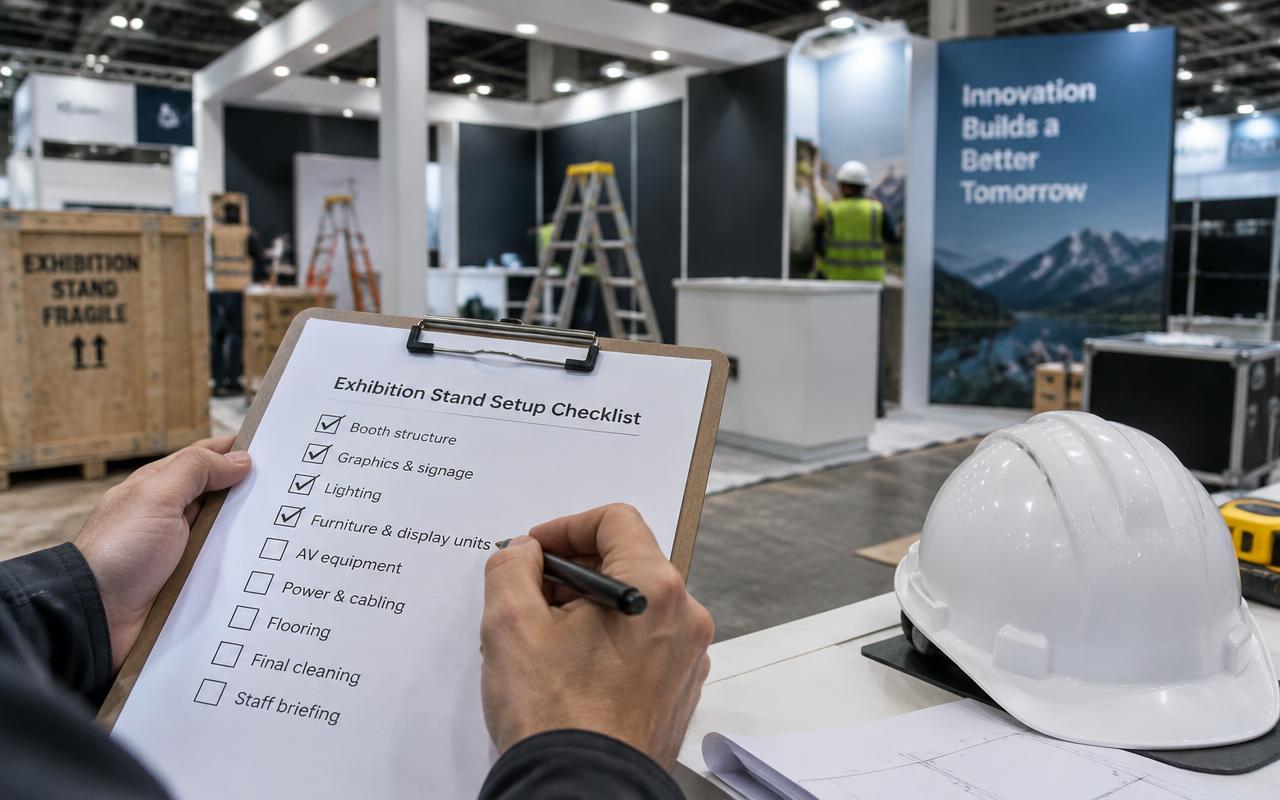
There are two kinds of checklist. One is a list of topics, which makes everybody feel organised and catches nothing. The other states what has to be true and what happens if it is not. This is the second kind, which is why each line is a sentence rather than a heading.
The items are grouped into seven phases that run in order, and each phase has a condition that has to be true before the next begins. The discipline that matters is not completing a phase — it is refusing to start the next one until the condition holds. Almost every show-week disaster is a phase that was allowed to start early: production released before drawings were approved, graphics printed before artwork was final, a vehicle dispatched before anybody had looked at the build.
Written for large exhibitors, government bodies, export councils and multinationals who want a single accountable partner for the whole participation, and deliberately not written for a particular size of stand. A 9 sq.m stand has fewer items in each phase than a pavilion, but it has the same phases, the same gates and the same two owners — one on your side, one on the build side.
01
Phase 1 — Brief, area and budget
Done when somebody could brief a designer without asking you a question. If the area, the open sides, the height limit, the budget and the one outcome are not written down, they will be invented later by whoever is closest to the deadline.
02
Phase 2 — Design and specification sign-off
Done when there is a version number everybody is agreeing to, a finish schedule standing behind the render, and no stakeholder left who has not yet seen it.
03
Phase 3 — Approvals, artwork and release
This is the phase with the queues in it. It ends when approvals are back rather than submitted, certificates exist rather than being arranged, and artwork is final rather than imminent.
04
Phase 4 — The pre-dispatch check
Finished when the snag list is closed and re-walked, the load is labelled against the drawing, and the spares are packed on purpose rather than from memory.
05
Phase 5 — Assembly on site
Closes when the stand is complete, powered, cleaned, lit and handed over inside the organiser's window, with the snag list signed and the dismantle plan already agreed in writing.
06
Phase 6 — Running the show days
Runs until the last visitor on the last day, repeating one short morning list: lights, screens, stock, cleaning, lead capture and a staff briefing. Stands fail on day three, not day one.
07
Phase 7 — Dismantle and follow-up
Closes when the space is cleared inside the organiser's deadline, deposits are released, reusable elements are back in storage and labelled, and every lead has been followed up.
Who owns each stage, and when it is due
Dates slip because stages have no owner, not because people are careless. The table below is the spine of the project: one line per stage, one accountable party, and a deadline expressed in weeks before the show so that it survives a change of date. If the show moves, you move the column rather than rewriting the logic.
The useful column is the right-hand one. It tells you which slips are survivable and which are not, and the answer is rarely intuitive: the glamorous decisions are usually floatable, while the paperwork is what everything else is standing on.
| What has to close | Owner | Deadline | Blocked until it does |
|---|---|---|---|
| Brief, area, open sides and budget | Exhibitor marketing lead | 6 weeks | Everything — no concept can start without a footprint |
| Show, hall and stand number checked against the floor plan | Exhibitor, with the organiser | 6 weeks | Transport planning, crew sizing and how many sides the design must finish |
| Organiser drawing submission and stamped approval | Project manager, exhibitor counter-signs | 4 weeks | Production release, rigging, height and any raised structure |
| Structural and fire certification where required | Fabricator, with a licensed engineer | 4 weeks | Double-deckers, staircases, hanging rigs and clearance at the gate |
| Power, water and internet ordered from the organiser | Project manager | 4 weeks | The published rate, and sometimes availability altogether |
| Print-ready artwork at final size | Exhibitor brand team | 3 weeks | Every printed surface, which is most of what a visitor sees |
| Production release to the workshop | Project manager | 3 weeks | Fabrication, finishing and the pre-dispatch date |
| Long-lead items ordered: screens, specialist lighting, imports | Project manager | 3 weeks | The build itself, if the stock is committed elsewhere |
| Furniture, AV, flooring and plants confirmed | Project manager | 2 weeks | Delivery slots, which are allocated in the order they are requested |
| Pre-dispatch inspection and snag closure | Workshop QC, exhibitor on a video call | 10 days | Dispatch — nothing loads with snags still open |
| Handover inspection, signed | Project manager and exhibitor together | Show day −1 | Your right to have snags fixed before doors open |
| Dismantle, clearance and deposit release | Project manager | Agreed before build-up | Return of reusable elements, and your deposit |
These are defaults for a standard custom stall. A bigger or more heavily finished stand pushes every row earlier, by exactly what the planner's formula adds: +1 from 24 sq.m, +2 from 54 sq.m, +2 premium, +2 double-decker, on a 3-week base.
Phase 1 — the brief, and the budget behind it
Get this phase right and the rest is administration. Get it wrong and every subsequent decision is made on a guess. The brief is a list of constraints and one outcome, not a mood board, and it should be short enough to fit on a page.
Before anything is drawn, agree what good looks like: a participation plan where every touchpoint, from the pavilion entrance to the VIP lounge, is designed to move visitors toward a meeting. That single line settles a surprising number of later arguments, because most design disagreements are actually unstated disagreements about what the stand is for.
- The products that will actually stand on the stand, with their weight and dimensions — a machine that will not fit through the hall door is a problem with no on-site solution
- Build-up, show and dismantle dates with the access hours attached — your usable build time is set by the organiser, not by your plan, and night-shift labour is priced differently
- Brand assets at print resolution, with logo variants and Pantone or CMYK references — a low-resolution logo pulled off a website is the most common reprint there is
- Stall area in square metres and the number of open sides — three open sides means three finished faces, three lighting runs and more staff than an inline stand of identical area
- Who will physically staff the stand, and whether they are free every show day — a roster agreed in week one avoids a stand run by whoever happened to be available
- Show name, city, venue, hall and stand number — crews have arrived at the right venue and the wrong hall, and an hour lost at two in the morning is an hour off your finishing time
- Budget band and exactly what it has to cover — a figure that silently excludes transport, installation, dismantle and taxes is not a budget, it is a deposit
- The single visitor action that matters most: a demo, a meeting, a sample or a signature — stands designed around three competing actions deliver none of them well
Phase 2 — signing off the design properly
There are two gates here, and skipping the second is the most common expensive mistake in the whole process. Liking the design is the easy one. Confirming it is buildable, compliant, transportable and affordable is the one that prevents a redesign in week four.
This is the last cheap place to change your mind, and it is worth spending an extra day here rather than an extra week later. Moving a counter on a drawing takes a minute; moving it in a workshop costs material; moving it in a hall costs a night shift and whatever the crew happens to be carrying.
- A written note of what was rejected and why, so the same idea does not return in week five as a fresh suggestion
- A deliberate decision about what the stand does not do, written down, so scope does not grow quietly through the approval chain
- Electrical load added up circuit by circuit and declared to the organiser, with the point of supply located on the plan
- Every graphic panel checked for text size and safe margins, because type cropped at a panel join cannot be fixed at the venue
- Visitor circulation checked on the plan: where somebody enters without committing, where they stop, and where your team stands without blocking the entrance
- A meeting area decided deliberately rather than by accident — 5% of the area by default, and more only if you are actually hosting meetings, because a meeting corner added after sign-off comes straight out of display space
- Weight and fixing method for anything hung, shelved or cantilevered, agreed before it is drawn rather than after it is built
- Ramp, threshold and turning space checked on the floor plan — accessibility is easy on paper and impossible to retrofit
An unowned item is an item nobody is doing.
Phase 3 — approvals, artwork and release
The work here is mostly waiting, and waiting is the hardest thing to manage because it generates no alarm. Submit early, chase deliberately, and treat every outstanding approval as a stopped production line rather than as an administrative loose end.
Treat the organiser's rulebook as a design input rather than a formality. Height limits, rigging permissions, fire ratings, floor loading, setback and the dismantle window are not negotiable on site, and a resubmission after a rejected drawing costs a working week that nobody has budgeted for.
- Payment milestones aligned to the production schedule, so finished work is never held at a workshop over an invoice during the last fortnight
- A structural engineer's certificate wherever there is a double-decker, a hanging structure, a staircase or a raised platform that carries people
- Fire-retardant certificates for every material entering the hall, carried physically by the site crew — uncertified material gets turned away at the gate, and the gate is not a place to argue
- Drawings submitted in the organiser's required format, and the stamped approval received back — a submission is not an approval, and the gap between them is a queue you share with the whole hall
- Vehicle, driver and crew details submitted for passes in the format the venue's security desk accepts
- Rigging and hanging-banner permission confirmed against the hall's actual hook positions rather than assumed ones
- Power, water, compressed air and internet ordered from the organiser inside their deadline, while the published rate still applies
- Floor loading checked against the hall's limit for anything heavy — a machine, a vehicle, a water feature or a fully stocked store
Event Management Company scope: the lines that must be in your order
Itemise or you cannot check. The two failures a lump sum conceals are paying twice for the same thing and paying for nothing at all, and both are discovered on site, where neither can be fixed cheaply.
Confirm the service scope first, then go hunting for the omissions. Freight, crew, strike and tax between them account for most of the gap between two quotes that look like they describe the same stand.
- Concept, budget and run-of-show planning — ask what happens if it fails on day one — whether a spare exists, and who is carrying it
- Venue scouting and permissions — confirm it is priced inside the figure you are comparing, rather than noted as available on request
- Stage, AV, lighting and decor in-house — name it in the order with a quantity against it, not only in the render — line items are what site crews work from, and renders are not contractual
- On-ground crew and show-calling — pin the material and the finish code, because "as per design" is not a specification a workshop can cut to
- Electrical fittings, distribution and the labour to connect them, which are frequently a separate trade and a separate bill
- Storage of reusable elements between shows, and who pays for it
- Reprints and small changes after sign-off, priced now rather than negotiated under pressure later
- Transport to the venue and back, with the vehicle type and the number of trips stated
- Cover on every show day — who answers if something fails at nine in the morning, and how long they take to arrive
Exhibiting soon? Let's build your stall.
Phase 4 — the pre-dispatch inspection
On a turnkey or pavilion project the pre-dispatch check runs twice: once per booth and once across the whole programme. Each co-exhibitor unit is assembled, photographed and snagged on its own, and then the pavilion is checked as a single object — consistent fascia treatment, consistent graphic sizing, matching flooring, one signage system, one colour. Inconsistency between booths is the failure visitors notice first and the one no individual vendor will ever report.
The test to apply is simple. Would you be happy for a buyer to walk onto this, right now, in a workshop, with the lights on? If the answer is no, the snag list is not closed and nothing should be loaded. Dispatch is a decision, not a date, and the only person who benefits from treating it as a date is whoever is behind schedule.
- Graphics checked against the final approved artwork file, not against the version that was approved three revisions ago
- A named person travelling with the load who has the authority to decide if something goes wrong on the road
- The load secured and sheeted for the actual journey, since a scratched laminate costs far more to repair on site than it did to make
- A copy of the packing list held by the exhibitor too, so a missing crate can be identified by somebody other than the person who mislaid it
- Fixings, spare laminate, touch-up paint, spare lamps, cable and tools packed deliberately rather than remembered at the last minute
- Photographed from every side and shared with you for written approval — you do not have to be in the workshop, but you do have to see it
- All lighting powered up and run in — a failed driver found in the workshop is a spare part, and the same driver found on site is a dark brand wall
- Assembled or part-assembled in the workshop with graphics mounted, so alignment problems surface before dispatch rather than at midnight in a hall
Phase 5 — build-up at the venue
Across a pavilion or a multi-booth programme, build-up is traffic management before it is anything else. Vehicles, crews and deliveries for every unit arrive into the same dock in the same hours, so the schedule has to be sequenced centrally and then held against pressure from whoever shouts loudest. One booth running late does not stay one booth's problem.
Everything in the table below is an ordering decision rather than a quality decision. Each row is finished before the next one starts, and the cost of getting the order wrong is in the final column. None of those costs are theoretical; they are the standard way a build-up goes late.
| Sequence | Condition to move on | Consequence of moving on early |
|---|---|---|
| Dock scheduling | An arrival slot per unit, so vehicles do not queue outside the access window | Whole-hall delays no single vendor has the authority to unblock |
| Common areas first | Pavilion entrance, lounge, stage and signage positioned and built | Co-exhibitor units built into the floor the entrance needed |
| Co-exhibitor units | Every booth assembled, powered and graphic-checked against one specification | Booths that look like different brands happened to buy adjacent floor |
| Services and hospitality | Power, internet, water, furniture and catering live in each unit | Exhibitors arriving to a booth they cannot actually work from |
| Single snag register | One list for the whole pavilion, owned by one person, closed in priority order | Twenty exhibitors raising twenty snags separately in the opening hour |
| Briefing the exhibitors | Each co-exhibitor shown their unit, its services and who to call | Exhibitors phoning the organiser because nobody told them who runs the pavilion |
Finish a day early on purpose. The last day of build-up is the only slack the project has, and spending it on contingency rather than on construction is the difference between a calm opening and a visible one.
Phase 6 — the daily show-day list
The hard part of show days is not effort but repetition. The same few checks every morning, by one named person, is what keeps a stand looking like its first day for the whole run.
Staff numbers are a calculation rather than a preference — area divided by 9, minimum two, giving roughly 4 for 36 sq.m and 8 for 72 sq.m. Get it wrong in either direction and the lead count falls for opposite reasons that look identical in a report.
- Stock, samples and brochures replenished from storage before the hall fills, not at lunchtime across a crowded aisle
- Phones charged and out of hands. Staff looking at phones is the most reliable way to make a busy stand look empty
- Meetings booked into slots rather than taken as they arrive, so the stand is never blocked by one long conversation
- Somebody counting conversations, qualified leads and meetings each day, so the show can afterwards be judged against something
- The stand cleaned and reset every morning — fingerprints on an acrylic panel are visible from the aisle and read as neglect
- A five-minute debrief each evening: what visitors asked for, what they walked past, what to move or say differently tomorrow
- Open-of-day check: every lamp, screen, demo unit, light box and charging point working, done before doors open rather than after the first complaint
- A headline message legible from the aisle. If a passing visitor cannot tell what you sell in three seconds, the stand is not working however good the joinery is
Phase 7 — taking it down, and cashing it in
Dismantle is agreed before build-up or it is not really agreed at all. Organisers run a hard clearance deadline and charge for overstay, venues withhold deposits, and the crew who built your stand are by then building somebody else's in another hall. Decide in advance what is coming back, what is being scrapped, who is driving it and where it is going.
The week after the show is where the return on the whole exercise is won or lost. A stand that produced three hundred conversations and no follow-up is an expense rather than an investment, and the cost of that failure is larger than anything else on this page.
- Reusable elements — frames, graphics, counters, furniture, screens — inventoried and labelled as they come out, because unlabelled stock is stock you will rebuild next time
- The space cleared inside the organiser's deadline, with the deposit release confirmed in writing rather than assumed
- Hired items returned and signed off, so rental days stop accruing on somebody else's ledger
- Products and samples packed by the people who own them, before a crew starts dismantling around them
- An internal debrief inside a fortnight, while the people who stood on the stand still remember what happened on it
- Waste removed rather than left in the aisle, because clearance charges are billed to whoever the organiser can identify
- Leads scored and followed up within 48 hours, while the conversation is still remembered on both sides of it
- Photographs taken on the first morning before the crowd arrives — an empty, lit, clean stand is the only usable image you are going to get all week
Where checklists usually fail
A checklist fails in one of three ways: nobody owns it, it lives in two places, or it is ticked optimistically. The third is the dangerous one. "Graphics are being printed" is not the same statement as "graphics are printed, proofed and crated", and the difference between them only becomes visible on the night of build-up.
The recurring problems on this kind of work are specific. Too many vendors with no single point of accountability, and inconsistent branding across co-exhibitor booths. Neither is discovered by looking at a render; both are discovered by asking who does the work and where.
- Delayed approvals that compress build-up time
- Too many vendors with no single point of accountability
- Inconsistent branding across co-exhibitor booths
- Budget overruns from scope that was never itemised
- The exhibitor manual filed unread, which is where most of the week's surprises were written down in advance
- No named owner for the final 48 hours, when every remaining task is urgent and nobody has the authority to choose between them
- Items ticked on intention rather than evidence — ask for a photograph, a certificate or a signed list instead of a reassurance
- Optimism about transit time, which is the one variable nobody controls and everybody underestimates
- Two copies of the checklist, one with the exhibitor and one with the vendor, quietly diverging from about week three onward
Next step: a checklist with your dates on it
Share your show name, city, dates, stall area, number of open sides and two or three reference images. That is enough for a concept, an itemised event management company scope and a dated version of this checklist mapped to your show rather than to a generic calendar, usually within 48 hours.
We design free with every confirmed fabrication order, fabricate in our own workshops, prepare the organiser drawings and approvals, and put one project manager on the job from brief through to dismantle — which is the only reliable way a list like this gets closed rather than filed.
Frequently asked questions
Who should own the checklist?+
One person on your side and one named project manager on the build side, reviewing a single shared copy every week. Two copies in two inboxes is functionally the same as no checklist at all.
Can you run this checklist for us?+
Yes. Every confirmed order gets a named project manager who owns the schedule, the organiser submissions, the pre-dispatch inspection, build-up, handover and dismantle, and who reports against this list weekly rather than when asked.
Do I need to attend the pre-dispatch inspection?+
Not in person, but you should see photographs from every side and sign off the closed snag list before anything is loaded. It is the last point at which a fix costs a fitter and twenty minutes rather than a van, a pass and a night shift.
Who signs the handover?+
The project manager and somebody from your side, together, walking the stand with the snag list in hand. A handover nobody signed is a handover you cannot refer back to while something is still outstanding.
What goes wrong most often on site?+
Sequence. Graphics before the frame is square, electrical after the walls are closed, cleaning before the last fitting is done. The structure is rarely the problem; the order the trades work in usually is.
How long before doors open should the stand be finished?+
A full day, if the organiser's build-up window allows it. That day is your only buffer for a wrong panel, a failed driver or a late furniture delivery, and handing over the night before leaves you none.
What is the item people most often miss?+
Print-ready artwork at final size. The printing itself is quick, but every printed surface waits behind final artwork, so a week lost there moves the whole production schedule and usually the dispatch date with it.
Is an event management company checklist different for a small stand?+
The phases are identical; the number of items in each is smaller. What does not shrink is the approval and artwork work, which is why small stands run late for exactly the same reasons large ones do.
Event Management Company near you
Our crews deliver event management company in every major Indian city.