By the Exhibition Stall Design editorial team · Updated 1 October 2026 · 13 min read
Short answer
Pick a custom exhibition booths partner on four things: who physically produces the work, what evidence exists that they have delivered at your size, whether the quote is itemised against a written exclusion list, and who will be standing on your stand during build-up. A supplier who answers all four with specifics is a safer buy than one who is noticeably cheaper and vague on any of them.
Key takeaways
- Approve dimensioned drawings, not renders, before fabrication starts. A render shows intent; a drawing is what the workshop cuts to.
- The biggest drivers of a custom exhibition booths quote are stall area in square metres and number of open sides and finish level (laminate, paint, veneer, acrylic, metal), so settle those before you brief anyone.
- Check the promise against the published lead time: 3 weeks is the base for a custom build, and it grows with area.
- Ask what the quote excludes. The answer to "is everything included?" is always yes, and never useful.
- Photographs of finished, occupied stands prove a builder. Renders alone only prove a designer.
- Ask who physically does the work before you ask what it costs — it is the answer that predicts every other one.
Why this decision deserves an hour of your time
This guide is for exhibitors, procurement teams and agencies who need a stall built on time, to drawing, and safely at the venue. It assumes the hard part is not finding someone who will quote — a dozen firms will quote within a day of your enquiry — but working out which of them actually controls the work they are selling you.
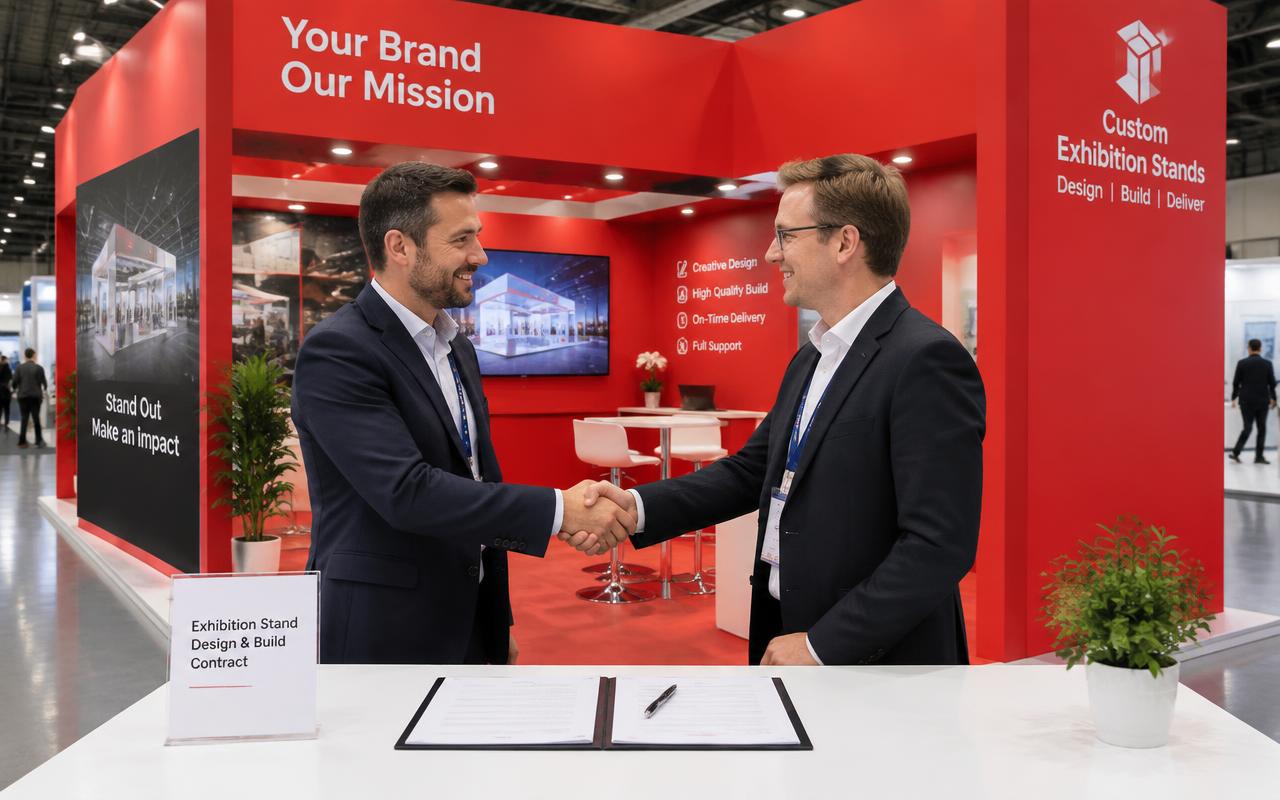
Bespoke booths with unique shapes, finishes and lighting that make your brand the landmark of the hall.
Most purchases allow a remedy: you return the item, withhold payment, or try again next month. A stand allows none of that. It is judged once, on one morning, by people who will not come back. That asymmetry is the whole argument for spending your effort on the supplier rather than on the discount.
Who physically does the work
The single most useful question in custom exhibition booths procurement is who physically does the work. The market holds two kinds of firm that look identical on a website: companies that own the capability they are selling, and companies that take your order and place it with somebody who does.
Reselling is not the problem in itself — coordination is a genuine skill, and some of the best work on any exhibition floor was bought in rather than built in-house. The problem is what you cannot see. A firm that does not hold the production slot cannot tell you where your job is, cannot absorb a delay, and ends up doing its quality checking in the hall. That is the root of the familiar custom exhibition booths failures: sub-contracted builds with no quality control; non fire-retardant materials rejected at the venue; late arrival on site that eats into build-up time; hidden extras for electrical, carpet or dismantling.
Finding out is simple. Ask to see the workshop, prep bay or studio where your job will be produced, and ask for the name of the person who will supervise it. A firm that owns the capability answers with an address and a date. A firm that does not offers photographs, a visit "closer to the time", or a reason why a visit is not possible.
- Ask whether the design, the build and the site crew all report to the same project manager
- Ask how many other jobs are in the queue for your show week
- Ask what happens to your schedule if a larger client books the same production week
- Ask what the firm delivered last season at roughly your area, at a show it is willing to name
- Ask for the mobile number of the person who will be on site, not of the person selling to you
- Ask whether print, joinery and metalwork happen under one roof or in three different places
- Ask who signs off the dry build in the workshop before anything is loaded
A supplier who cannot show you the workshop is asking you to trust a schedule they do not control.
How the two kinds of firm behave differently
You can tell most of it apart from the outside. Use the table as a side-by-side for two shortlisted firms: work down it on a call and the gap usually appears inside ten minutes.
Weight the rows by what your show actually has to achieve — a stall layout with a clear entry, a working demo counter, storage that keeps the floor clean, and a closed meeting area for serious buyers. The rows that bear most directly on that are capability, drawings and on-site accountability, which is also the order in which they tend to be neglected.
| What to verify | A real supplier | A reseller, or a risk |
|---|---|---|
| On-site accountability | One named project manager on site through build-up and show days | A phone number that changes between build-up and show open |
| Materials | Names the board, the finish and the fire treatment in the quote | Says "premium quality" and leaves the specification open |
| The quote | An itemised scope, line by line, with the exclusions written down | A lump sum, or a figure quoted before the brief has been understood |
| Drawings | Dimensioned plans and elevations you approve before cutting begins | Fabrication starts from a render and a verbal brief |
| Schedule | Dated milestones from drawing release to dispatch that you can hold them to | A delivery week, with no stages in between |
| Workshop quality control | Dry-builds and tests the stand before dispatch, and will show you proof | First assembly happens on your stand, in the hall |
| Evidence of past work | Photographs of finished, occupied stands at a comparable size and finish | Renders only, or photographs with no show, area or date attached |
| After the show | Dismantles inside the organiser's window and stores reusable elements | Leaves clearing, storage and penalties undefined |
Every row here is verifiable before you sign anything. If a supplier scores well on price and badly on three of these rows, the price is not the number you think it is.
How to read a custom exhibition booths quote
A quote is only a price if you know what it buys. Two firms given one brief will often land far apart, and the reason is hardly ever a cheaper method — it is a smaller scope. Make them both itemise against one list and the difference stops being mysterious.
From ₹10,000 per sq.m for premium custom builds. Where a per-square-metre rate appears, from ₹10,000 per sq.m is the published figure for the build element of this service, and the published custom fabrication band across this site is ₹9,000–₹18,000 per sq.m. Anything well below the band is quoting a different specification, not a better deal.
The useful question is what has been left out. Four lines go missing more often than any others: the venue power connection and fittings, the flooring, the transport home, and the dismantle. Every one of them is compulsory in practice, which is exactly why leaving them out makes a quote look competitive.
- Unique architectural forms
- Premium laminates, acrylic and metal finishes
- Integrated storage and AV
- Backlit brand walls
- Flooring, carpet and cable management
- Furniture, planters and anything hired rather than built
- Electrical fittings, distribution and the venue power connection
- Graphics — print area, substrate, and what a reprint would cost
- Storage of reusable elements between shows
- Technical drawings and the organiser submission
- Dismantle and clearing the stand inside the organiser's window
What a lump sum hides: a worked example
Two suppliers quote the same 36 sq.m brief. One returns an itemised quote; the other returns a lower lump sum described as all-inclusive. The lines below are the scopes that lump sum turned out not to cover — each of which had to be bought anyway before the hall opened.
₹2,17,000 later, the lump sum was the more expensive quote. The second cost is harder to see: every one of these lines was bought in a show week, from whoever still had capacity, which is the worst possible moment to be a buyer.
| Electricals — connection, distribution and light fittings | ₹38,000 |
|---|---|
| Raised platform, carpet and cable management | ₹43,000 |
| Transport to the venue and back | ₹52,000 |
| Dismantle and clearing within the organiser's window | ₹29,000 |
| An extra shift to finish inside the build-up window | ₹24,000 |
| Hired furniture — counters, seating, planters | ₹31,000 |
| Bought later, outside the lump sum | ₹2,17,000 |
Illustrative figures on a 36 sq.m brief. The point is the pattern rather than the amounts: the items missing from a lump sum are precisely the ones you cannot decline. Ask for each to be priced in or priced out explicitly, in writing, before you compare totals.
The checks that turn a conversation into a contract
Each of these takes one request and one careful reading. Together they are the difference between a contract and a hope, and all of them can be done inside a week without specialist knowledge.
01
Establish the show-day cover
Find out who is on the floor during show hours, how quickly they can reach your stand, and what spares travel with the crew. Lamps fail, laminate chips and power trips; the only real question is whether anybody planned for it.
02
Read the storage and reuse terms
If elements are meant to come back for the next show, agree now who stores them, who pays for the storage, and what condition they are returned in. Reuse that was never documented has a habit of becoming a fresh build next year.
03
Name the people who will be on site
Get the project manager's name and mobile number, the crew size, and the hours they will work during build-up. "Our team will be there" is not an answer. A name, a number and a shift pattern is, and it predicts how build-up morning goes better than anything else in the file.
04
Confirm the dismantle and clearing scope
Ask who strikes the stand, whether it happens inside the organiser's window, what gets removed and where the reusable elements go. Dismantle is the scope most often left unpriced, and the one where deposits and penalties actually land.
05
Verify insurance and site compliance
Ask what cover the crew works under and what safety documentation the venue requires from a contractor. It is a dull question with a revealing answer: firms that work in halls regularly have the paperwork ready, and firms that do not have to go and find out.
06
Settle the change-order process
Agree in writing what a variation costs, how it gets quoted, and who on each side may authorise one. Verbal agreements made on the floor during build-up are the largest single source of invoices nobody remembers approving.
07
Write the exclusions down
Whatever is not included goes into the quote as an exclusion list, signed by both sides. That single page prevents the most common post-show dispute, which is almost never about build quality — it is about who agreed to pay for electrical, flooring or clearing.
Exhibiting soon? Let's build your stall.
Contract terms and payment milestones that hold
Write the contract around evidence. Each payment should answer the question "what do I have in hand if this stops here?" — which is a different and much better question than "what week are we in?"
Hold something back until after handover. This is not about distrust — it is the only thing that reliably keeps a crew available on show morning for the lamp that will not light and the panel that chipped in transit. A supplier paid in full the day before has no remaining reason to be in the hall.
| Milestone | What must exist before you release it |
|---|---|
| On workshop sign-off | Photographs or video of the dry build, panels numbered and circuits tested |
| After dismantle | The stand cleared inside the organiser's window, reusable elements in storage and the deposit released |
| On order | A signed scope with the exclusion list attached, and a dated production schedule |
| On show close | Show-day support delivered, and any variation already priced in writing |
| On dispatch | A loading list and panel numbering you can check against the drawing |
| On organiser submission | Drawings, electrical load and material certificates lodged, with the acknowledgement shared with you |
Whatever split you agree, put the variation process in the same document. Milestones control the planned work; the change-order clause controls everything else.
Match the supplier to the size of the job
Capability is size-specific. A firm that turns out neat 12 sq.m system booths all season may never have engineered a two-storey structure, and a firm geared to large pavilions will quote a small stand as though it were one. Ask for the largest and smallest they actually delivered last season.
Lead time is the check that catches most mismatches. A custom build needs 3 weeks as a base, plus 1 week from 24 sq.m and plus 2 weeks from 54 sq.m, with a further 2 weeks for a premium finish and 2 for a double-decker. A supplier who promises a 72 sq.m stand in a fortnight is either sub-contracting it or planning to disappoint you, and both are worth knowing before you sign.
The same check works on capability rather than capacity. Ask what your area can physically hold: at 36 sq.m the answer is 28.8 sq.m of display, room for roughly 11 visitors and 4 staff, with 5.4 sq.m going to storage. A supplier who has never done that arithmetic is selling joinery by the square metre.
| Size | Lead time | What to establish before you appoint |
|---|---|---|
| 12 sq.m | 3 | Do they hold system stock, so a small stand is not treated as a bespoke job? |
| 100 sq.m | 5 | Multi-trade coordination and one accountable owner across every element |
| 54 sq.m | 5 | Crew depth for a longer build-up and a full dismantle window |
| 36 sq.m | 4 | Own workshop, dimensioned drawings and a named site manager |
| 24 sq.m | 4 | Can they show a stand at this size that did not end up feeling like a corridor? |
Build weeks follow the published lead times: 3 weeks base, plus 1 from 24 sq.m and plus 2 from 54 sq.m. Premium finishes and double-decker structures add more on top.
The signals worth acting on
Any one of these is a reason to ask harder questions. Two of them together is a reason to go back to your shortlist. The risks specific to custom exhibition booths come first, because they are the ones that show up on the floor rather than in the paperwork.
Urgency is the signal to watch hardest. A deadline on your decision that has nothing to do with your show dates is somebody else's cash-flow problem being transferred to you, and transferring it back afterwards is never possible.
- Sub-contracted builds with no quality control
- Non fire-retardant materials rejected at the venue
- Late arrival on site that eats into build-up time
- Hidden extras for electrical, carpet or dismantling
- Fabrication proposed without drawings for you to approve first
- Reference photographs with no show name, stall area or date attached
- A site contact who changes between build-up and show open
- Every question answered by the salesperson and none by anyone who builds
- A discount offered the moment you hesitate, with nothing removed from the scope
- A price that arrives before the brief has been fully understood
- Unwillingness to let you see the stand dry-built before it is dispatched
A decision framework for the final call
If both shortlisted firms survive the checks, stop comparing impressions and score them. The weighting below deliberately subordinates price, which stays negotiable, to capability and documentation, which do not.
Mark each criterion out of ten and weight it. Most of the time the total agrees with your instinct — the point is that it also explains your instinct to the person who has to approve the purchase order.
| What you are scoring | Weight | The evidence to look for |
|---|---|---|
| Owns the capability | 25 | Did you see the workshop, studio or crew, and meet the supervisor who will run your job? |
| Comparable finished work | 20 | Photographs of built, occupied stands at your area and finish level — not renders |
| Quote clarity | 20 | An itemised scope, a written exclusion list, and a straight answer on taxes |
| On-site accountability | 15 | A named project manager, a crew size and shift hours for build-up and show days |
| Venue and organiser experience | 10 | Knows the submission deadline and the height, rigging and fire rules without checking |
| Price and reuse value | 10 | All-in cost per square metre, and what you still own once the show closes |
The weights add up to 100 — adjust them rather than treat them as fixed. A first-time exhibitor should push compliance up; a company doing six shows a year should push reuse up.
Score the shortlist. An argument about impressions has no end; a weighted sheet has a total.
The next step
Send all three suppliers the same brief: show name, city, dates, stall area, number of open sides, your budget band, and two or three reference images with a line on what you liked about each. Identical briefs are what make the quotes comparable — and the quality of the questions that come back is the most reliable early signal you will get about how the project will be run.
On our side: design is free with every confirmed fabrication order, the build happens in our own workshops, we prepare the organiser drawings and handle the approvals, and one project manager stays with the job from the first brief to the last panel out of the hall. The published rate for custom exhibition booths is from ₹10,000 per sq.m for the build.
Frequently asked questions
What is the most important factor when hiring a custom exhibition booths company?+
Whether the firm owns the capability it is selling. In-house production decides quality control and the ability to hold a date; everything else — price, design flair, responsiveness — only matters once that is established.
How much usable space will my stand actually have?+
At 36 sq.m the split works out at roughly 28.8 sq.m of display, 5.4 sq.m of storage and 1.8 sq.m of meeting corner — room for about 11 visitors at once with 4 staff on duty. Ask a shortlisted supplier to do the same arithmetic for your own area.
What are the warning signs during quoting?+
A price offered before the brief is understood, reluctance to put exclusions in writing, fabrication proposed without approved drawings, and no clear answer on who is on site during build-up. Watch too for hidden extras for electrical, carpet or dismantling.
Do I need a different supplier for a large stand?+
Often, yes. Area changes the lead time, the crew depth and the engineering: 3 weeks at small sizes becomes 5 from 54 sq.m, and a double-decker adds 2 more. Ask what the largest stand they delivered last season actually was.
Should I choose the cheapest quote?+
Not by default. Ask what each quote excludes and add those lines back before comparing. On a 36 sq.m brief, electrical, flooring, transport, dismantle, night-shift labour and furniture can add around ₹2,17,000 to a figure that looked cheaper on paper.
What should the contract include?+
An itemised scope, a written exclusion list, a dated production schedule, who handles the organiser submission, the named site contact, the change-order process, and payment milestones tied to deliverables.
How do I check a custom exhibition booths company is not quietly sub-contracting the work?+
Ask for the workshop or studio address and a visit this week, the name of the production supervisor, and how many other jobs are in the queue for your show week. A firm that owns the capability answers all three without hesitating.
What if a supplier will not itemise the quote?+
Treat the refusal as information. Without line items you cannot compare two quotes, cut scope you do not need, or tell the difference between a cheaper supplier and a smaller scope.
Custom Exhibition Booths near you
Our crews deliver custom exhibition booths in every major Indian city.