By the Exhibition Stall Design editorial team · Updated 1 October 2026 · 13 min read
Short answer
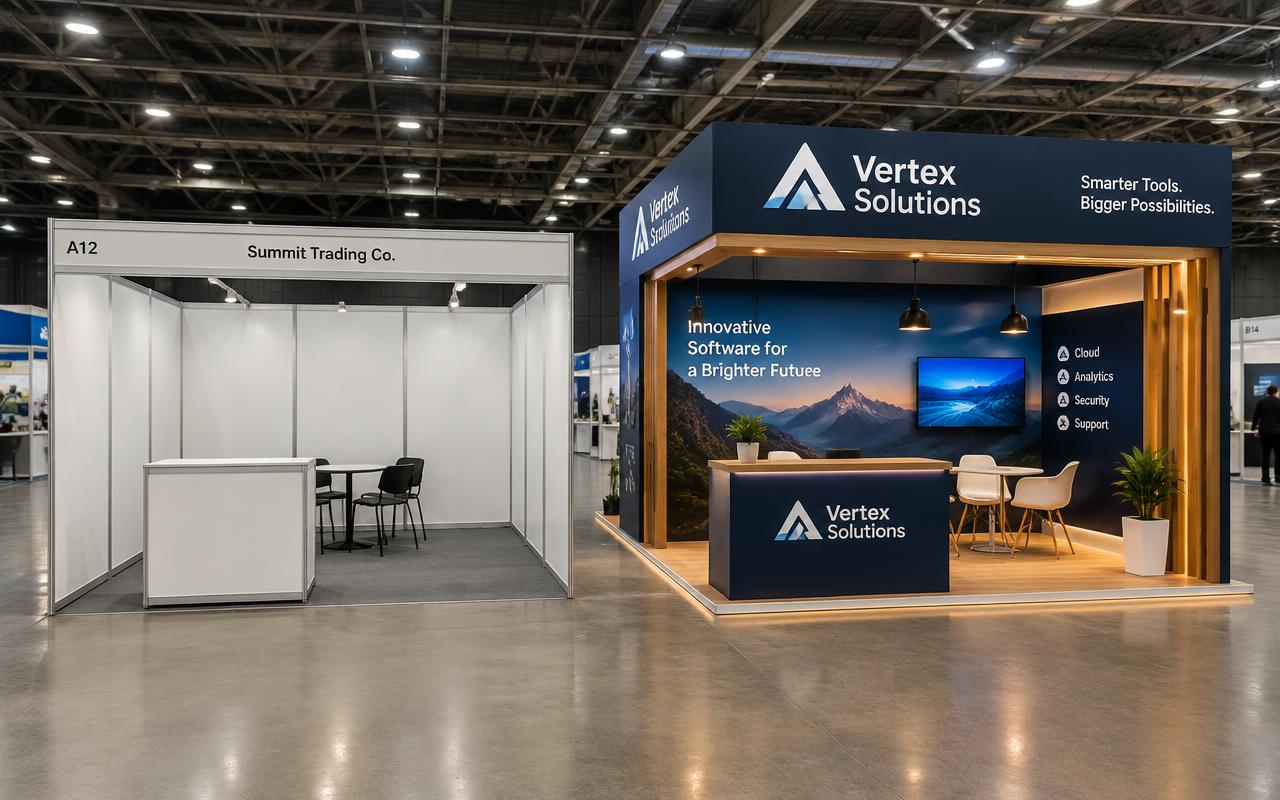
Choose octanorm & system stalls if you are exhibiting once, testing a show, or need a tidy pavilion booth at the lowest entry cost. Choose custom exhibition booths if you are judged on the environment around the product as much as the product. The decision is settled far more often by how many times you will exhibit than by preference: on the illustrative figures on this page, four outings come to ₹8,58,000 by the octanorm & system stalls route against ₹15,36,000 by the custom exhibition booths route, a difference of ₹6,78,000. Octanorm & system stalls is cheaper at the first outing and at every outing after it, so the case for custom exhibition booths has to be made on what it buys rather than on cost. Both can be quoted together, under one project manager.
Key takeaways
- Octanorm & System Stalls: Clean aluminium shell-scheme and system booths. Buys you the lowest possible first-show cost and no storage liability afterwards.
- Custom Exhibition Booths: One-of-a-kind booths built around your brand. Buys you premium finishes, backlit brand walls and architectural forms built once for you.
- Octanorm & system stalls is cheaper at every outing on these figures, so pick custom exhibition booths for what it buys, not to save money.
- Across four outings the illustrative gap is ₹6,78,000 — far larger than anything you will negotiate off a single quote.
- The second question is whether the stand's appearance is part of the product. If visitors judge your product by the environment around it, the finish is not decoration.
- Compare total cost across a year of shows, including storage, refurbishment and freight — not headline prices.
What you get with octanorm & system stalls
Aluminium octanorm and maxima systems for shell-scheme upgrades, pavilions and budget-friendly participation.
The figures used for octanorm & system stalls on this page cover an illustrative 36 sq.m stand — structure, graphics, lighting, transport and installation. On that basis the first outing comes to ₹2,34,000, and each later outing in the same programme to ₹2,08,000. Upfront, that is lowest. Reuse: graphics only — the profiles are hired again each time. Lead time: three weeks, faster still for a shell-scheme upgrade.
The honest summary is that octanorm & system stalls buys you the lowest possible first-show cost and no storage liability afterwards. That is the thing to weigh, because it is the thing the alternative cannot give you at any price.
- Octanorm and maxima profiles
- Fascia names and graphics
- Furniture and lighting packages
- Ideal for pavilions and startups
What you get with custom exhibition booths
Bespoke booths with unique shapes, finishes and lighting that make your brand the landmark of the hall.
The figures used for custom exhibition booths cover an illustrative 36 sq.m stand — structure, graphics, lighting, transport and installation. On that basis the first outing comes to ₹4,86,000 and each later outing to ₹3,50,000. Upfront, that is highest of the single-storey options. Reuse: limited — hero elements and graphics only. Lead time: six weeks at 36 sq.m with premium finishes.
What custom exhibition booths buys you is premium finishes, backlit brand walls and architectural forms built once for you. Both options are priced on the same basis here, so the figures can be compared directly.
- Integrated storage and AV
- Backlit brand walls
- Unique architectural forms
- Premium laminates, acrylic and metal finishes
The two options on one screen
Everything that matters is in the table below, and the two rows to read as a pair are upfront cost and cost per later outing. The first is the number that gets circulated internally; the second is the number that decides what a year of shows costs. When they disagree — and they usually do — the second one is right.
Lead time matters as much as money if your show is close. For stall work our planner starts at 3 weeks, adds 1 week from 24 sq.m and 2 from 54 sq.m, and adds 2 more for premium finishes — so a 36 sq.m stand is a 4-week job before any premium finish is specified. If you do not have 4 weeks, the lead-time row has already made the decision for you, whatever the money says.
| Criterion | Octanorm & System Stalls | Custom Exhibition Booths |
|---|---|---|
| What the figures cover | An illustrative 36 sq.m stand — structure, graphics, lighting, transport and installation | An illustrative 36 sq.m stand — structure, graphics, lighting, transport and installation |
| Upfront cost, first outing | ₹2,34,000 — lowest | ₹4,86,000 — highest of the single-storey options |
| Cost per later outing | ₹2,08,000 | ₹3,50,000 |
| Four outings, cumulative | ₹8,58,000 | ₹15,36,000 |
| Reuse | Graphics only — the profiles are hired again each time | Limited — hero elements and graphics only |
| Lead time | Three weeks, faster still for a shell-scheme upgrade | Six weeks at 36 sq.m with premium finishes |
| Look and finish | Clean and systematic rather than bespoke | A landmark; the booth is the brand statement |
| Best-fit size or scale | 9–36 sq.m | 24 sq.m and above |
| Pick it if you | are exhibiting once, testing a show, or need a tidy pavilion booth at the lowest entry cost | are judged on the environment around the product as much as the product |
Illustrative planning figures on the bases stated in the first row, before GST. Where custom fabrication is involved, the structure is costed inside the published ₹9,000–₹18,000 per sq.m band. Your quote will differ with finish level, city, venue rules and how much AV you add.
How often you exhibit changes the answer completely
Before anything else, count the shows. One a year and amortisation never happens, so buy the cheapest thing that does the job properly. Three or more and the arithmetic inverts: the thing you own gets re-skinned for a fraction of its original cost, and the thing you hire costs the same on the fourth outing as it did on the first.
Both routes below are priced on the same basis, so the running totals are directly comparable. The per-outing column is the first outing's cost on row one and the repeat cost on every row after it. The running total is what you will actually have spent by the end of that outing.
There is no crossover in this pairing, and saying so is more useful than inventing one. Octanorm & system stalls is cheaper at the first outing — ₹2,34,000 against ₹4,86,000 — and cheaper at every outing after it, ₹2,08,000 against ₹3,50,000. Its running total is never overtaken, and across four outings the difference is ₹6,78,000. That settles the cost question completely, which means the decision has to rest on what custom exhibition booths buys that octanorm & system stalls cannot: premium finishes, backlit brand walls and architectural forms built once for you. If you do not need that, take the cheaper route with a clear conscience — and spend the difference on lighting, staffing or a second show.
| Outing | Octanorm & System Stalls — this outing | Octanorm & System Stalls — running total | Custom Exhibition Booths — this outing | Custom Exhibition Booths — running total |
|---|---|---|---|---|
| 1 | ₹2,34,000 | ₹2,34,000 | ₹4,86,000 | ₹4,86,000 |
| 2 | ₹2,08,000 | ₹4,42,000 | ₹3,50,000 | ₹8,36,000 |
| 3 | ₹2,08,000 | ₹6,50,000 | ₹3,50,000 | ₹11,86,000 |
| 4 | ₹2,08,000 | ₹8,58,000 | ₹3,50,000 | ₹15,36,000 |
| 5 | ₹2,08,000 | ₹10,66,000 | ₹3,50,000 | ₹18,86,000 |
| 6 | ₹2,08,000 | ₹12,74,000 | ₹3,50,000 | ₹22,36,000 |
Outing 1 carries the build or commissioning cost in full. Later outings carry only what genuinely has to be done again — refurbishment, reprints, freight and installation for an owned asset, or the whole hire again where the option is rented. Storage and maintenance between editions are folded into the repeat figure. Illustrative, before GST.
Where the four payments actually fall
The example below takes the cheaper of the two across four outings — octanorm & system stalls — and lays the four payments out so you can see where the money actually falls. The shape is what matters: a large first payment followed by three smaller ones is a very different cash-flow conversation from four equal payments, even when the totals are close.
Four outings by this route total ₹8,58,000. The same four outings by the custom exhibition booths route total ₹15,36,000, which is ₹6,78,000 more. Put that number next to whatever discount you were planning to negotiate on the first quote and the priorities rearrange themselves: the route decision is worth several times the negotiation.
One caveat worth stating, because this is the most common way the arithmetic goes wrong in practice. The repeat figures assume the asset is stored properly, that graphics and content are designed to be reprinted or re-run rather than rebuilt, and that you actually do exhibit the number of times you planned to. A structure built for reuse and then left in a damp godown for eleven months is a structure you will pay for twice.
| Outing 1 — first build or commissioning, everything in the basis above | ₹2,34,000 |
|---|---|
| Outing 2 — the same package commissioned again, in full | ₹2,08,000 |
| Outing 3 — the same package commissioned again, in full | ₹2,08,000 |
| Outing 4 — the same package commissioned again, in full | ₹2,08,000 |
| Four outings, cumulative, before GST | ₹8,58,000 |
Illustrative only, on this basis: an illustrative 36 sq.m stand — structure, graphics, lighting, transport and installation. The comparable four-outing figure for the custom exhibition booths route is ₹15,36,000, a difference of ₹6,78,000. Storage and maintenance between editions are included in the repeat lines. Organiser space rent, travel and your own team's time are excluded because they are identical whichever option you choose. GST is extra.
When finish is worth paying for, and when it is not
That leaves one question, and it is the only one that justifies overriding the arithmetic above. Does the space around your product form part of what the buyer is judging?
In aesthetic categories — jewellery, interiors, premium consumer goods, hospitality, automotive — the stand is evidence about the product, and a thin-looking stand is evidence against it. No brochure recovers that judgement once a visitor has made it in three seconds from the aisle, which is why a finish premium there is a product cost rather than a vanity one.
Specification-led buyers — industrial, chemical, machinery, software, tender-driven — need somewhere clean, properly lit and quiet enough to talk. Beyond that, extra finish buys nothing measurable, and the same budget spent on trained staff or on a second show demonstrably does.
For octanorm & system stalls specifically, two risks are worth naming at quoting stage, because they recur across this kind of work whichever route you take: sub-contracted builds with no quality control, and non fire-retardant materials rejected at the venue. Neither is a reason to prefer one option over the other — they are reasons to get the scope written down in both quotes before you compare them.
If visitors judge your product by the space around it, the finish is part of the product. If they judge it on specification, it is not.
Exhibiting soon? Let's build your stall.
Lead time, approvals and risk
Timing eliminates options faster than budget does. Octanorm & system stalls needs three weeks, faster still for a shell-scheme upgrade. Custom exhibition booths needs six weeks at 36 sq.m with premium finishes. If your show is six weeks away and one route needs eight, the comparison is over regardless of which one you would have preferred.
Get the organiser's paperwork before deciding, not after. The stand plan tells you the dimensions and how many sides are open; the hall rules tell you the height limit, whether rigging and fixings are allowed, what power is available and what certification your materials need. Any one of those can rule out an option outright — a height limit kills a double-decker, a no-rigging hall kills a hanging banner, and a venue that demands fire-retardant certification kills an improvised build.
The risk profiles also differ in kind, not just in degree. A hired or system-built option carries availability risk: if the inventory is committed elsewhere during a busy show week, no amount of budget conjures it up. An owned, custom-built option carries schedule and storage risk: it has to be finished, loaded, transported and installed within the organiser's build-up window, and then kept somewhere safe for eleven months. Pick the risk you are better placed to manage.
- Confirm the current edition's dates, hall and stand number with the organiser in writing
- Check whether storage between editions is included, and at whose cost
- Check height, rigging, fixing, power and fire-certification rules for the hall
- Ask who physically does the work, and whether any of it is sub-contracted
- Agree in writing who clears the stand inside the organiser's dismantle window
- Get the second-outing price in writing at the same time as the first
- Lock artwork at least two weeks before dispatch, whichever route you take
Choose octanorm & system stalls if…
Pick octanorm & system stalls when you are exhibiting once, testing a show, or need a tidy pavilion booth at the lowest entry cost. On the figures above that is a first outing of ₹2,34,000 and ₹2,08,000 for each one after it. Reuse: graphics only — the profiles are hired again each time. Lead time: three weeks, faster still for a shell-scheme upgrade.
You are the cheaper option at the first outing and at every one after it, ₹6,78,000 less across four, which makes this the default answer unless custom exhibition booths buys something you specifically need: premium finishes, backlit brand walls and architectural forms built once for you.
- You are exhibiting once, testing a show, or need a tidy pavilion booth at the lowest entry cost
- You need the lowest possible first-show cost and no storage liability afterwards
- Your size or scale sits at 9–36 sq.m
- Your timeline allows for three weeks, faster still for a shell-scheme upgrade
- Reuse in your case means: graphics only — the profiles are hired again each time
Choose custom exhibition booths if…
Pick custom exhibition booths when you are judged on the environment around the product as much as the product. That is a first outing of ₹4,86,000 and ₹3,50,000 for each one after it. Reuse: limited — hero elements and graphics only. Lead time: six weeks at 36 sq.m with premium finishes.
This route costs more at the first outing and at every one after it, so choose it for what it buys rather than to save money: premium finishes, backlit brand walls and architectural forms built once for you. Across four outings the premium is ₹6,78,000 — a fair price if you genuinely need that, a poor one if you do not.
- You are judged on the environment around the product as much as the product
- You need premium finishes, backlit brand walls and architectural forms built once for you
- Your size or scale sits at 24 sq.m and above
- Your timeline allows for six weeks at 36 sq.m with premium finishes
- Reuse in your case means: limited — hero elements and graphics only
The combination most exhibitors end up with
Treat these as ingredients rather than as alternatives. The structure is the part visitors cannot assess, so buy it on cost and reuse. The brand wall, the lighting and where the hero product stands are the parts they assess in the first three seconds, so buy those on effect. That split is what most well-judged stands turn out to be on closer inspection.
The other common pattern is sequencing. Start with octanorm & system stalls for the first show, learn what your stand actually needs from standing on it for three days, then commit to custom exhibition booths for the following year with a brief written from experience rather than from a render. The first show is the cheapest research you will ever buy, and it routinely changes the layout brief more than any internal discussion does.
What should not be mixed is accountability. Two vendors sharing one stand is how a schedule slips and how a defect becomes nobody's problem. Whatever combination you choose, keep one project manager answerable for the whole of it, from drawings to dismantle.
Get both options priced on the same brief
The cleanest way to settle this is not to read further — it is to have both routes quoted against one brief. Share your show, city, dates, stall area, number of open sides and two or three reference images, and ask for an itemised quote for each option plus a concept. Comparing two itemised quotes against identical scope takes ten minutes and removes every assumption on this page.
Ask for the same five lines in both: structure, graphics, lighting, transport and installation. Ask both to state the finish, the lighting count and the flooring type. Ask both what the second outing would cost if you reused what you could. That last question is the one that separates a vendor who has thought about your programme from one who has quoted a single show.
We design free with every confirmed fabrication order, fabricate in our own workshops, prepare the organiser drawings and approvals, and put one project manager on the job from brief to dismantle. Octanorm & System Stalls: Economical packages for 9–18 sq.m booths. Custom Exhibition Booths: From ₹10,000 per sq.m for premium custom builds.
Frequently asked questions
Is octanorm & system stalls better than custom exhibition booths?+
Neither is better in the abstract. On the illustrative figures here, four outings come to ₹8,58,000 by the octanorm & system stalls route and ₹15,36,000 by the custom exhibition booths route. Octanorm & system stalls is cheaper at the first outing and at every outing after it, so the case for custom exhibition booths has to be made on what it buys rather than on cost.
Which one is cheaper?+
Octanorm & system stalls is cheaper at the first outing — ₹2,34,000 against ₹4,86,000 on these illustrative figures. It also stays cheaper at every later outing, so there is no point at which the other route wins on cost alone.
How many outings does it take for reuse to pay?+
In this pairing, it does not arise: octanorm & system stalls is cheaper to commission and cheaper to repeat, so there is nothing to pay back. Reuse arithmetic decides between an owned structure and a hired one, and here both routes sit on the same side of that line.
Can I combine both?+
Yes, and it is common. The usual split is the cheaper reusable route for the structure, with the saving spent on lighting, graphics and the hero product position. We deliver octanorm & system stalls and custom exhibition booths together under one quote and one project manager.
Which has the shorter lead time?+
Octanorm & System Stalls: Three weeks, faster still for a shell-scheme upgrade. Custom Exhibition Booths: Six weeks at 36 sq.m with premium finishes. Our planner's base is 3 weeks, plus 1 week from 24 sq.m, plus 2 from 54 sq.m, and plus 2 for premium finishes — so a 36 sq.m stand is a 4-week job before any premium finish.
What does reuse actually cover?+
Octanorm & System Stalls: Graphics only — the profiles are hired again each time. Custom Exhibition Booths: Limited — hero elements and graphics only. Ask in writing what will be stored, where, at whose cost, and what the second outing would be quoted at — a reuse claim with no storage arrangement behind it is not a reuse claim.
How do these figures relate to the published per-sq.m band?+
For custom fabrication, the published band is ₹9,000–₹18,000 per sq.m for the build, and system-built or modular construction sits below it because the frame is reused rather than cut fresh. A shell-scheme upgrade sits below that again. Those are different trade-offs between cost, reuse and how bespoke the stand can look — not different qualities of the same thing.
What should I decide first?+
How many times you will exhibit in the next twelve months, and whether your product is judged partly on the environment around it. Those two answers settle this comparison in almost every case; everything else is detail inside the quote.
Octanorm & System Stalls near you
Our crews deliver octanorm & system stalls in every major Indian city.