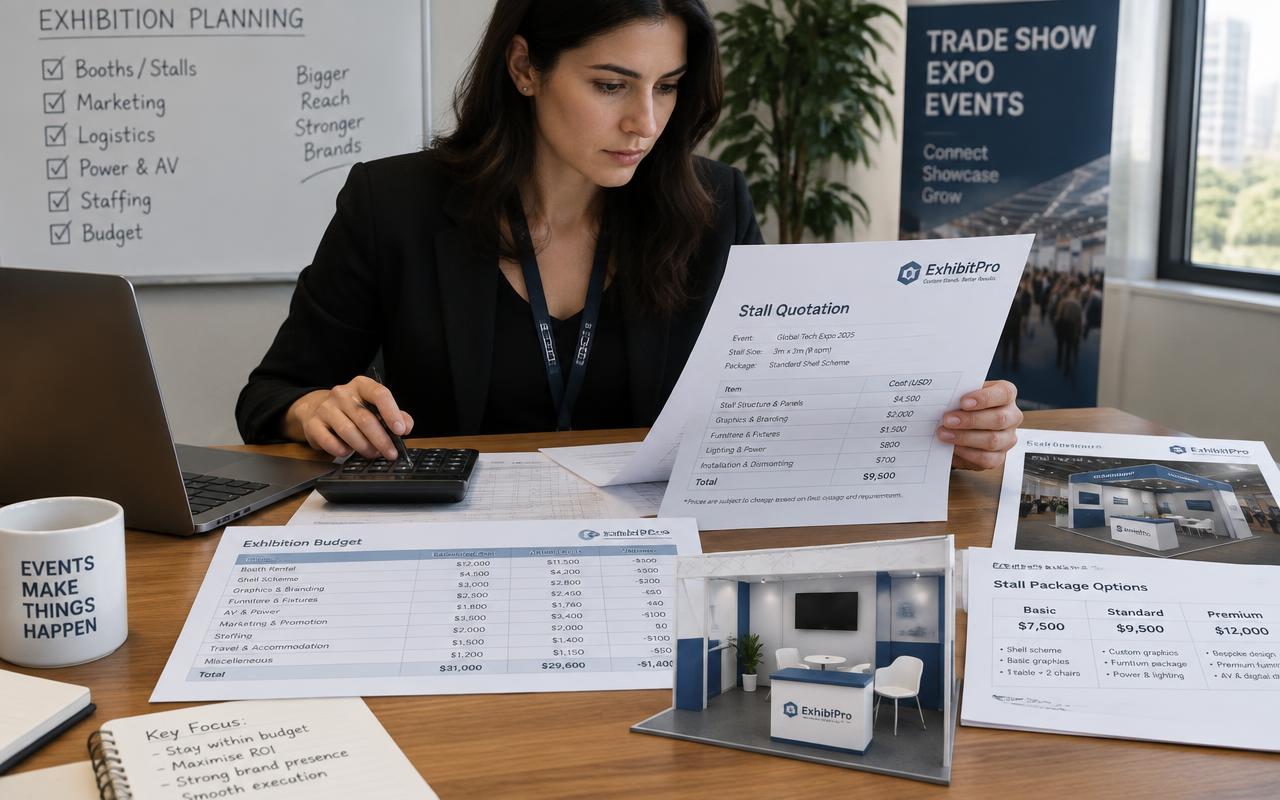
By the Exhibition Stall Design editorial team · Updated 1 October 2026 · 17 min read
Short answer
Economical packages for 9–18 sq.m booths. What moves the number for octanorm & system stalls is stall area in square metres and number of open sides, finish level (laminate, paint, veneer, acrylic, metal) and height, hanging structures and double-decker elements — and what makes two numbers incomparable is scope that nobody wrote down. Send the show, the city, the dates, the area, the open sides and two reference images, and ask for the quote itemised line by line.
Key takeaways
- Two things dominate the quote: stall area in square metres and number of open sides and finish level (laminate, paint, veneer, acrylic, metal).
- Six ordinary substitutions explain 22% of the gap between two quotes for the same brief. Ask for the itemisation and the gap stops being a mystery.
- Transport, installation, dismantle and taxes are separate lines. Confirm they are in the figure you are comparing.
- Reuse beats negotiation. A second outing with the same structure is 32% of the first show's figure, with nothing haggled.
- Spend longer at concept stage than feels comfortable. It is the only point at which a change costs nothing but time.
- Economical packages for 9–18 sq.m booths.
What octanorm & system stalls costs in India
Aluminium octanorm and maxima systems for shell-scheme upgrades, pavilions and budget-friendly participation.
Economical packages for 9–18 sq.m booths. Prices in metro cities such as Delhi NCR, Mumbai and Bengaluru tend to sit slightly higher because of venue labour rules and compressed build-up timings, while Tier 2 cities can be more economical when the build is planned well in advance. The difference is rarely in the fabrication itself — it is in transport distance, crew availability during a busy show week, and whether the organiser's schedule forces night-shift labour.
Custom fabrication is published at ₹9,000–₹18,000 per sq.m. Below that sit system builds, where the frame is reused instead of cut fresh, and below those an upgraded shell scheme. Read those as three different bargains rather than three qualities: you are trading how bespoke the stand looks against how much of it you still own after the show.
The band has an arithmetic shape worth seeing. Because ₹18,000 is twice ₹9,000, the same build money buys either a large plain stand or half the area beautifully finished. Exhibitors who have decided which of those they need brief quickly and buy well; exhibitors who have not spend the whole process trying to have both.
| Construction type | Where it sits on cost | What you still own afterwards | Typical fit |
|---|---|---|---|
| Shell scheme upgrade | Lowest | Graphics only | 9–18 sq.m, first-time or budget exhibitors |
| Octanorm / system build | Low | Frame and graphics | 9–36 sq.m, exhibitors doing several shows a year |
| Modular with custom graphics | Medium | Frame, graphics, furniture | 18–54 sq.m, repeat exhibitors wanting a branded look |
| Custom wooden build | ₹9,000–₹18,000/sq.m | Limited | Any size where the stand must look bespoke |
| Double-decker | Quoted per project | Structure, with engineering | 72 sq.m and above, when meetings would eat display space |
Only the custom band is a published per-sq.m rate. The others are positions relative to it, because what they cost depends on how much of the frame already exists.
What actually moves an octanorm & system stalls price
Every octanorm & system stalls quote is built from the same handful of variables. Knowing them lets you control the budget before you brief anyone, and lets you tell the difference between a vendor who is cheaper and a vendor who has quoted less work.
Area and open sides dominate everything else. A stand with three open sides needs three finished faces, three lighting runs and more staff than an inline stand of the same area, so it costs more per square metre even before any design decision is made.
After area, the two variables with the most money in them are time and finish. Time, because a job booked inside the lead time is a job partly done at overtime rates: our own schedule needs 4 weeks for 36 sq.m, and compressing it does not remove work, it only moves it to a more expensive shift. Finish, because the difference between a good laminate and a veneer is invisible from the aisle and perfectly visible on the invoice.
- Distance from the workshop to the venue and build-up hours
- Stall area in square metres and number of open sides
- Finish level (laminate, paint, veneer, acrylic, metal)
- Height, hanging structures and double-decker elements
- LED walls, lighting and raised flooring
- The number of open sides, which decides how many faces have to be finished
- The finish on surfaces visitors can touch, as against the ones they cannot
- The number of approval rounds before the drawing is frozen
- How much of the stand has to be new, and how much can come out of storage
You cannot compare two quotes until both describe the same stand.
The lines a quote has to name
A professional quote lists every element separately so you can compare vendors fairly and remove items you do not need. A lump sum hides which of these you are about to pay for twice — or not at all.
The exclusions are more informative than the inclusions. Transport back from the venue, the crew who put it up, the dismantle inside the organiser's window, the electrical fittings and the tax: ask about those five by name, because a quote rarely mentions what it has left out.
For fabrication work there are a few lines beyond the obvious ones that belong on the page: the certification the venue will ask for, the drawings the organiser will ask for, and the person whose phone you will be ringing at seven in the morning on build-up day. None of those are large figures. All of them are expensive to arrange late.
- Furniture and lighting packages
- Ideal for pavilions and startups
- Organiser drawing submission and approval handling
- Electrical fittings, the stand's own wiring, and the load being declared
- Fire-retardant certification for the materials being used
- Dismantle and clearing the stand inside the organiser's window
- Transport to the venue and the return leg, stated separately
- Installation, the on-site crew, and who supervises them
- Octanorm and maxima profiles
- Fascia names and graphics
What 36 sq.m actually costs, line by line
Here is how a mid-size custom build actually breaks down. The structure line uses the bottom of the published band — ₹9,000 per sq.m across 36 sq.m — and everything below it is a separate scope that a lump-sum quote would bury.
At ₹6,73,000 this stand works out at roughly ₹18,694 per sq.m all-in, which is the number worth comparing between vendors. Note how much of it is not the stand: graphics, lighting, flooring, furniture, transport and crew together come to ₹3,49,000, a little more than the fabrication itself.
Two caveats, both of which matter when you use this to plan. The structure line sits at the bottom of the band, so a premium finish moves it upward — at the top of the band the same 36 sq.m of structure is ₹6,48,000 rather than ₹3,24,000. And GST sits on top of the whole thing. Treat the figure as a planning number, not as a quotation.
| Structure and joinery (36 sq.m × ₹9,000) | ₹3,24,000 |
|---|---|
| Graphics — brand wall, tensioned fabric and vinyl | ₹97,000 |
| Lighting — track, aimed spots and backlit panels | ₹54,000 |
| Raised flooring and carpet | ₹43,000 |
| Furniture — counters, seating, planters | ₹38,000 |
| Transport, both ways | ₹52,000 |
| Installation, crew and dismantle | ₹65,000 |
| Indicative total, before GST | ₹6,73,000 |
Illustrative only, using the published ₹9,000–₹18,000 per sq.m band at its lower end for the structure line. The remaining lines are planning figures rather than a quotation, and your own will differ with finish level, city, venue rules and how much AV you add. GST is extra. Space rental, power, badges, travel and your own team's time are not in this figure — they are invoiced by the organiser or by nobody at all.
Area against finish: what the band actually means
This is the comparison most briefs skip. At every size, the band gives you a lower figure and an upper one, and the gap between them is not padding: it is finish, light, floor and detail. The last column names what it buys, so you can decide whether you want it more than you want the extra square metres.
Hold the two middle columns next to each other and the trade is exact: the difference between them, ₹9,000 per sq.m, is the same as the lower rate itself. Upgrade the finish or double the footprint — at the published band, those two cost the same. Few budget decisions are this clean, and almost nobody uses it.
Choose by the job, not the taste. Anything involving queuing, demonstrating, handling or sitting down is an argument for area, because the premium finish on a stand nobody can enter is money spent on photographs. Anything involving persuasion rather than throughput is an argument for finish — and in that case a smaller stand, properly lit, beats a larger one that looks provisional.
| Stall size | Lower end of the band | Upper end of the band | The spread pays for |
|---|---|---|---|
| 9 sq.m | ₹81,000 | ₹1,62,000 | Better print, aimed light instead of clip lamps, and an edge finish that survives the week |
| 12 sq.m | ₹1,08,000 | ₹2,16,000 | A laminate that survives handling, a lighting track, and a counter that locks |
| 36 sq.m | ₹3,24,000 | ₹6,48,000 | Veneer or PU paint in place of laminate, backlit panels and a screened meeting corner |
| 54 sq.m | ₹4,86,000 | ₹9,72,000 | Double-height brand elements, integrated AV and a storage wall that hides the cartons |
| 100 sq.m | ₹9,00,000 | ₹18,00,000 | All of the above, plus the engineering a raised or second-storey element needs |
Both columns are build only, at the two ends of the published band. Read them as the first line of a quote rather than as a quote.
Where the difference between two prices lives
When two prices for the same stand are far apart, the instinct is to suspect the higher one. Usually both are honest and the brief was not specific: every unspecified detail is a decision the vendor makes for you, and the cheaper quote is simply the one that made the cheaper decisions.
The arithmetic below is the whole phenomenon in one table. Take the 36 sq.m example and make six substitutions a vendor could defend in a meeting, and ₹6,73,000 becomes ₹5,23,000. The 22% difference — ₹1,50,000 — is entirely scope, and none of it is visible in a lump-sum comparison.
What follows from that is a procurement rule rather than a design one: write the scope down, in your own words, before you ask for prices. Name the board, the graphics medium, the fixture count, the flooring type, the furniture list and the crew. Then the quotes you get back are comparable, and the cheapest of them may genuinely be the right one.
| Where quotes diverge | What each vendor has assumed | Ask this and the gap closes |
|---|---|---|
| Furniture | Hired against fabricated, and a four-piece package against an eight-piece one | List the pieces, and say which are hired and which are built |
| Risk | One vendor has priced the unknowns; the other will raise them later as variations | What happens to this price if the drawing changes? |
| Drawings and approvals | One vendor is preparing the organiser submission; the other expects you to | Who prepares the drawings, and who submits them? |
| Lighting | Fourteen aimed fixtures against six, or against none at all | How many fixtures, of what type, aimed at what? |
| Dismantle | Frequently missing from the cheaper quote entirely | Is clearing the stand inside the organiser's window in this price? |
| Taxes | One total is before tax and the other after it | Give me both the pre-tax and the post-tax figure |
| Electrical | The organiser's power charge, the stand's own wiring, or neither | Who pays the organiser, and who wires the stand? |
| Structure | Ply and MDF to a finished edge in one quote, a lighter board with an exposed edge in the other | Name the board, the thickness and the edge finish |
Work down the list before you negotiate. A gap explained is usually a gap you no longer want closed, because you now know which stand you are buying.
| Lighter board in the structure, with an exposed edge instead of a finished one | ₹42,000 |
|---|---|
| Printed flex taped to panels instead of tensioned fabric on a frame | ₹26,000 |
| Six aimed spots instead of fourteen, and no backlit panel | ₹18,000 |
| Carpet laid straight on the hall floor instead of a raised platform with cable management | ₹21,000 |
| A four-piece hired furniture package instead of eight pieces | ₹12,000 |
| Installation and dismantle left as "to be advised" | ₹31,000 |
| Total difference between the two quotes | ₹1,50,000 |
Illustrative, built by making six substitutions to the 36 sq.m example above. The higher quote is ₹6,73,000 and the lower is ₹5,23,000; the difference is ₹1,50,000, 22% of the higher figure. None of these substitutions is dishonest — each is a decision the brief failed to make — and none of them is visible unless both quotes are itemised. Figures are planning numbers, not a quotation, and GST is extra on both.
The false economies, and the real ones
There are two kinds of saving in a stall quote. One kind removes something nobody was going to look at. The other removes something that then has to be dealt with on site, at site prices, by people with the wrong tools. The lines look identical on paper.
Apply a single test to every candidate for deletion: if it is missing, who handles it and where? Anything that ends up being handled at the venue has not been saved. Site is the most expensive place on earth to buy a sheet of board, an electrician's hour or a reprint.
The list immediately below is the first kind: real options, which can go without anybody noticing. The table after it is the second kind — lines that look like fat and are not, with what actually happens when each one is cut. Start with the list, because the genuinely optional items on an octanorm & system stalls quote are usually larger than the false economies and far less painful to remove.
- Fabricated furniture, where hired furniture would have been collected afterwards anyway
- Wall height above the sightline, which costs material and is read by nobody
- Backlighting on every panel, rather than on the one panel you want looked at
- A printed floor, when plain carpet in the brand colour does the same job
- Veneer or PU paint where a good laminate reads identically from the aisle
- A model, a mock-up or a prop that duplicates something the product already demonstrates
| Line item | Why it reads as padding | The consequence |
|---|---|---|
| A single project manager | Each vendor manages themselves | Then every gap between vendors is yours to discover, usually at eight o'clock on the first morning |
| The cable and socket count on the drawing | That is site detail | Site detail becomes a visible extension lead across the floor of a stand you paid to look expensive |
| Pre-build at the workshop | The crew can assemble it on site | Site is where there is no spare panel, no saw and no time. A dry run finds the problem while it is still cheap |
| Storage between shows | We will decide after this one | "After this one" is a fortnight of the structure stacked in a corner, which is where reusable elements stop being reusable |
| The power load calculation | The organiser supplies power | The organiser supplies the load you declared. A screen added after the declaration is a screen without power |
| Packing crates and transport cover | It travelled fine last time | Once is not a plan. A cracked acrylic panel is a reprint, a lorry and a lost day |
| One spare panel for the hero wall | It will be fine | A scuffed hero panel is the one thing every photograph of the stand will show |
The common thread is that each one is cheap in a workshop and expensive at a venue. Timing, not quality, is what makes them worth keeping.
A saving that has to be dealt with on site is not a saving. It is a deferral with a surcharge.
What changing your mind costs, stage by stage
Changes are where budgets actually overrun, and they do not appear on any quote. What makes them expensive is timing rather than magnitude: moving an entrance is a conversation at concept stage, a redraw after sign-off, a rebuild in production, and an improvisation at the venue.
The practical consequence is to front-load the arguing. With 4 weeks on the schedule for 36 sq.m, every disagreement settled before sign-off is free and every one settled afterwards has a price. Add 2 weeks for a premium finish or 2 for a double-decker element, and the calendar is still unforgiving once production has started.
Protect yourself with two things. First, a single named approver — two people with different opinions about the same wall is the most expensive organisational arrangement in exhibiting. Second, a written variation process, so that every change has a price attached at the moment it is agreed rather than at the moment it is invoiced.
| Stage | The price of changing your mind | What has already happened |
|---|---|---|
| While the concept is being designed | Time, and nothing else | Nothing has been drawn to scale, priced, cut or ordered. This is the only stage where changing your mind is free, which is the argument for spending longer in it |
| After design sign-off, before production | A redraw and a requote | Drawings have gone to the organiser and materials have been priced against them. Both have to be done again, and the organiser's queue does not restart for you |
| After materials are ordered | The material, plus its replacement | Board, laminate and print are bought to a cutting list. A changed dimension turns the ordered sheet into offcuts |
| In production | The labour already spent, plus the labour to redo it | A fabricated wall is days of somebody's bench. Changing it means buying those days twice, inside a window that has not moved |
| During build-up | Night-shift labour, and whatever can be improvised | There is no workshop at the venue, no spare material, and the clock belongs to the organiser rather than to you |
| Once the show has opened | Usually nothing can be done at all | The hall is open and the stand is public. The only honest response is to write it down for the next edition |
The pattern is the whole lesson: the cost of a change is set by what has already been bought, drawn or built, not by how large the change is.
Exhibiting soon? Let's build your stall.
Planning a budget backwards from a total
Most exhibitors do not start with a design, they start with a number. Working backwards from that number is a more reliable method than briefing a design and discovering afterwards what it costs — and it has one step that nearly everybody misses, which is subtracting the costs that no stand builder will ever quote you.
What follows is the list of costs no stand builder will quote you, and then one way to split a total, shown against ₹10,00,000. Treat it as an illustration and not as a benchmark — there is no published standard and we are not inventing one. Its useful feature is the last two lines: ₹9,00,000 is what a builder quotes against, ₹1,00,000 is yours alone, and ₹50,000 of the total is held back rather than committed.
That leaves ₹4,50,000 for the build itself in this illustration, which at ₹9,000 per sq.m is 50 sq.m of structure, or 25 sq.m at ₹18,000. Compare that with the area you have actually booked and you will know immediately whether your budget and your floor plan are in agreement — and if they are not, you have found it out at the right time, which is before the design.
- Travel, hotels and local transport for everyone who will stand on the stand
- Lead-capture devices, the data connection, and somewhere to charge them
- Printed collateral, samples, and anything you intend to hand over
- Promoters, hostesses or interpreters, if your visitors need them
- Product freight — the goods on display travel separately from the stand that holds them
- The cost of your own team being away from their desks for the build-up and the show
- Photography and video of the finished stand, which is the asset you use all year
- Hospitality: tea, coffee, water, and whatever the meeting corner is going to serve
| Where the money goes | Share of the budget | Against ₹10,00,000 |
|---|---|---|
| Stand build — structure, joinery and finish | 45% | ₹4,50,000 |
| Graphics, lighting and AV | 20% | ₹2,00,000 |
| Flooring and furniture | 10% | ₹1,00,000 |
| Transport, installation and dismantle | 15% | ₹1,50,000 |
| Your own show costs — travel, staffing, collateral, hospitality | 5% | ₹50,000 |
| Contingency, held back rather than allocated at briefing | 5% | ₹50,000 |
Illustrative only. There is no published standard split and this is not offered as one — it is a planning habit, shown with the arithmetic visible so you can substitute your own shares. The shares are whole percentages summing to 100, so the amounts total exactly ₹10,00,000. The first four rows, ₹9,00,000, are what a stand builder quotes against. GST sits on top.
What the area actually gives you
Stall area decides more than price — it decides what the stand can physically do. The split below is the same arithmetic as our stall planner: storage takes 10% of the area up to 18 sq.m and 15% above it, a meeting corner takes 5% unless you are actually hosting meetings, and display takes the remainder.
Read the visitor column as a constraint rather than as information. It is display area divided by 2.5, and if your footfall expectation implies more people in the stand at once than that, the thing standing in the way is the floor plan, not the campaign.
The build-weeks column is a budget column in disguise. Our schedule is 3 weeks base, +1 from 24 sq.m, +2 from 54 sq.m, +2 for a premium finish and +2 for a double-decker. Compressing it does not reduce the work; it relocates the work to night shifts and rush rates.
| Area booked | Display | Storage | Staff | Visitors at once | Lead time |
|---|---|---|---|---|---|
| 9 sq.m | 7.6 sq.m | 0.9 sq.m | 2 | 3 | 3 |
| 12 sq.m | 10.2 sq.m | 1.2 sq.m | 2 | 4 | 3 |
| 36 sq.m | 28.8 sq.m | 5.4 sq.m | 4 | 11 | 4 |
| 54 sq.m | 43.2 sq.m | 8.1 sq.m | 6 | 17 | 5 |
| 72 sq.m | 57.6 sq.m | 10.8 sq.m | 8 | 23 | 5 |
| 100 sq.m | 80 sq.m | 15 sq.m | 12 | 32 | 5 |
Staff = area ÷ 9, minimum 2. Visitors = display ÷ 2.5, minimum 3. Lead time is 3 weeks base, +1 from 24 sq.m and +2 from 54 sq.m.
Milestones that correspond to something
There is no universal payment schedule in this industry and anybody presenting one is describing their own terms rather than a standard. So the useful discussion is not about the percentages but about what each payment should buy, and that can be specified precisely.
Hold to a single principle and the rest follows: no payment stage without a deliverable attached. The deliverables are obvious once you ask for them — the approved drawing set, the materials on the floor, the dry assembly, the finished stand — and each one is something you or a colleague can physically verify.
One more thing belongs in this conversation, because it is where disputes actually start: the variation process. Agree, before the first payment, who on your side approves a change, in what format, and whether its price is confirmed before the work begins. Unpriced variations are where almost every uncomfortable conversation about an exhibition invoice begins, and they are the one budget risk that is entirely administrative to remove.
01
Name one approver on your side
One person signs the drawing, the finish schedule and every variation. Two approvers with different opinions is the most expensive organisational structure in exhibiting, because the cost of resolving them lands in production.
02
Tie every stage to something you can see
A milestone should correspond to a deliverable you can check with your own eyes: approved drawings, materials on the shop floor, a pre-build you can walk around, the stand standing complete at the venue. A date in a calendar is not a milestone, because a date arrives whether or not the work did.
03
Write the variation process down before there is a variation
Agree who on your side can approve a change, in what format, and whether the price of that change is confirmed before the work starts. Most budget overruns are not one large surprise; they are six small changes that nobody priced at the moment they were agreed.
04
Ask for the schedule inside the quote
Payment terms belong in the same document as the itemised scope, not in a separate message afterwards. If the stages and the deliverables are written on one page, you can see whether they line up — and if they do not, that is a conversation to have before you sign rather than in week three.
05
Get the tax position in writing
Ask for the pre-tax total, the post-tax total and the GST treatment stated on the face of the quote. It makes vendor comparison honest, and it stops your own finance team discovering the difference at the point of payment.
06
Ask what happens if the show moves
Editions get postponed and dates shift. Ask what is recoverable and what is not if that happens, and at which stage the answer changes — the honest answer is different before materials are ordered and after a wall has been built.
A milestone with no deliverable attached is a date, and a date is not a milestone.
How the cost per show falls across a year
Everything above prices a single appearance. If you exhibit more than once a year, that is the wrong unit, and using it is the most expensive accounting mistake in exhibiting. The right unit is the cost per show across the programme, and it falls sharply after the first outing if — and only if — the first stand was designed to come apart and go back together.
The second outing is costed in full in the example on this page. The structure, having been stored, does not reappear: what remains is a graphics reprint for the new message, refurbishment of what got marked, storage between the two shows, and the same transport and installation as before. That comes to ₹2,15,000 against the first show's ₹6,73,000 — 32% of it — because ₹4,58,000 of the first build is not bought a second time.
Extended to a third show in the table, the average per show becomes about ₹3,67,667, against ₹6,73,000 for the first outing alone: a 45% fall. No negotiation produces that. It comes entirely from a design decision taken before the first panel was cut, which is why it has to be asked for at briefing stage.
It depends on three things being true. A modular structure that comes apart without damage; graphics as a removable layer rather than as part of the wall; and storage, which costs money and is therefore a line in the example rather than an assumption. Miss any one and the second show is close to the price of the first.
| Outing | This edition | Spent to date | Running average |
|---|---|---|---|
| Show 1 — the first build | ₹6,73,000 | ₹6,73,000 | ₹6,73,000 |
| Show 2 — same structure, new graphics | ₹2,15,000 | ₹8,88,000 | ₹4,44,000 |
| Show 3 — same structure, new graphics | ₹2,15,000 | ₹11,03,000 | ₹3,67,667 |
Illustrative, built from the two worked examples on this page: ₹6,73,000 for the first build and ₹2,15,000 for each subsequent outing with the same structure. The average is the cumulative figure divided by the number of shows, rounded. It assumes the stand is stored and reused rather than rebuilt, and that each show carries its own transport and installation — which it does.
| Graphics reprinted for the new show and the new message | ₹48,000 |
|---|---|
| Refurbishment — replaced panels, touch-up paint, relaminating what is marked | ₹32,000 |
| Storage of the structure between the two shows | ₹18,000 |
| Transport, both ways | ₹52,000 |
| Installation, crew and dismantle | ₹65,000 |
| Indicative second-show total, before GST | ₹2,15,000 |
Illustrative, and dependent on the first stand having been specified as modular. There is no structure line because the structure already exists; the refurbishment line is what a stored stand typically needs rather than a fixed figure. Against the first show's ₹6,73,000, this is 32%, so ₹4,58,000 of the original build is not purchased again. GST is extra. Space rental, power and badges are the organiser's invoices and appear in neither figure.
Spending less without showing it
Put the money where a visitor's eye lands before they decide whether to walk in: the main graphic, the lighting on it, and whatever you most want them to look at. Everything behind that can be built to a budget without anybody noticing.
The structural saving is reuse: a modular frame with reprintable graphics turns the second show into a fraction of the first. Beyond that, hire the furniture, print on fabric rather than rigid board, and buy the whole scope from one place instead of paying three separate margins.
Cut structure before light. Visitors cannot admire quality they are standing in the shadow of, and lighting costs a fraction of the thing it makes visible.
Read the list with the calendar in mind. These are savings at briefing stage and costs at any stage after it — a reprint instead of a rebuild saves money only if the design anticipated it, and a simpler footprint saves money only if the cutting list has not been written yet.
- Book early: rush charges and night-shift labour are avoidable rather than inevitable
- Share a lorry with your own product freight, if the dates allow it
- Hire the AV for the week instead of buying a screen you will then have to store
- Freeze the layout once and leave it frozen, because the expensive version of every saving is a change
- Keep graphics on fabric, so the next edition is a reprint instead of a rebuild
- Keep the footprint simple — every curve, angle and radius is another line on the cutting list
- Reuse a modular structure across several shows — the second outing costs a fraction of the first
The three expensive failures
The expensive failures on octanorm & system stalls happen at quoting stage, not at the venue, which is why they are worth listing here rather than in a build guide. Start with the commonest: sub-contracted builds with no quality control. The question that prevents it is what the quote actually specifies, and who is answerable for delivering it.
The second is scope that was never written down. If the quote does not name the finish, the lighting count and the flooring type, two vendors are not quoting the same stand and the comparison is meaningless.
The last of the three is subtler. The quote was right; the job changed. Half a dozen small additions after sign-off, none of them priced at the time, and the final figure is not the one anybody approved — which is an argument for agreeing the variation process at the same moment as the price.
- Non fire-retardant materials rejected at the venue
- Late arrival on site that eats into build-up time
- Hidden extras for electrical, carpet or dismantling
- Sub-contracted builds with no quality control
Get an accurate price
Six things get you a real figure: the show, the city, the dates, the area, the number of open sides, and two or three images of stands you liked. With those, a concept and an itemised octanorm & system stalls quote normally come back inside 48 hours.
We design free with every confirmed fabrication order, fabricate in our own workshops, prepare the organiser drawings and approvals, and put one project manager on the job from brief to dismantle. Economical packages for 9–18 sq.m booths.
Whoever you end up using, ask for three things in writing: the itemisation, the exclusions, and how a change gets priced. Those three answers are what turn a number into a price you can plan around, and any vendor worth using will give them without being pressed.
Frequently asked questions
Does reusing a stand really lower the cost?+
Directly, and more than negotiation does. On this page's illustrative figures a second outing with the same structure carries ₹2,15,000 rather than ₹6,73,000 — 32% of the first show — because ₹4,58,000 of the first build is not bought again. Across three shows the average falls to about ₹3,67,667.
Do you charge separately for design?+
3D design is free with every confirmed fabrication order, and revised until you approve it. Design-only projects are quoted per stall.
How far ahead should I book to avoid rush costs?+
Our own lead times are 3 weeks for a small stall, 4 from 24 sq.m and 5 from 54 sq.m, with another 2 for a premium finish and 2 for a double-decker. Work backwards from the build-up date and add your own approval rounds — those, not fabrication, are what usually makes a job late and therefore expensive.
Is the cheapest quote ever the right one?+
Yes, when it is the cheapest quote for the same written scope. That is a rarer event than it looks, which is why the scope has to be written down before the prices are compared rather than inferred from them afterwards.
How much contingency should I hold back?+
Enough to absorb one change you have not thought of yet. The illustrative allocation on this page holds back ₹50,000 of ₹10,00,000, which is a planning habit rather than a published rule — set your own figure, but set it before briefing, because a contingency invented afterwards is just an overrun.
What does a 36 sq.m stand cost?+
Using the published band, the structure alone is ₹3,24,000–₹6,48,000. Add graphics, lighting, flooring, furniture, transport and installation and the illustrative all-in figure on this page is ₹6,73,000 before GST — about ₹18,694 per sq.m — for a mid-finish custom stand.
How can I lower the cost without the stand looking cheap?+
Book early so no part of the job is paid at rush rates, reuse a modular frame, hire furniture rather than building it, keep graphics on fabric so the next edition is a reprint, and spend the saving on light. Lighting is the smallest significant line on a quote and the one with the largest visible effect.
What is never included in a stall quote?+
Space rental, your power connection and your exhibitor badges are invoiced by the organiser, not by us. Travel, hotels, your own team's time, product freight, hospitality and giveaways are yours too. On the illustrative split on this page they are ₹1,00,000 of ₹10,00,000 — small enough to forget and large enough to hurt.
Why do two quotes for the same brief differ so much?+
Almost always because they describe two different stands. On the illustrative 36 sq.m figures on this page, six substitutions — board, graphics medium, fixture count, flooring, furniture package and installation — account for ₹1,50,000, or 22% of ₹6,73,000. Ask both vendors to itemise against the same written scope and the gap explains itself.
Octanorm & System Stalls near you
Our crews deliver octanorm & system stalls in every major Indian city.