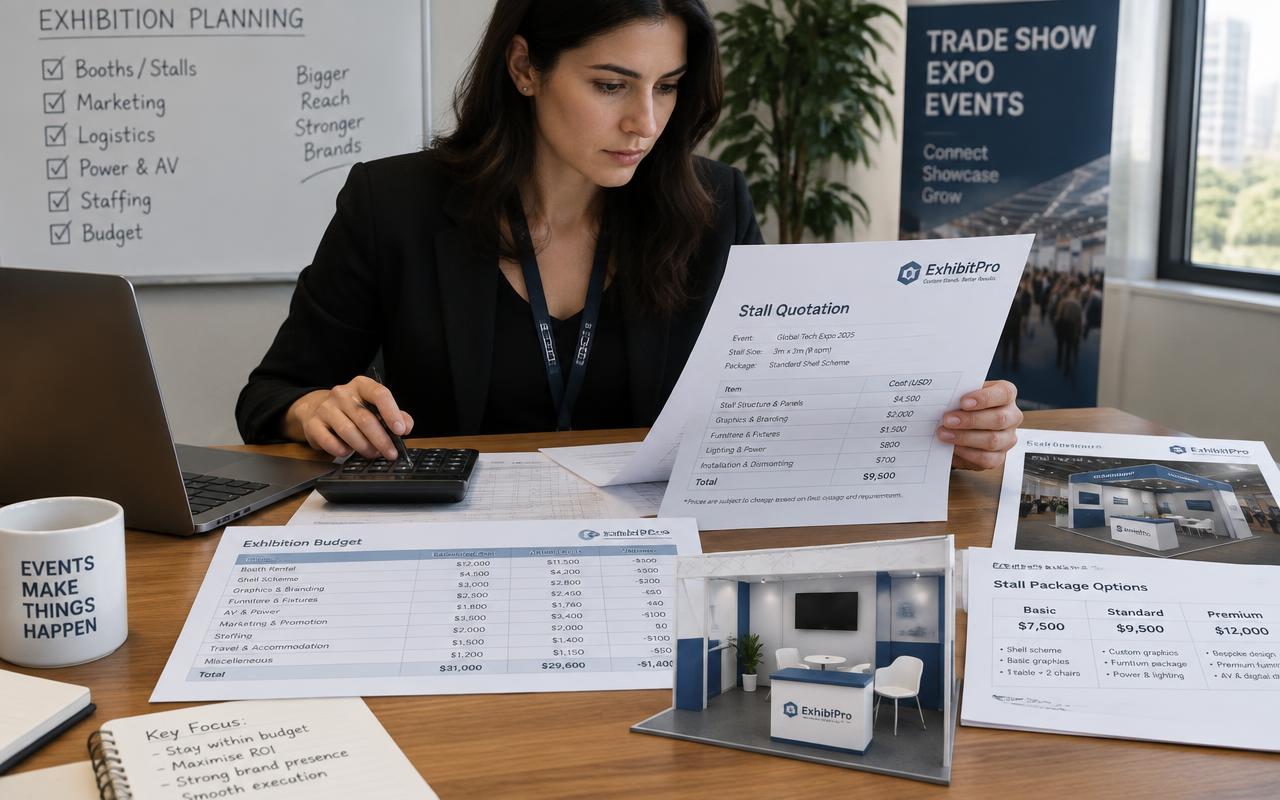
By the Exhibition Stall Design editorial team · Updated 1 October 2026 · 17 min read
Short answer
Quoted per show based on surface size, projector count and content length; small stall or stage mapping starts lower than facade shows. What moves the number for projection mapping is show duration and number of event days, equipment size and specification (screen size, projector brightness or drone count) and content creation and programming time — and what makes two numbers incomparable is scope that nobody wrote down. Send the show, the city, the dates, the area, the open sides and two reference images, and ask for the quote itemised line by line.
Key takeaways
- Every budget overrun has a date on it, and the date is always after design sign-off.
- Quoted per show based on surface size, projector count and content length; small stall or stage mapping starts lower than facade shows.
- Two things dominate the quote: show duration and number of event days and equipment size and specification (screen size, projector brightness or drone count).
- Always compare itemised quotes, not lump sums — the cheapest total is usually the one with the most left out.
- Only 50% of this page's illustrative total is fabrication. The other ₹4,88,000 is everything a lump sum hides.
- The cheapest stand you will ever build is the second outing of one you already own.
Projection mapping: the published ranges
We map video content onto building facades, stage sets, product launches and exhibition stalls so the surface itself moves, transforms and tells your brand story. Content design, high-lumen projectors, media servers and on-site technicians come as one package.
Quoted per show based on surface size, projector count and content length; small stall or stage mapping starts lower than facade shows. Expect a modest premium in Delhi NCR, Mumbai and Bengaluru, driven by venue labour rules and compressed build-up windows rather than by the build itself. A Tier 2 city planned four weeks out is frequently the cheapest version of the same stand.
The published band for custom fabrication is ₹9,000–₹18,000 per sq.m for the build. Modular and octanorm system construction sits below that band because the frame is reused rather than cut fresh, and an upgraded shell scheme — the organiser's own panels wrapped in printed fabric, with a raised floor, spotlights and a branded counter — sits below that again. Those three options are not different qualities of the same thing; they are different trade-offs between cost, reuse and how much the stand can be made to look like only your brand.
One thing worth noticing about that band before we go further: ₹18,000 is exactly twice ₹9,000. A build budget therefore covers twice the area at the bottom of the band as at the top, and the single largest decision in an exhibition budget is which of those two stands you would rather have. There is no general answer. A product that has to be touched wants area; a brand that has to be believed wants finish.
| Construction type | Where it sits on cost | What you still own afterwards | Typical fit |
|---|---|---|---|
| Shell scheme upgrade | Lowest | Graphics only | 9–18 sq.m, first-time or budget exhibitors |
| Octanorm / system build | Low | Frame and graphics | 9–36 sq.m, exhibitors doing several shows a year |
| Modular with custom graphics | Medium | Frame, graphics, furniture | 18–54 sq.m, repeat exhibitors wanting a branded look |
| Custom wooden build | ₹9,000–₹18,000/sq.m | Limited | Any size where the stand must look bespoke |
| Double-decker | Quoted per project | Structure, with engineering | 72 sq.m and above, when meetings would eat display space |
Only the custom band is a published per-sq.m rate. The others are positions relative to it, because what they cost depends on how much of the frame already exists.
The variables doing the work
Price every projection mapping enquiry against the same short list and vendor comparison stops being guesswork. Each line below is something you can change; the total is only what they add up to.
Two numbers set the budget before anyone opens a sketchbook: how many square metres you booked and how many of its sides are open. An island stand is not a more expensive taste, it is four finished faces instead of one.
After area, the two variables with the most money in them are time and finish. Time, because a job booked inside the lead time is a job partly done at overtime rates: our own schedule needs 5 weeks for 54 sq.m, and compressing it does not remove work, it only moves it to a more expensive shift. Finish, because the difference between a good laminate and a veneer is invisible from the aisle and perfectly visible on the invoice.
- Equipment size and specification (screen size, projector brightness or drone count)
- Content creation and programming time
- Rigging, power backup and technician crew size
- Permissions, venue rules and rehearsal time
- Show duration and number of event days
- The number of approval rounds before the drawing is frozen
- The finish on surfaces visitors can touch, as against the ones they cannot
- Whether the build-up window runs in daytime hours or forces a night shift
- How much of the stand has to be new, and how much can come out of storage
You cannot compare two quotes until both describe the same stand.
What a projection mapping quote should itemise
Insist on the itemisation before you discuss the total. Every line is a decision somebody made on your behalf, and some of those decisions are ones you would have made differently if you had been shown them.
The exclusions are more informative than the inclusions. Transport back from the venue, the crew who put it up, the dismantle inside the organiser's window, the electrical fittings and the tax: ask about those five by name, because a quote rarely mentions what it has left out.
There is a third group of lines, small in value and large in consequence: who certifies the materials, who prepares and submits the organiser drawings, and who answers the phone during build-up. Ask for those to be named rather than assumed, because on experience and AV work they are the lines that decide whether the rest of the quote gets delivered.
- Site survey, test-run and show-calling crew
- Organiser drawing submission and approval handling
- Night-shift or overtime labour, if the build-up window forces it
- Pre-build or dry assembly at the workshop before dispatch
- GST, shown as a figure rather than as a footnote
- A named project manager, with a phone number, for the build-up days
- Graphics proofing, and what happens if a panel has to be reprinted
- Facade, stage and object projection mapping
- 3D content design and animation in-house
- High-lumen laser projectors and media servers
A worked example: 54 sq.m custom stand
Here is how a mid-size custom build actually breaks down. The structure line uses the bottom of the published band — ₹9,000 per sq.m across 54 sq.m — and everything below it is a separate scope that a lump-sum quote would bury.
₹9,74,000 across 54 sq.m is about ₹18,037 per sq.m all-in, and that all-in figure is the one to compare, because it is the only one both vendors have to answer for. The split is the interesting part: fabrication is 50% of the total and everything else is the other 50%, or ₹4,88,000.
Two caveats, both of which matter when you use this to plan. The structure line sits at the bottom of the band, so a premium finish moves it upward — at the top of the band the same 54 sq.m of structure is ₹9,72,000 rather than ₹4,86,000. And GST sits on top of the whole thing. Treat the figure as a planning number, not as a quotation.
| Structure and joinery (54 sq.m × ₹9,000) | ₹4,86,000 |
|---|---|
| Graphics — brand wall, tensioned fabric and vinyl | ₹1,34,000 |
| Lighting — track, aimed spots and backlit panels | ₹78,000 |
| Raised flooring and carpet | ₹62,000 |
| Furniture — counters, seating, planters | ₹54,000 |
| Transport, both ways | ₹68,000 |
| Installation, crew and dismantle | ₹92,000 |
| Indicative total, before GST | ₹9,74,000 |
Illustrative only, using the published ₹9,000–₹18,000 per sq.m band at its lower end for the structure line. The remaining lines are planning figures rather than a quotation, and your own will differ with finish level, city, venue rules and how much AV you add. GST is extra. Space rental, power, badges, travel and your own team's time are not in this figure — they are invoiced by the organiser or by nobody at all.
Area against finish: what the band actually means
The band is a range, not a price, and its two ends buy very different stands. At any given size, the lower figure is the plain version and the upper is the premium one — and because the upper is twice the lower, the premium version of a stand costs the same as the plain version of twice the area. Here is that worked out at common sizes.
Notice the symmetry in the middle two columns: the spread at any size is the lower figure again, because ₹18,000 minus ₹9,000 is ₹9,000. So the question "should I take more area or better finish?" is, at the published band, an exactly even trade. That is unusually clean, and it makes the decision a strategic one rather than an arithmetical one.
The honest rule is that area serves activity and finish serves belief. Demonstrations, queues, meetings and products that must be touched all need floor, and no amount of veneer compensates for a stand people cannot get into. A launch, a new category entry, or a brand that has to look established needs finish, and does better with a smaller, denser, well-lit stand than with a larger plain one.
| Stall size | Plain finish, build only | Premium finish, build only | What separates the two |
|---|---|---|---|
| 12 sq.m | ₹1,08,000 | ₹2,16,000 | A laminate that survives handling, a lighting track, and a counter that locks |
| 24 sq.m | ₹2,16,000 | ₹4,32,000 | A branded floor, a demo counter that actually works, and a spare hero panel |
| 54 sq.m | ₹4,86,000 | ₹9,72,000 | Double-height brand elements, integrated AV and a storage wall that hides the cartons |
| 72 sq.m | ₹6,48,000 | ₹12,96,000 | Architectural form — curves, a ceiling element, and a stand that reads as a building |
| 100 sq.m | ₹9,00,000 | ₹18,00,000 | All of the above, plus the engineering a raised or second-storey element needs |
Both columns are build only, at the two ends of the published band. Read them as the first line of a quote rather than as a quote.
Where the difference between two prices lives
When two prices for the same stand are far apart, the instinct is to suspect the higher one. Usually both are honest and the brief was not specific: every unspecified detail is a decision the vendor makes for you, and the cheaper quote is simply the one that made the cheaper decisions.
The arithmetic below is the whole phenomenon in one table. Take the 54 sq.m example and make six substitutions a vendor could defend in a meeting, and ₹9,74,000 becomes ₹7,56,000. The 22% difference — ₹2,18,000 — is entirely scope, and none of it is visible in a lump-sum comparison.
The remedy is unglamorous. Write the specification yourself — board, graphics medium, number of fixtures, flooring type, furniture list, crew and shift — and send the same page to everybody. The prices that come back will be close together, and you will be choosing a vendor rather than guessing at a scope.
| Where quotes diverge | What each vendor has assumed | Ask this and the gap closes |
|---|---|---|
| Graphics | Tensioned fabric on a frame against printed flex taped to a panel | What is it printed on, and how is it fixed to the wall? |
| Furniture | Hired against fabricated, and a four-piece package against an eight-piece one | List the pieces, and say which are hired and which are built |
| Flooring | A raised platform with cable management against carpet on the hall floor | Raised or not, and where do the cables run? |
| Electrical | The organiser's power charge, the stand's own wiring, or neither | Who pays the organiser, and who wires the stand? |
| Installation | A day crew against a night-shift crew, with or without supervision | How many crew, on which shift, and who supervises them? |
| Taxes | One total is before tax and the other after it | Give me both the pre-tax and the post-tax figure |
| Drawings and approvals | One vendor is preparing the organiser submission; the other expects you to | Who prepares the drawings, and who submits them? |
| Structure | Ply and MDF to a finished edge in one quote, a lighter board with an exposed edge in the other | Name the board, the thickness and the edge finish |
None of these rows implies bad faith. They are all consequences of a brief that left a decision open, which is why the brief is the cheapest place to fix them.
| Installation and dismantle left as "to be advised" | ₹45,000 |
|---|---|
| Lighter board in the structure, with an exposed edge instead of a finished one | ₹62,000 |
| Printed flex taped to panels instead of tensioned fabric on a frame | ₹38,000 |
| Six aimed spots instead of fourteen, and no backlit panel | ₹26,000 |
| Carpet laid straight on the hall floor instead of a raised platform with cable management | ₹30,000 |
| A four-piece hired furniture package instead of eight pieces | ₹17,000 |
| Total difference between the two quotes | ₹2,18,000 |
Illustrative, built by making six substitutions to the 54 sq.m example above. The higher quote is ₹9,74,000 and the lower is ₹7,56,000; the difference is ₹2,18,000, 22% of the higher figure. None of these substitutions is dishonest — each is a decision the brief failed to make — and none of them is visible unless both quotes are itemised. Figures are planning numbers, not a quotation, and GST is extra on both.
Where to cut, and where cutting costs more
Not every line in a quote is load-bearing, and not every cheap line is optional. The distinction is worth learning properly, because the expensive mistakes in exhibiting are almost all deletions that came back — on the first morning, in the organiser's window, at somebody else's rates.
One question sorts them. What happens if this is not in the quote? Answers of the form "nobody will notice" are genuine savings. Answers of the form "we will sort it at the venue" are deferrals, and the venue is the worst place to buy anything, because you are buying it in a hurry from whoever is standing there.
Both halves of the distinction follow. First the lines that genuinely are optional — and these are usually the bigger numbers, which is the happy part of this section. Then, in the table, the ones that only look optional, each with its consequence spelled out.
- A ceiling or hanging element, unless the stand has to be found from across the hall
- A printed floor, when plain carpet in the brand colour does the same job
- A second set of graphics for a message you have not tested on anybody yet
- Giveaways in quantity, which measure footfall rather than interest
- Fabricated furniture, where hired furniture would have been collected afterwards anyway
- Working shutters and locks on storage that nobody will see
| Line item | Why it reads as padding | The consequence |
|---|---|---|
| Raised flooring | Carpet on the hall floor costs less | The cables then run under the carpet, and every visitor finds them with their feet |
| Fire-retardant certified material | Nobody asks to see the certificate | The venue safety officer asks, and an uncertified panel is refused at the hall door on the first morning |
| The power load calculation | The organiser supplies power | The organiser supplies the load you declared. A screen added after the declaration is a screen without power |
| Storage between shows | We will decide after this one | "After this one" is a fortnight of the structure stacked in a corner, which is where reusable elements stop being reusable |
| A graphics proofing round | The artwork is final | Large-format print is where a wrong size and a missing bleed turn into a full reprint of the hero wall |
| Supervision during build-up | The crew knows the drawing | When a drawing and a wall disagree, somebody has to have the authority to decide, on the spot, in the organiser's window |
| A single project manager | Each vendor manages themselves | Then every gap between vendors is yours to discover, usually at eight o'clock on the first morning |
If the budget genuinely will not stretch, cut from the list below this table instead. These lines are the ones that cost more when they are missing.
The venue is the most expensive shop in India, and it only opens when you have run out of time.
What changing your mind costs, stage by stage
The single largest controllable item in most stall budgets is not a line on the quote at all. It is the cost of changes, and it rises steeply with the stage at which the change arrives. The same decision — move the entrance, change the logo size, add a screen — costs nothing in week one and a night shift in the last week.
So the cheapest thing you can buy is time at the front. A 54 sq.m build runs to 5 weeks on our schedule — 3 weeks base plus 2 for the area — and a premium finish or a double-decker element adds 2 and 2 weeks respectively. None of that window is spare, which is exactly why a decision taken in week one is free and the same decision in week four is not.
Two habits keep this under control. Name one approver on your side, so that a change is a decision rather than a negotiation. And ask, before the first payment, how variations are priced and approved — in writing, with a figure confirmed before work starts, rather than appearing on a final invoice as a surprise.
| Stage | The price of changing your mind | What has already happened |
|---|---|---|
| While the concept is being designed | Time, and nothing else | Nothing has been drawn to scale, priced, cut or ordered. This is the only stage where changing your mind is free, which is the argument for spending longer in it |
| After design sign-off, before production | A redraw and a requote | Drawings have gone to the organiser and materials have been priced against them. Both have to be done again, and the organiser's queue does not restart for you |
| After materials are ordered | The material, plus its replacement | Board, laminate and print are bought to a cutting list. A changed dimension turns the ordered sheet into offcuts |
| In production | The labour already spent, plus the labour to redo it | A fabricated wall is days of somebody's bench. Changing it means buying those days twice, inside a window that has not moved |
| After dispatch | Freight both ways, and a hole in the build schedule | The panel is on a lorry. The alternative is a modification on site, with the wrong tools and an audience |
| During build-up | Night-shift labour, and whatever can be improvised | There is no workshop at the venue, no spare material, and the clock belongs to the organiser rather than to you |
The pattern is the whole lesson: the cost of a change is set by what has already been bought, drawn or built, not by how large the change is.
Exhibiting soon? Let's build your stall.
Working back from the number you have
In practice the budget usually exists before the brief. That is not a problem; it is a better starting point, provided you do the subtraction first. The step that gets skipped is taking out the exhibiting costs that never appear on a stall quote at all, because those are the ones that arrive late and unbudgeted.
The allocation below is illustrative — a planning habit rather than a rule, and we have no source for a standard split. First, though, the list below: the exhibiting costs that never reach a stall quote at all. The allocation table after it is shown against ₹15,00,000 so the arithmetic is visible. Its important feature is the bottom two rows: ₹1,50,000 of ₹15,00,000 is money a stand builder never sees, and ₹75,000 of it is deliberately not allocated at briefing stage.
The build line comes to ₹6,75,000, which buys 75 sq.m of structure at the bottom of the published band and 37.5 sq.m at the top. Hold that against the stall you have booked. If the booked area is larger than 75 sq.m, the arithmetic is telling you to use a system build rather than a custom one, and it is telling you now rather than in week three.
- Lead-capture devices, the data connection, and somewhere to charge them
- Space rental, invoiced to you by the organiser rather than by your stand builder
- Printed collateral, samples, and anything you intend to hand over
- Storage of reusable elements between this edition and the next
- Insurance on goods in transit and on the stand itself
- The cost of your own team being away from their desks for the build-up and the show
- Hospitality: tea, coffee, water, and whatever the meeting corner is going to serve
- Exhibitor badges, extra passes and vehicle parking
| Where the money goes | Share of the budget | Against ₹15,00,000 |
|---|---|---|
| Stand build — structure, joinery and finish | 45% | ₹6,75,000 |
| Graphics, lighting and AV | 20% | ₹3,00,000 |
| Flooring and furniture | 10% | ₹1,50,000 |
| Transport, installation and dismantle | 15% | ₹2,25,000 |
| Your own show costs — travel, staffing, collateral, hospitality | 5% | ₹75,000 |
| Contingency, held back rather than allocated at briefing | 5% | ₹75,000 |
Illustrative only. There is no published standard split and this is not offered as one — it is a planning habit, shown with the arithmetic visible so you can substitute your own shares. The shares are whole percentages summing to 100, so the amounts total exactly ₹15,00,000. The first four rows, ₹13,50,000, are what a stand builder quotes against. GST sits on top.
Size, space and what fits inside it
Before comparing prices per square metre, look at what a square metre does. Our planner's ratios are simple: storage at 10% up to 18 sq.m and 15% beyond it, a default 5% for a meeting corner, and the balance as display. Apply them and most stall-size arguments resolve themselves.
The visitors column is the one most exhibitors never calculate. Divide display area by 2.5 and you get roughly how many visitors can stand in the stand at once — which tells you whether your staffing plan and your footfall expectation are compatible.
The build-weeks column is a budget column in disguise. Our schedule is 3 weeks base, +1 from 24 sq.m, +2 from 54 sq.m, +2 for a premium finish and +2 for a double-decker. Compressing it does not reduce the work; it relocates the work to night shifts and rush rates.
| Stall size | Usable display | Storage | Staff on the stand | Visitors it holds | Weeks to build |
|---|---|---|---|---|---|
| 9 sq.m | 7.6 sq.m | 0.9 sq.m | 2 | 3 | 3 |
| 18 sq.m | 15.3 sq.m | 1.8 sq.m | 2 | 6 | 3 |
| 24 sq.m | 19.2 sq.m | 3.6 sq.m | 3 | 7 | 4 |
| 36 sq.m | 28.8 sq.m | 5.4 sq.m | 4 | 11 | 4 |
| 54 sq.m | 43.2 sq.m | 8.1 sq.m | 6 | 17 | 5 |
| 72 sq.m | 57.6 sq.m | 10.8 sq.m | 8 | 23 | 5 |
Staff = area ÷ 9, minimum 2. Visitors = display ÷ 2.5, minimum 3. Lead time is 3 weeks base, +1 from 24 sq.m and +2 from 54 sq.m.
Payment, milestones and what each one should mean
Payment terms vary by vendor, by scope and by how long the two of you have worked together, and we are not going to invent a standard split — there is no honest source for one. What can be said without inventing anything is what each stage ought to correspond to, and that is the part worth negotiating.
The principle is that a payment stage should correspond to a deliverable rather than to a date. Approved drawings exist or they do not. Materials are on the shop floor or they are not. A pre-build can be walked around or it cannot. The stand is standing at the venue or it is not. Each of those is checkable; "end of week two" is not.
The item to settle alongside the schedule is how changes get priced. Who approves them on your side, in what format, and is the figure confirmed before work starts? Nearly every uncomfortable conversation about an exhibition invoice began as a change that nobody priced at the moment it was agreed.
01
Ask what happens if the show moves
Editions get postponed and dates shift. Ask what is recoverable and what is not if that happens, and at which stage the answer changes — the honest answer is different before materials are ordered and after a wall has been built.
02
Write the variation process down before there is a variation
Agree who on your side can approve a change, in what format, and whether the price of that change is confirmed before the work starts. Most budget overruns are not one large surprise; they are six small changes that nobody priced at the moment they were agreed.
03
Get the tax position in writing
Ask for the pre-tax total, the post-tax total and the GST treatment stated on the face of the quote. It makes vendor comparison honest, and it stops your own finance team discovering the difference at the point of payment.
04
Confirm what the first payment actually unlocks
Ask the question plainly: what starts when this is paid, and what is the first thing I will be shown? A first payment that buys drawings and a materials order is a different thing from a first payment that buys a place in a queue, and the quote rarely distinguishes them unless you ask.
05
Tie every stage to something you can see
A milestone should correspond to a deliverable you can check with your own eyes: approved drawings, materials on the shop floor, a pre-build you can walk around, the stand standing complete at the venue. A date in a calendar is not a milestone, because a date arrives whether or not the work did.
06
Keep something payable after handover
Snags are negotiated very differently depending on whether a balance is still outstanding. Agree in advance that a portion falls due after the stand is handed over complete at the venue, and agree what "complete" means while everyone is still calm.
The invoice you argue about is almost always the one that followed a verbal agreement.
Reuse arithmetic: the second show is the cheap one
The arithmetic changes completely once you exhibit twice. Costing a stand against one show, when it will stand at three, overstates it by a wide margin; but it only overstates it if the stand was built to be reused, which is a decision made at design stage and cannot be made afterwards.
Costed properly — see the example — the second show has no structure line, a graphics reprint, a refurbishment allowance, storage between editions, and transport and installation as before. The total is ₹2,96,000 — 30% of the ₹9,74,000 first show — because ₹6,78,000 of that first figure was a one-time purchase.
The table follows it across three shows, and the average per show falls from ₹9,74,000 to ₹6,35,000 and then to about ₹5,22,000 — a fall of 46% against the first outing, with nothing negotiated and no corner cut. That is the strongest cost lever in exhibiting, and it is available only to exhibitors who asked for it before the first stand was built.
Three conditions have to hold, and they are all specification rather than luck. The structure has to be modular, dismantled in panels rather than broken down. The graphics have to be a separate layer — fabric on a frame, reprinted rather than rebuilt. And somewhere has to store it, which is a real cost and appears as a line in the example rather than being quietly ignored.
| Outing | This edition | Spent to date | Running average |
|---|---|---|---|
| Show 1 — the first build | ₹9,74,000 | ₹9,74,000 | ₹9,74,000 |
| Show 2 — same structure, new graphics | ₹2,96,000 | ₹12,70,000 | ₹6,35,000 |
| Show 3 — same structure, new graphics | ₹2,96,000 | ₹15,66,000 | ₹5,22,000 |
Illustrative, built from the two worked examples on this page: ₹9,74,000 for the first build and ₹2,96,000 for each subsequent outing with the same structure. The average is the cumulative figure divided by the number of shows, rounded. It assumes the stand is stored and reused rather than rebuilt, and that each show carries its own transport and installation — which it does.
| Graphics reprinted for the new show and the new message | ₹67,000 |
|---|---|
| Refurbishment — replaced panels, touch-up paint, relaminating what is marked | ₹45,000 |
| Storage of the structure between the two shows | ₹24,000 |
| Transport, both ways | ₹68,000 |
| Installation, crew and dismantle | ₹92,000 |
| Indicative second-show total, before GST | ₹2,96,000 |
Illustrative, and dependent on the first stand having been specified as modular. There is no structure line because the structure already exists; the refurbishment line is what a stored stand typically needs rather than a fixed figure. Against the first show's ₹9,74,000, this is 30%, so ₹6,78,000 of the original build is not purchased again. GST is extra. Space rental, power and badges are the organiser's invoices and appear in neither figure.
Spending less without showing it
Put the money where a visitor's eye lands before they decide whether to walk in: the main graphic, the lighting on it, and whatever you most want them to look at. Everything behind that can be built to a budget without anybody noticing.
Three habits cut more than any negotiation does — reuse the frame, hire rather than build the furniture, and keep graphics on fabric so next year's edition costs a reprint instead of a rebuild.
What not to cut is lighting. Hall lighting is designed for circulation, not for your product, so an unlit stand reads as under-funded no matter what the joinery cost. It is the cheapest line with the largest visible effect.
One qualification on the whole list: timing. Each of these is a genuine saving if it is decided before the brief is frozen and an expensive change if it is decided afterwards. Hiring furniture is cheaper than building it; deciding to hire it after it has been built is not.
- Keep the footprint simple — every curve, angle and radius is another line on the cutting list
- One strong message instead of five competing ones, which is cheaper and also works better
- Choose a laminate that reads like veneer from a metre away, and spend the difference on light
- Print one hero graphic properly and keep everything around it plain
- Book early: rush charges and night-shift labour are avoidable rather than inevitable
- Keep graphics on fabric, so the next edition is a reprint instead of a rebuild
- Reuse a modular structure across several shows — the second outing costs a fraction of the first
The three expensive failures
The expensive failures on projection mapping happen at quoting stage, not at the venue, which is why they are worth listing here rather than in a build guide. Start with the commonest: under-specified equipment that looks dull in a bright hall. The question that prevents it is what the quote actually specifies, and who is answerable for delivering it.
The second is scope that was never written down. If the quote does not name the finish, the lighting count and the flooring type, two vendors are not quoting the same stand and the comparison is meaningless.
The third failure is a budget that was correct when it was written. Scope added in ones and twos after sign-off does not announce itself as an overrun until the final invoice, which is exactly why the change procedure matters as much as the price.
- Content not built for the actual screen or surface size
- Under-specified equipment that looks dull in a bright hall
- No rehearsal or technical run before doors open
- Missing backup power or spare units
Getting a projection mapping quote you can rely on
Send the show name, city and dates, the area you have booked, how many sides are open, and a couple of reference images. That is a complete brief for pricing purposes, and it produces a concept and an itemised projection mapping quote within about two days.
We design free with every confirmed fabrication order, fabricate in our own workshops, prepare the organiser drawings and approvals, and put one project manager on the job from brief to dismantle. Quoted per show based on surface size, projector count and content length; small stall or stage mapping starts lower than facade shows.
One closing piece of advice that applies to every vendor including us. Ask for the itemised scope, ask explicitly what is excluded, and ask how variations are priced. A supplier who answers all three without hesitation is telling you something useful about how the build will go.
Frequently asked questions
How much does projection mapping cost in India?+
Quoted per show based on surface size, projector count and content length; small stall or stage mapping starts lower than facade shows. For a custom build, work from ₹9,000–₹18,000 per sq.m for the structure, and treat graphics, lighting, flooring, furniture, AV, transport, installation and taxes as separate lines rather than as details inside that figure.
How far ahead should I book to avoid rush costs?+
Our own lead times are 3 weeks for a small stall, 4 from 24 sq.m and 5 from 54 sq.m, with another 2 for a premium finish and 2 for a double-decker. Work backwards from the build-up date and add your own approval rounds — those, not fabrication, are what usually makes a job late and therefore expensive.
When is payment due?+
Terms are agreed in the quote. Ask for the schedule in writing alongside the itemised scope, and check that each stage corresponds to something you can see — approved drawings, materials on the floor, a pre-build, the finished stand — rather than only to a date.
Does a bigger stand cost proportionally more?+
The build line scales with area at the published band — 75 sq.m of structure at ₹9,000 per sq.m is ₹6,75,000, and the same money buys 37.5 sq.m at ₹18,000. The lines that do not scale in a straight line are transport, crew and supervision, so ask your builder which of your lines move with area and which are closer to fixed.
Does reusing a stand really lower the cost?+
Directly, and more than negotiation does. On this page's illustrative figures a second outing with the same structure carries ₹2,96,000 rather than ₹9,74,000 — 30% of the first show — because ₹6,78,000 of the first build is not bought again. Across three shows the average falls to about ₹5,22,000.
Is GST included in projection mapping quotes?+
A quote should say so on its face. Ask for the pre-tax total and the post-tax total, because two vendors quoting on different bases will look further apart, or closer together, than they actually are.
What does a 54 sq.m stand cost?+
Using the published band, the structure alone is ₹4,86,000–₹9,72,000. Add graphics, lighting, flooring, furniture, transport and installation and the illustrative all-in figure on this page is ₹9,74,000 before GST — about ₹18,037 per sq.m — for a mid-finish custom stand.
What is never included in a stall quote?+
Space rental, your power connection and your exhibitor badges are invoiced by the organiser, not by us. Travel, hotels, your own team's time, product freight, hospitality and giveaways are yours too. On the illustrative split on this page they are ₹1,50,000 of ₹15,00,000 — small enough to forget and large enough to hurt.
Do you charge separately for design?+
3D design is free with every confirmed fabrication order, and revised until you approve it. Design-only projects are quoted per stall.
Projection Mapping near you
Our crews deliver projection mapping in every major Indian city.