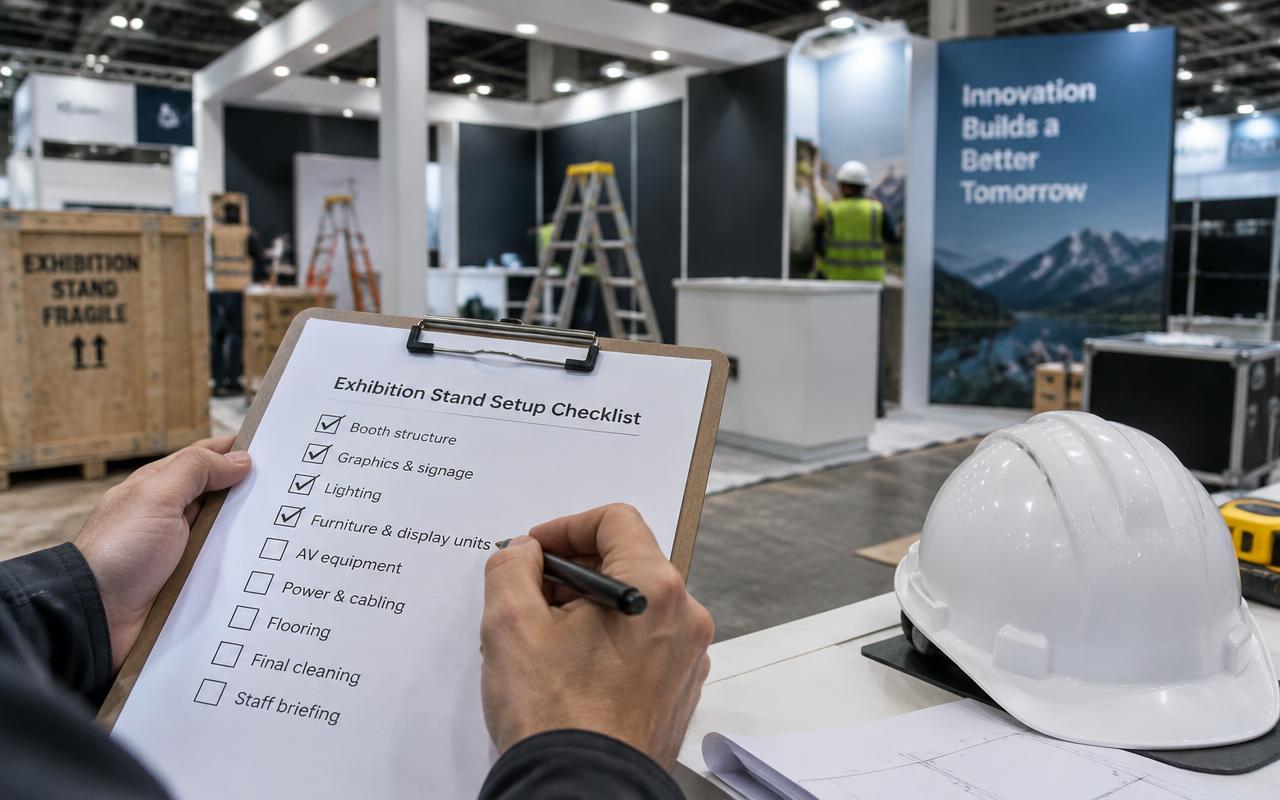
How to use this checklist
Sixty days is the comfortable window for an exhibition, not the minimum one. The fabrication itself needs three weeks from sign-off, four from 24 sq.m and five from 54 sq.m. Everything else on this list — briefing, design approval, organiser submissions, graphics, logistics, staffing — has to fit around that block of build time rather than inside it.
The plan below works backwards from the show's opening day. If you are reading this with less than sixty days left, start at whichever section matches your remaining time and accept that the compressed tasks will cost more. Nothing in the last fortnight can be brought forward, so the time has to come out of the earlier stages.
Treat the organiser's exhibitor manual as the master document. It contains the real deadlines for stand drawings, electrical load, rigging requests, badges and build-up slots, and those deadlines override anything on this page.
60 to 45 days out: decide and brief
This fortnight is about decisions that are expensive to reverse. Stand size and position are already fixed by your booking, so the work here is turning them into a brief: what the stand has to achieve, how many people will staff it, what has to be demonstrated and who you need to meet.
Brief the designer properly and the whole project gets easier. A brief that says only "something eye-catching" produces two weeks of revisions; a brief that names the area, the open sides, the budget band, the hero product and the two visitor actions that matter produces a workable concept first time.
- Download the exhibitor manual and extract every deadline into a calendar
- Confirm your stand area, open sides and position on the hall plan
- Set the budget band, separating build, AV, furniture and logistics
- Write the brief: objectives, hero product, visitor actions, meeting needs
- Collect brand assets — logos, fonts, product photography, colour references
- Decide the staffing number, using roughly one person per 9 sq.m as a base
- Book travel and accommodation while there is still inventory near the venue
- Confirm whether you need hostesses, translators or demonstrators
45 to 30 days out: design and approve
Design approval is the gate the whole project passes through. Until the layout is frozen, nothing can be procured, drawn for the organiser or priced accurately. The single most useful thing an exhibitor can do in this fortnight is give consolidated feedback quickly rather than feedback in instalments.
Review the 3D at eye level from the aisle rather than from a flattering corner angle, because that is what a visitor sees. Check the practical things while you are there: is there storage, is there somewhere to charge a phone, can two staff stand behind the counter without colliding.
- Review the concept and consolidate all internal feedback into one round
- Check the layout against the brief: entry, dwell point, demo, meeting, storage
- Approve the 3D with the real graphics and the real materials shown
- Sign off the dimensioned drawing set and the materials schedule
- Confirm the electrical load and raise the sanction request with the organiser
- Submit stand drawings to the organiser by their published deadline
- Request rigging points or hanging approval if the design needs them
- Lock the AV specification — screen sizes, players, sound, technician
- Place the furniture rental order while the catalogue still has stock
30 to 15 days out: produce and prepare
With drawings approved, fabrication takes over and your attention should shift to graphics, content and people. Artwork is the single most common cause of late-stage delay, usually because final product shots or an approved tagline arrive after the print window has closed.
Supply graphics at the right size and resolution for the panel they are going on, in the format the printer asked for. A logo pulled from a website looks acceptable on a laptop and visibly soft when it is two metres wide and lit from the side.
- Deliver final artwork in print-ready files at the specified sizes
- Approve print proofs, checking colour against your brand reference
- Finalise screen content: short, loop-friendly, legible without sound
- Print literature, business cards and any giveaway material
- Set up lead capture — the form, the scanner or the CRM entry point
- Write the staff briefing: the opening line, the demo script, the qualifying questions
- Confirm the build-up slot, crew pass requirements and vehicle entry permits
- Book transport for the stand, products and any heavy exhibit
- Arrange insurance cover for exhibits in transit and on site
- Order consumables: water, pantry supplies, cleaning material, spare bulbs
Exhibiting soon? Let's build your stall.
15 days to show week: logistics and dry runs
The last fortnight before build-up is for removing surprises. Any product that needs to be craned, driven in or connected to a special supply has to be discussed with the organiser now, because vehicle movement windows in a busy hall are tight and non-negotiable.
Run the demonstration at least once outside the hall, with the actual equipment and the actual script. A demo that has only ever been described in a meeting will fail on day one, usually in a small, avoidable way.
- Confirm the vehicle movement window if any exhibit has to be driven or craned in
- Pre-assemble and quality-check the stand at the workshop before dispatch
- Collect fire-retardant certificates for every material going into the hall
- Rehearse the demonstration end to end with the real equipment
- Brief staff on shifts, breaks, the lead form and who handles what
- Pack a site kit: tools, cable ties, tape, cleaning cloths, spare lamps, a power strip
- Confirm housekeeping and security arrangements for the stand overnight
- Share the on-site contact list — organiser, fabricator, AV, your own team
Build-up and handover
Handover is a formal moment, not a courtesy. Walk the stand with the project manager, switch everything on, open every door and sign only once it works. Problems found at handover get fixed by the crew who are still on site; problems found on the morning of day one get fixed by you.
The checks below take twenty minutes and they catch almost everything that commonly goes wrong on a first morning. Do them with the hall lights on and then again with them off, because a stand that looks fine under full hall lighting can look very different once the general light is reduced.
| Check | What you are looking for | When |
|---|---|---|
| Graphics | Correct version, correct way up, no scuffs or bubbles | At handover |
| Lighting | Every lamp working, aimed at product, no glare into eyes | At handover, lights off |
| Power | Every socket live, load within sanction, no trailing cable | At handover |
| AV | Content plays on loop from cold start, sound at the agreed level | At handover and again on day one |
| Storage | Lockable, with a working light and the key in your hand | At handover |
| Flooring | Flat, no trip edge, clean, carpet joins tight | At handover |
| Furniture | Right quantity, right items, undamaged | At handover |
| Cleanliness | Fingerprints, dust and packing material removed | Night before opening |
| Fire compliance | Extinguisher accessible, certificates available on the stand | Before the organiser's inspection |
Show days
Running a stand well is mostly discipline. Staff standing in a line behind the counter looking at phones undoes an expensive stand within an hour, and no amount of design compensates for it. Keep people forward, keep the counter clear and keep the lead capture flowing.
Build in a short reset before doors open each morning and a short debrief after they close. Both take ten minutes and both pay for themselves — the reset keeps the stand looking like day one, and the debrief catches what visitors are actually asking about so you can adjust the pitch for day two.
- Reset the stand before doors open: tidy, restock, wipe down, lamps on
- Keep at least one person forward of the counter at all times
- Run the demonstration on the published schedule, not on request
- Capture every lead at the point of conversation, not from memory later
- Rotate staff through breaks so nobody is on the floor for a full day
- Photograph the stand early on day one, before it gets busy
- Debrief for ten minutes at close: what did people ask, what is missing
- Keep the storage locked and your valuables out of the stand overnight
After the show
The follow-up window is short and the return on the whole exercise is decided inside it. Leads that sit untouched for a fortnight are cold, and the person who collected the lead is the one who remembers the conversation, so get the notes out of their head and into the system before they travel home.
Dismantling matters more than it seems, because it determines what you still own for the next show. A stand designed in modules, dismantled carefully and stored labelled is a reusable asset. The same stand ripped out at midnight is waste.
- Export and clean the lead list within twenty-four hours
- Send the agreed follow-up to every lead inside the first week
- Record what each visitor actually asked for, not just their contact details
- Supervise the dismantle so reusable elements come out intact
- Confirm what goes into storage, labelled, and what is being discarded
- Reconcile the final invoices against the original quote, line by line
- Hold a debrief: footfall quality, layout problems, what to change
- Write the brief for the next show while the detail is still fresh
Exhibiting soon? Let's build your stall.