The one question that sorts the market
Ask where the stand will actually be built, and by whom. A fabricator with its own workshop controls the carpentry, the finishing, the printing and the schedule. A broker takes your order, sub-contracts the build to whoever is available in that city and manages the relationship by telephone.
Both can deliver a good stand. Only one of them can tell you, on a Tuesday afternoon three weeks out, exactly what state your walls are in. When a project slips — and under a compressed show calendar some do — the difference between those two positions is the difference between a problem being fixed and a problem being reported.
This is not an argument against local partners. Working with a crew who know a specific hall is often essential. It is an argument for knowing which arrangement you are buying, so you can judge the quote and the promises against it.
Ask who will be holding the drill. If nobody in the room can answer that, you are buying a phone call, not a stand.
What to look for in a portfolio
Portfolios are curated, so read them for evidence rather than for impression. The useful question is not whether the work looks good but whether it looks like your project: your size band, your industry, and ideally your venue.
Ask for photographs taken at the show rather than renders. A render shows what was designed; a photograph shows what was built, how the lighting actually behaved and whether the cable management survived contact with a real hall. The gap between the two is the most informative thing in any portfolio.
- Work at a similar stall size, not just the largest project they have done
- Work in your industry, where the display requirements are comparable
- Work at the venue you are exhibiting in, or at a similar type of venue
- Photographs from the show floor alongside the renders
- Evidence of the finish level you are paying for, in close-up
- A double-decker or structural project, if that is what you need
- Modular work, if reuse across shows is part of your plan
Making quotes comparable
Two quotes for the same stand will almost always differ on scope rather than on price, and the only way to see that is to insist on quantities. Square metres of wall, running metres of counter, number of lamps, number of printed panels, number of crew on site for how many hours.
Custom design and fabrication runs between ₹9,000 and ₹18,000 per sq.m. A quote well below that band is not a bargain; it is a different scope, a thinner finish or a line that has been left out and will reappear later. A quote above it should be explained by something visible — a structural element, a backlit wall, a premium finish.
| Line | What to insist on seeing | Why it matters |
|---|---|---|
| Design | Included, or separately priced if you do not proceed | Avoids a surprise bill for a concept you declined |
| Fabrication | Area, finish specification and a per sq.m rate | Makes the quote comparable with the published band |
| Graphics | Number of panels, area and print method | Print area is a common hidden difference between quotes |
| Lighting | Fixture count by type | Under-lighting is the most common silent economy |
| Flooring | Raised or direct-lay, and the finish | A platform is a substantial cost, not a detail |
| Transport | To the venue and back, both ways | The return leg is the one usually omitted |
| Installation | Crew size and build-up hours covered | Overtime on site is expensive and avoidable |
| Dismantling | Included, with waste removal | Venues charge for material left behind |
| AV and furniture | Itemised, or clearly excluded | "As required" is not a price |
| Taxes | GST shown separately | Keeps the comparison on like-for-like terms |
Capability checks that are worth making
Some claims can be verified in a few minutes and are worth verifying, because they predict how the project will run. Fire-retardant certification is the clearest example: it is either producible on request or it is not, and a venue inspection is a bad time to find out.
Ask about pre-assembly specifically. A stand assembled and checked in the workshop before dispatch arrives as a kit of parts that are known to fit. A stand that has never been assembled arrives as an experiment conducted in your build-up window.
- An in-house workshop, with carpentry, finishing and printing on site
- Fire-retardant certificates produced on request, not promised later
- Pre-assembly and a quality check before anything is dispatched
- Experience with the organiser's drawing submission process
- A structural engineer available if the design needs certification
- A named project manager, reachable during build-up
- Their own site crew rather than labour hired on the day
- Storage facilities, if you intend to reuse the stand
- Capacity during your show window, honestly stated
Exhibiting soon? Let's build your stall.
Reading the schedule they give you
A credible fabricator will give you dates, not reassurance. Our published lead times are three weeks from sign-off up to 18 sq.m, four weeks from 24 sq.m and five weeks from 54 sq.m, and any schedule that promises materially less than that for a custom build deserves a direct question about how.
The answer is usually overtime, express freight and material bought at short notice. That is sometimes a legitimate choice, but it should be a choice you made knowingly, with the cost visible, rather than a promise that quietly becomes your problem in build-up week.
| Stall size | Build weeks from sign-off | What has to be finished before the clock starts |
|---|---|---|
| Up to 18 sq.m | 3 | Layout frozen, finishes chosen, artwork supplied |
| 24 to 36 sq.m | 4 | As above, plus organiser drawing submission in progress |
| 54 sq.m and above | 5 | As above, plus any structural or rigging approvals |
These weeks cover drawing production, procurement, carpentry, finishing, printing, pre-assembly and the quality check. The organiser's own approval cycle sits in front of them, not inside them.
Warning signs
Most projects that go badly showed signs early. None of the items below is proof of anything on its own, but two or three together are a reason to keep looking.
The most reliable signal is vagueness about quantities. A fabricator who will not put a lamp count or a crew number on paper is either not planning the project in that detail or is leaving room to reduce it later.
- A single lump-sum price with no quantities behind it
- A rate well below the published band with no explanation of the scope
- Renders that cannot be matched to a dimensioned drawing
- No named project manager, or a different contact each time you call
- Reluctance to discuss where the stand will physically be built
- No mention of fire certificates until you raise it
- Dismantling and transport missing from the quote
- A promised lead time materially shorter than the size warrants
- Pressure to sign before the layout has been agreed
The contract and the handover
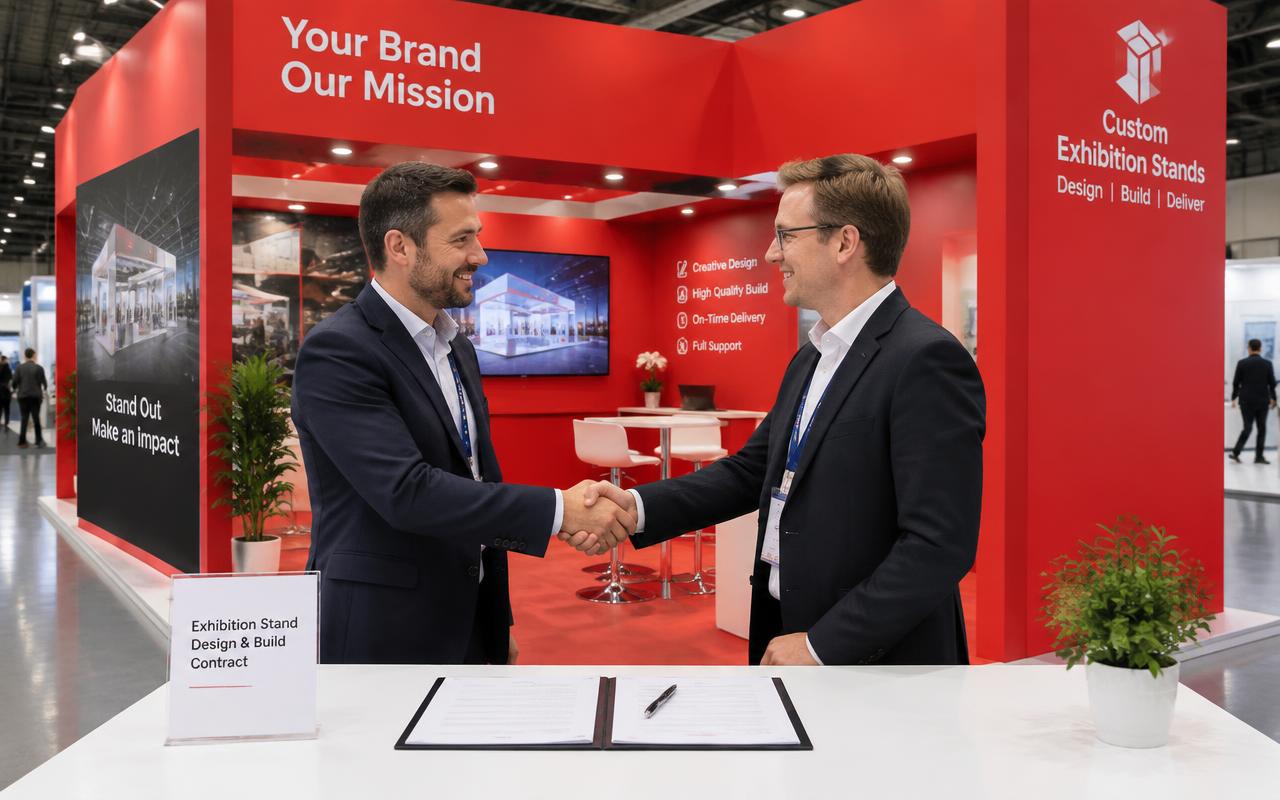
Put the scope in writing with the quantities attached, and make handover a defined moment rather than an assumption. A handover walk-through with the project manager, everything switched on, every door opened and a signature at the end is the mechanism that gets small problems fixed by the crew who are still on site.
Agree the change process too. Layouts do change, and that is normal; what causes disputes is an undocumented change discussed verbally during build-up. A one-line written confirmation of what changed and what it costs protects both sides.
Finally, agree what happens to the stand afterwards. If reuse is part of the plan, the contract should say what is being stored, who stores it, how it is crated and what the inventory is. Without that, a reusable stand quietly becomes waste on the last night of the show.
- Scope with quantities, attached to the contract
- Payment schedule tied to stages, not to dates alone
- A named project manager and an on-site contact number
- The handover process, and what counts as acceptance
- A written change process with cost implications stated
- Who carries the risk for transit damage
- What is stored after the show, by whom, and the inventory
- GST and invoicing details agreed before fabrication starts
Exhibiting soon? Let's build your stall.