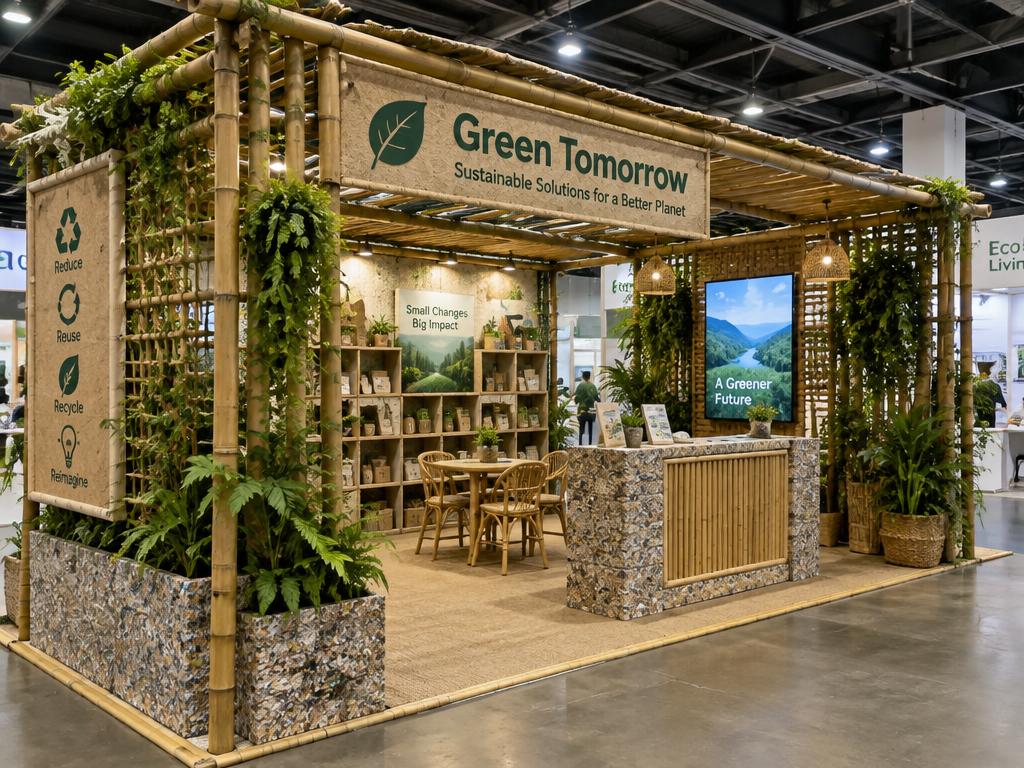
Where exhibition waste actually comes from
Exhibition waste is a design problem long before it is a materials problem. The large majority of what goes into a skip on the last night of a show is structure that was glued, screwed and painted into a shape that can only be taken apart by breaking it. The material was never the issue; the joint was.
That is the uncomfortable truth about sustainable stand building. A bamboo stand assembled with adhesive and discarded after three days is worse than a laminated board stand built in panels that go back into storage and come out again at the next show. Reuse beats material choice, consistently and by a wide margin.
So the useful question is not "what is this made of" but "what happens to it on the last night". A stand designed around that question ends up cheaper over a show calendar as well as less wasteful, which is the rare case where the environmental argument and the budget argument point the same way.
The greenest stall is the one you build twice. Material choice is the second decision, not the first.
Design for disassembly first
Designing for disassembly means deciding, at the sketch stage, how every element comes apart. Panels sized to a standard sheet and a standard crate. Bolted and clamped connections instead of glue. Graphics that peel or unzip rather than graphics bonded permanently to the surface they are printed on.
It also means designing in modules that have a life beyond this layout. A wall built as four identical panels can become a different wall at the next show. A wall built as one bespoke curved assembly can only ever be that wall, in that position, at that show.
- Size panels to standard sheet dimensions so offcuts are minimal
- Use bolted, clamped or slotted connections in place of adhesive
- Keep graphics separable from structure — tensioned fabric, not bonded print
- Design storage, counters and plinths as repeatable modules
- Number and label every component so it can be reassembled by a different crew
- Specify finishes that survive dismantling, transport and a second install
- Build crates and covers as part of the project, not as an afterthought
- Keep the heaviest elements small enough for two people to handle
Materials that genuinely help
With the joints sorted out, material choice starts to matter. The list below is the set we actually work in, with a plain statement of what each one is good for. None of these is a green badge on its own; each one is a sensible choice in the right place.
Treat fire performance as non-negotiable while you are choosing. Every material going into a hall needs a fire-retardant certificate, and a sustainable material without that certificate will be refused at the venue — which produces the worst outcome of all, a stand rebuilt in a hurry out of whatever is available.
| Material | Good for | Worth knowing |
|---|---|---|
| Aluminium system frames | Reusable structure across many shows | High initial cost, very long life, fully recyclable at end of life |
| Tensioned fabric graphics | Large graphic areas, backlit panels | Light to transport, washable, reprintable without replacing the frame |
| Bamboo and engineered bamboo | Visible structure, screens, slatted walls | Needs a treated, certified supply; detailing has to suit the material |
| Recycled and composite boards | Infill panels and plinths | Verify the fire certificate; finish quality varies between suppliers |
| Plywood with a clear finish | Counters, plinths, exposed joinery | Reusable if not painted over; keep the finish repairable |
| Modular raised flooring | Level platforms over uneven floors | Panels and legs both reuse; carpet is the consumable |
| LED fixtures | All stand lighting | Lower load than older fittings, so a smaller power sanction |
| Rented furniture | Seating, tables, planting | Already in a reuse cycle; nothing is fabricated for three days |
What to stop doing
Some habits create waste for no design benefit at all, and they are easy to drop. Printed panels with the show name on them cannot be reused. Vinyl bonded directly to board means the board goes in the skip with it. Carpet laid loose over an entire floor and walked on for three days is a consumable nobody needs.
Giveaways deserve a mention. A stand can be built impeccably and still send a few hundred unwanted plastic items home with visitors who throw them away at the station. If the giveaway is not genuinely useful or genuinely wanted, the most sustainable version of it is not having one.
- Printing the show name and dates onto structural panels
- Bonding vinyl directly to boards you intend to keep
- Full-floor carpet where a defined walkway would do
- Single-use foam, thermocol and crates built only for one journey
- Spray-painting surfaces that could have been laminated and wiped clean
- Over-ordering literature that will be recycled unread
- Branded giveaways nobody asked for
- Building seating into the structure instead of renting it
Exhibiting soon? Let's build your stall.
Reuse maths over a show calendar
The case for reuse is easiest to see across a calendar rather than a single show. A custom stand costs between ₹9,000 and ₹18,000 per sq.m to design and fabricate. A stand designed in modules costs the same the first time, and at each subsequent show the fresh spending is graphics, labour, transport and storage rather than fabrication.
Storage is the line exhibitors forget and the reason reuse plans fail. A kit stacked in a corner of a factory gets damaged, loses components and arrives at the next show incomplete. Proper crated storage with an inventory is a real cost and it is what makes the whole approach work.
| Appearance | Build once and discard | Design for reuse |
|---|---|---|
| First show | Full design and fabrication | Full design and fabrication, plus crates |
| Second show | Full design and fabrication again | Graphics, labour, transport, storage |
| Third show | Full design and fabrication again | Graphics, labour, transport, storage |
| Layout change | Redesign from scratch | Reconfigure the same modules |
| Waste at each dismantle | Most of the structure | Consumables and old graphics only |
| What you own afterwards | Nothing | A kit, crated and inventoried |
Reuse only pays if the kit is stored properly and inventoried. Budget for crating and storage from the first show; a damaged, incomplete kit costs more than a fresh build.
Working within venue rules
Venues and organisers have their own environmental rules now, and they vary. Some halls restrict on-site painting and cutting. Some require waste segregation at dismantle. Some ban certain adhesives or require all materials to be removed rather than left for the venue to dispose of.
None of that is onerous if it is known in advance, and all of it is difficult if it is discovered during build-up. Read the exhibitor manual for the environmental and waste clauses specifically, and design to them.
- Check whether on-site cutting, painting or welding is permitted at all
- Confirm the waste segregation and removal obligations at dismantle
- Carry fire-retardant certificates for every material on the stand
- Confirm the sanctioned electrical load, which LED lighting makes easier to meet
- Ask whether the venue carpet must be protected rather than covered
- Check vehicle access timings so transport is not run twice
- Agree who removes packing material from the hall, and when
Making the claim honestly
If sustainability is part of your brand story, say only what is true about the stand in front of the visitor. "This stand is built from a reusable aluminium frame with tensioned fabric graphics, and it will be reconfigured for our next three shows" is specific, verifiable and more persuasive than any badge.
Avoid implied numbers you cannot stand behind. Percentage waste reductions, carbon figures and recycled-content claims need a basis, and a visitor from a technical background will ask for it. A plain description of the construction is both safer and more credible.
The strongest version of the story is usually the least dramatic one: the stand comes apart, it goes into crates, it comes back out at the next show, and the only things replaced are the graphics and the carpet. That is a real practice rather than a claim, and it is visible in the stand itself.
Exhibiting soon? Let's build your stall.